Sunday, November 05, 2006

Vineyards as a Motif in the Bible

There are many laws in the Torah concerning vineyards- the Nazirite laws, first fruits, vineyards as a gift to the people, the Jews compared to the vineyard of God.

Aside from these general laws concerning vineyards, however, vineyards crop up in stories. And as a motif, they symbolize, foreshadow or are connected to unhappiness.

There are three incidents (two more clear, one tangential) in Tanakh where vineyards are connected to unhappiness.

1. Noah's planting of a vineyard, his subsequent drunkenness and the episode with his sons

2. Navos and Achav (Achav desires Navos' vineyard, Jezebel acquires it for him through bringing false witnesses against Navos and having him killed)

3. Samson's walking through the vineyards of Timnah, meeting the lion, and on his return journey eating the honey from the lion's carcass

I personally find the vineyard-motif interesting. In fact, there's almost a progression in the way the vineyard affects people. Noah is guilty of actually drinking the wine made from the fruit of the vineyard (and becoming drunk) while Navos comes to grief simply because he owns the vineyard, and Samson sins simply because he walks through the vineyard (exposing himself to temptation, the Midrash adds, that he should not have, being that he was a Nazir) and happens to come across the lion, later eating honey from its carcass (incorrect on his part.) From drinking the wine to owning to walking through, the vineyard's effect on people (whenever it comes up in story-form) is that of foreshadowing, of an association with unhappiness and sadness.

Slightly off-topic now- have you ever noticed the similarity between the wording of Samson's sin by the lion and the first sin, that of Adam and Eve?

Compare, by Samson-


    ט וַיִּרְדֵּהוּ אֶל-כַּפָּיו, וַיֵּלֶךְ הָלוֹךְ וְאָכֹל, וַיֵּלֶךְ אֶל-אָבִיו וְאֶל-אִמּוֹ, וַיִּתֵּן לָהֶם וַיֹּאכֵלוּ; וְלֹא-הִגִּיד לָהֶם, כִּי מִגְּוִיַּת הָאַרְיֵה רָדָה הַדְּבָשׁ.

    9 And he scraped it out into his hands, and went on, eating as he went, and he came to his father and mother, and gave unto them, and they did eat; but he told them not that he had scraped the honey out of the body of the lion.


to the verses by Adam and Eve:


    ו וַתֵּרֶא הָאִשָּׁה כִּי טוֹב הָעֵץ לְמַאֲכָל וְכִי תַאֲוָה-הוּא לָעֵינַיִם, וְנֶחְמָד הָעֵץ לְהַשְׂכִּיל, וַתִּקַּח מִפִּרְיוֹ, וַתֹּאכַל; וַתִּתֵּן גַּם-לְאִישָׁהּ עִמָּהּ, וַיֹּאכַל.

    6 And when the woman saw that the tree was good for food, and that it was a delight to the eyes, and that the tree was to be desired to make one wise, she took of the fruit thereof, and did eat; and she gave also unto her husband with her, and he did eat.


Interesting, isn't it? Samson eats the honey, then gives it to his mother and father (not telling them of its forbidden origin.) Eve eats the honey, then gives it to Adam and all the beasts (according to the Midrash) and, according to some interpretations, not telling Adam of its forbidden origin either.

Although, of course, if I'm engaged in comparisons, I have to compare Samson to David as well:

By David-


    לד וַיֹּאמֶר דָּוִד אֶל-שָׁאוּל, רֹעֶה הָיָה עַבְדְּךָ לְאָבִיו בַּצֹּאן; וּבָא הָאֲרִי וְאֶת-הַדּוֹב, וְנָשָׂא שֶׂה מֵהָעֵדֶר.
    34 And David said unto Saul: 'Thy servant kept his father's sheep; and when there came a lion, or a bear, and took a lamb out of the flock,

    לה וְיָצָאתִי אַחֲרָיו וְהִכִּתִיו, וְהִצַּלְתִּי מִפִּיו; וַיָּקָם עָלַי--וְהֶחֱזַקְתִּי בִּזְקָנוֹ, וְהִכִּתִיו וַהֲמִיתִּיו.
    35 I went out after him, and smote him, and delivered it out of his mouth; and when he arose against me, I caught him by his beard, and smote him, and slew him.


and by Samson-


    ה וַיֵּרֶד שִׁמְשׁוֹן וְאָבִיו וְאִמּוֹ, תִּמְנָתָה; וַיָּבֹאוּ, עַד-כַּרְמֵי תִמְנָתָה, וְהִנֵּה כְּפִיר אֲרָיוֹת, שֹׁאֵג לִקְרָאתוֹ.
    5 Then went Samson down, and his father and his mother, to Timnah, and came to the vineyards of Timnah; and, behold, a young lion roared against him.

    ו וַתִּצְלַח עָלָיו רוּחַ יְהוָה, וַיְשַׁסְּעֵהוּ כְּשַׁסַּע הַגְּדִי, וּמְאוּמָה, אֵין בְּיָדוֹ; וְלֹא הִגִּיד לְאָבִיו וּלְאִמּוֹ, אֵת אֲשֶׁר עָשָׂה.
    6 And the spirit of the LORD came mightily upon him, and he rent him as one would have rent a kid, and he had nothing in his hand; but he told not his father or his mother what he had done.


To compare Samson and David is easier than comparing Samson and Eve- Samson and David were both men of great strength, leaders of the people, began their respective careers with the slaying of a lion barehanded, fought multitudes through skill, strength and cunning (compare Samson's riddles to David's message about Uriah), and both were betrayed by people very close to them- Samson by his wives- both Timnah, in her being given to another man, and Delilah, in her capturing him- and David by his sons, both Avshalom and Adoniyahu, who rebelled against him and tried to usurp the throne. (David also had his wife- Michal, daughter of Saul- taken from him and given to another man, but he reclaimed her and the man she had been given to had not touched her/ cohabited with her, so it ends a bit differently.) Samson and David are actually very, very much alike.

Perhaps David represents the completion of Samson...after all, he does have at least one son who doesn't betray him, Solomon. That's a sad reading of David's story, but an interesting one.

Friday, November 03, 2006

Egyptian Women in the Torah

It is intriguing, and perhaps telling, that various episodes in the Torah, all of which involve an important change or direction in terms of future Judaism and Jewish life, are acted out by Egyptian women. There are three Egyptian women of prominence, all of whom are royal, all of whom interact with members of the chosen people, and all of whom effect changes that play with the very fabric of our destiny.

These three women are Hagar, Zelicha (Potiphar’s wife) and Bithia (Pharoah’s daughter.)

These women are fascinating in their roles in the Torah, their similarities and their differences. Hagar is the Rival, set up as Sarah the Matriarch’s rival and nemesis. Zelicha is the Temptress, the Seductress, the woman who uses charm and beauty to attain her ends, or if she fails, to have her revenge. And Bithia is the Savior, the one who saves Moses from the Nile, taking him (after the first two years) to adopt and rear as her own son.

From the text, these women appear to have very great differences in their personalities. Hagar is proud, and cannot bear harsh treatment. However, instead of acting in a manipulative fashion, she removes herself from the source of this treatment, Sarah, and flees the house. Of course, she also has the status of a handmaiden, a servant, and hence such manipulations may not have been available to her. Zelicha, on the other hand, makes fantastic use of her royal position to slander Joseph, and place her husband in a situation where, even though he may realize Joseph is falsely accused, he must still punish him. Bithia is interesting in that her role has nothing to do with sexual wiles or coupling (neither in an approved fashion, such as Hagar with Abraham, or in a wild, desirous fashion, such as Zelicha’s attempted seduction of Joseph) but rather with a virtuous act- the saving of an infant, and her immediate love and tender feelings toward that infant. Bithia is presented as someone more refined, someone in whom the passions do not reign, someone less dynamic and more static, the good character, the kind one. However, we notice a streak in her that does not suit this sweet personality- that of her rebellion against her father, the incredible irony that is apparent in her raising his future deposer as her son.

I believe the very introductions in the Torah serve to acquaint us with these womens’ personalities as Rival, Temptress and Savior.

From Genesis 16: 1

Now Sarai, Abram’s wife, had borne him no children. She had an Egyptian maidservant whose name was Hagar.

The immediate effect of this information is to inform us of Hagar’s status and place- she is Egyptian and a maidservant to Sarai. We can even infer what is to follow due to the fact that the first verse clarifies that Sarai has no children.

From Genesis 39: 7
After these things, his master’s wife cast her eyes upon Joseph and she said, “Lie with me.”

Our first actual introduction (as opposed to the oblique reference to her as “bread” in the previous verses) to Potiphar’s wife exhibits her sexual nature and her role as Temptress. She is extremely frank and direct, stating, “Lie with me,” as opposed to using any euphemism or shading her words.

Bithia, in Exodus 2: 5, is introduced with the words, “Pharoah’s daughter went down to bathe by the River and her maidens walked along the river.”

The very action Bithia is caught in, bathing, connotes purity and cleanliness. As many commentaries suggest, Bithia is actually in the act of becoming a convert and is therefore immersing herself in the Nile. Others state that she was washing off her father’s regime and his laws by this symbolic dip in the Nile. If that is the case, the verse is read with the words “lirchotz al ha’yor” or “to bathe on the Nile” meaning that “al hayor” or “on the Nile” refers to Pharoah, who proclaimed himself as god over (or on, as it were) the Nile. Hence Bitiah descended to wash herself off from the vestiges of Al-Hayor (the title), referring to her father. (Consider, by the way, the other woman we see with regard to bathing- Bath-Sheba, by David. She, too, is a pure and righteous woman, although David's methods of acquiring her are seen as questionable.)

Let us go back to Hagar. Who was Hagar? Where did she come from?

According to Midrash Rabbah, we learn that Hagar was actually Phaorah’s daughter. R. Simeon b. Yochai explains that, “when Pharoah saw what was done on Sarah’s behalf in his own house, he took his daughter and gave her to Sarah, saying, Better let my daughter be a handmaid in this house than a mistress in another house.” Her very name, Hagar, is associated with this idea, for Pharoah meant to suggest “Here is thy reward (agar).” (All quotes are from the Soncino Midrash Rabbah by Rabbi Freedman)

Hagar’s being a princess places her and Sarai on equal footing. As we often learn, the literal translation of “Sarai” is princess whereas Sarah means “mother of nations.” At the beginning, however, both Hagar and Sarai were royalty.

Hagar being Sarai’s handmaiden, it appears that Sarai could do what she would with her. Sarai desired to give Abraham children, and hence famously offers Hagar to him, claming that Hagar will “bear upon my knees so that I too may be built up [through her, i.e. in having a son.]” Hagar’s child is to be Sarai’s child. Why would Hagar agree to this? Here we are given the answer- Sarai persuades her, claiming that it is an honor for Hagar to be married to such a man.

Hagar becomes pregnant and speaks proudly and thoughtlessly, claiming that Sarai cannot possibly be righteous- if she were, would she not have conceived? Sarai, upset, begins to regret her magnanimous gesture and implies that Abram should administer punishment. Abram refuses, explaining that he cannot do so, but the maid is in thy hand…Sarai can administer punishment. And she does. According to Midrash Rabbah, Sarai-

1. Restrained Hagar from cohabiting with Abram
2. Slapped Hagar’s face with a slipper
3. Forced her to carry water buckets and bath towels to the baths

Hagar, unhappy, ran away (some suggest that she was trying to return to her royal family.) However, either four or five angels came to meet her and stopped her flight.

Stop a moment. FOUR OR FIVE angels came to meet Hagar. Many cite this as proof of the grandeur of Abram’s household- that Hagar saw five angels and did not bat an eyelash (while in later times Manoach, upon seeing an angel, believed he would die, as did Gideon the Judge.) However, I think it is worth mentioning that I do not believe any other woman in all Tanakh is gifted with the sight of four or five angels at once. Hagar, an Egyptian woman, is the only one given that honor. I would like to suggest that perhaps Hagar merited this reward in her own honor (as opposed to that of Abram’s household.) If you consider the trials and tribulations heaped upon her when all she had done was simply follow Sarai’s initial command and wish- to cohabit with Abram- you may see that her lot seems truly unfair. Worse yet that the royal princess is the one forced into this position.

Notice also Hagar’s astounding statement- she acknowledges Sarai as her mistress when asked why she has run away. She does not lie. She does not give a long list of complaints. She tells the truth in an absolute fashion.

Now the introduction of Ishmael. One of the fascinating things about Ishmael is how different his personality appears from his mother’s. Ishmael is going to be strong. He is the type of man who can protect his mother- a man who will be reared in the wilderness, a “wild ass of a man.” This is not the man who will bow subserviently to Sarai or to anyone; this is the man who has the capability and capacity to fend for himself.

Hagar’s statement that God is a God of Seeing, refers to the fact that God is able to See her suffering and pain.

Notice that our next mention of Hagar and Ishmael is with Hagar cast as the role of mother, Ishmael being her son. Notice also that Ishmael does not flee from Sarai, even though one could suggest he was aware of her lack of love for him. Rather, he and his mother are “cast out” of Abraham’s house with a pitcher of water and some bread. Sarai gives Ishmael the evil eye, which cause him great pain and fever.

Hagar lay Ishmael down and removed herself so that she would not see him die. Many commentaries chastise her for this, stating, “What kind of mother abandons her son so as not to see him die?” To counter this rather uncharitable approach, I want to draw a comparison to Jochebed and Moses. Jochebed does not know what will happen to her son; it may be that he will die. She hides him as best she can in a little ark, sets him amidst the bulrushes, and leaves. Jochebed is not even the one who commands Miriam to stand guard and observe her brother- indeed, this seems to be Miriam’s own initiative, the Torah states that “his sister stood far off- to know what would be done from him.” From the portrayal in the Midrash Rabbah, which states that Jochebed struck Miriam on the head and said, “My daughter, what of your prophecy?” we see that Jochebed was not entirely assured that the outcome would be all right. One commentary even states that Jochebed made a little bridal canopy and adorned the little ark with it, saying, “Perhaps I shall not see him wed (because he will die.)” And yet nobody appears to find fault with Jochebed. I find that rather odd. She, too, abandons her son- one might suggest, because she does not want to see her die. We know that she is not there because Miriam has to run and fetch her for the daughter of Pharoah. Especially considering the approaches that suggest that many people were bathing at the Nile (and they all left when the princess came down), why couldn’t Jochebed at least have stayed and pretended to be one of those bathers? It therefore appears to me unjust to state that Hagar ought to have done something differently as opposed to Jochebed.

Another common misconception has to do with Ishmael’s age. Many picture him as a little boy, abandoned by his awful mother who didn’t want to watch him die. In truth, he was twenty-seven at the time, a grown man.

In point of fact, all works out well and Ishmael grows up…but not in his father’s household. Possibly his hate festers ( I would think against Sarah, being that it was her idea to remove him.) He grows up to be a fantastic archer (I think the mention of his weapon in the Torah is significant. It’s always interesting to associate personalities and weapons. For example, David is associated with the slingshot.) An archer cannot be a brute, who wins battles through force and sheer strength. He must be quick, agile, keen. These qualities, I would then suggest, also portray Ishmael.

Hagar choose an Egyptian wife for Ishmael (Egypt was her country, and hence it is fitting that his wife originates from there.)

Hagar’s story, when read, then, appears sad. A princess who is sent away by her father in the keeping of a woman who at first persuades Hagar to cohabit with her husband on her behalf, then becomes angry with her and turns the evil eye upon her (even causing her to lose her first child), is unhappy with her son- the son Sarah originally stated would be counted as hers- and eventually succeeds in removing both Hagar and her child from the house. From this reading, it would appear that Hagar ought to have been a bitter and angry woman. I find it to be a definite mark in Hagar’s favor that these ideas are not expressed on her part. We do not see definitive complaints. We do not see her fostering hatred in Ishmael. All we see are the two of them living in the desert, as they must, resigned, as it were. Hagar accepts her position as Rival, and accepts what seems to be the unjust punishment that comes along with it.

Zelicha, in contrast, does no such thing. She is a fiery woman, beautiful, charming, a seductress and temptress. She is royal and asserts her power in every capacity. Her word is law. It is for this reason that she is absolutely stymied by Joseph’s refusal to her overtures- even commands.

The first statement the Midrash Rabbah makes is to explain that certain verses from the book of Proverbs, 7:7, refer to Zelicha-

י וְהִנֵּה אִשָּׁה, לִקְרָאתוֹ; שִׁית זוֹנָה, וּנְצֻרַת לֵב. 10 And, behold, there met him a woman with the attire of a harlot, and wily of heart.

יא הֹמִיָּה הִיא וְסֹרָרֶת; בְּבֵיתָהּ, לֹא-יִשְׁכְּנוּ רַגְלֶיהָ. 11 She is riotous and rebellious, her feet abide not in her house;

יב פַּעַם, בַּחוּץ--פַּעַם בָּרְחֹבוֹת; וְאֵצֶל כָּל-פִּנָּה תֶאֱרֹב. 12 Now she is in the streets, now in the broad places, and lieth in wait at every corner.

יג וְהֶחֱזִיקָה בּוֹ, וְנָשְׁקָה לּוֹ; הֵעֵזָה פָנֶיהָ, וַתֹּאמַר לוֹ. 13 So she caught him, and kissed him, and with an impudent face she said unto him:

Zelicha wears the “attire of a harlot” to seduce Joseph, is “wily of heart” toward her husband, “riotous and rebellious” in that she “went about weeping,” and her catching him and kissing him refer to her catching Joseph by his garment.

An interesting characterization of Zelicha is reached by comparing her with Ruth. Ruth uses an apt and pretty turn of phrase to describe sexual relations, telling Boaz, “Spread therefore thy skirt over thy handmaid.” Zelicha, on the other hand, is bold and frank, (the Midrash terms her animalistic) in stating bluntly, “Lie with me.”

Zelicha utilized several different methods to tempt Joseph.
1. She changed her attire several times a day, each time donning more ravishing and appealing clothes
2. She stated that she would do away with whatever stopped Joseph from sinning with her- would kill his father, if need be
3. She threatened him and stated she would hurt him in various ways if he refused to comply

What’s most interesting about Zelicha and Joseph is that Joseph was tempted. The very word “Va’y’maen” meaning “And he refused,” shows the struggle that went into his decision. Joseph refused…but that does not mean he did not WANT to accept. Indeed, he very much wanted to sleep with her, and was even going to do so until he visualized his father’s face, at which point his ardor for her cooled.

Zelicha involves her fellow ladies of court in her schemes. When asked why she was despondent, a famous Midrash details that she invited women of the court to her room, and handed them all citrus fruit and paring knives. While they cut the fruit, she summoned Joseph to appear before her. The women were so struck by his beauty that they cut their fingers, never noticing the blood until after he had departed. “You see him for only an instant,” Zelicha stated, “while I have him before my eyes always!” The women commiserated with her.

Zelicha was even wilier than most because she wanted Joseph to sleep with her, not only so she would have pleasure of him in this world, but so that she could catch him and he would remain with her in the next world.

The Yalkut Me’am Loez explains why this would be so. Even though the Jews had not been given the Torah at this point, the Noachide Laws included improper sexual relationships.

We have this recording of a conversation between Joseph and Zelicha-

Yosef: It is the custom in my family for one member to be appointed as the sacrifice, and what if God chooses me, for I am beloved of my brothers, and if I do this (sleep with Zelicha), then I will be pasul for the korban. God can come upon me/ choose me suddenly, and then I will be unable. And I have seen that Adam the First was expelled from the Garden simply for not keeping his one mitzvah, and all the more so me, for committing a sin such as this. And my father is a very zealous man- one small sin by brother Reuven committed, in switching the beds, and he lost the birthright because of this! And do not think that my father will not find out- he is a prophet, and he will know.

Zelicha: I will kill your father/ order him killed, and then you will do my will.

Yosef: Is it not enough that I should sin with you (in committing adultery); you now want me to be party to murder!?

(It is curious to consider how this conversation brings new meaning to Joseph’s questions about his father to his brothers. For all he knew, while he was in jail, Zelicha could have ordered Jacob killed in a fit of jealous anger.)

Indeed, according to the Me’am Loez, when Zelicha finally caught Yosef alone, she held his garment in one hand and a sword in the other, and stated that if he would not listen to her, she would kill him. And she had closed all the doors so that no man could surprise her (in the middle of relations and/or her killing him.)

So powerful are Zelicha’s charms, and so overriding her temptation, that we learn that Yosef could only overcome them through-

1. Seeing the image of his father, who informed him that his, Joseph’s, name would not be on the breastplate if he sinned in this fashion (the fact that Jacob’s visage was there is alluded to by the fact that “no man was in the house”- no man who was OF the house (servants of Pharoah or Egyptians) but another man was there, Jacob
2. Joseph saw an image of the Even Shisiya, and realized that if he slept with Zelicha he would cause the destruction of the world, bring a plague upon the world

Now, there are those who attribute powers of foresight to Zelicha- she was either an astronomer or astrologer, but either way could read the portents of the sky, and knew that she or a member of her family was to sleep with Joseph so that he might have children- she did not know this referred to Osnat rather than her.

So clever was Zelicha that she planted false evidence on Joseph- she took an egg white and smeared it on the bed to suggest semen, and brought others to exclaim over what the Hebrew slave had tried to do with her. (Me’am Loez)

Zelicha was also clever enough to scream and cry out (so that Joseph would not have time to inform upon her attempted seduction) and accuse him, although in truth she hugged his garments to herself, and kissed and fondled them because they were his.

Zelicha also used her charms and body upon Potiphar in order to force him to her will- at the time of cohabitation she told Potiphar what his servant had “done to her” in order to enflame him and arouse his anger.

Although some suggest that Potiphar was aware that Joseph was not truly guilty of any sin, and therefore he was placed in a better part of the dungeon (with the king’s own servants and courtiers for companions, rather than rough men), one has to wonder what the psychological effect of being lowered into this pit was, considering the last time he had been in a pit.

According to the Midrash Rabbah, even then Potiphar’s wife was not content. This is what is said of her:

“She [Potiphar’s wife] would taunt him, ‘See how I have made you suffer! By your life, I will persecute you in other ways too.’ To which he would reply, ‘[The Lord] Executeth justice for the persecuted’ ‘I will have your food rations cut down’- “He giveth bread to the hungry” was his reply. “I will have you put in chains.” – “The Lord looseth those who are bound.” “I will make you bent and bowed-“ “The Lord raiseth up them that are bowed down”- “I will blind you-“ “The Lord openeth the eyes of the blind.” How far did she go? Said R. Huna in R. Aha’s name: She went so far as to place an iron fork under his neck so he should have to lift up his eyes and look at her. Yet in spite of that he would not look at her. Thus it is written, His feet they hurt with fetters, his person was laid in iron. “

Zelicha was therefore a strong, powerful, wily and manipulative lady. She played her husband (by causing him to put Joseph in jail), gained the commiseration of her ladies in waiting, made Joseph’s name “a byword” in the mouths of the people- gave him a reputation as a seducer, in other words, extricated herself from a sticky situation by claiming the man SHE had tried to seduce had seduced her, and was unafraid to use violence (killing Jacob, threatening Joseph with a sword, the iron fork…)

Zelicha’s personality is therefore wholly combatative. Her purpose as Seductress was fulfilled, and as Joseph passed the test, she is indirectly responsible for one of the great merits of the Jewish people. Her purpose was to tempt Joseph, she succeeded in doing that and he succeeded in overcoming temptation. Once again, she is fascinating.

Our final Egyptian woman is Bithia, daughter of Pharoah. Very different from the seemingly submissive Hagar, who flees and returns by an angel’s command, but rears a son to protect her, or the aggressive Zelicha, who uses charms and wiles to get her way, Bithia is pure, good, a compassionate person (or simply a woman very desirous of having a child.)

Why does Bithia go down to the Nile? One suggestion is that she had tzaraas, the awful skin disease, and hence she went down to bathe in order to rid herself of it (we see the same idea by Na’aman. It’s interesting to correlate her supposed tzaraas to Pharoah’s- there is a Midrash that suggests that Pharoah had tza’raas and his advisors bade him bathe in the blood of babies. It’s curious to think that Pharoah bathed in the BLOOD of babies to cure HIS tza’raas, while his daughter went down to the Nile and SAVED a baby because of her tza’raas.) In this case, we learn that when Bitiah touched the little ark that contained Moses, she was cured of her tza’raas (and that is how she was able to perceive the Shechinah.)

We have already mentioned the approach that Bithia went down to the Nile to convert and/or rid herself of any association with Pharoah’s regime.

Bithia either stretched out her hand (which elongated) or sent her servant to fetch her Moses’ cradle (according to one approach, she explicitly disobeyed her maidens, ignoring their scandalized cries; Gabriel then smote them into the ground, or killed them.) She loved Moses as soon as she saw him (because his cradle cured her of her skin disease.)

Bithia treated Moses with absolute love- she used to “kiss and hug him, loved him as if he were her own son and would not allow him out of the royal palace. Because he was so handsome, everyone was eager to see him, and whoever saw him could not tear himself away from him. Pharoah also used to kiss and hug him…”

We learn that the debt of gratitude runs so deep that the Torah refers to Moses as “Moshe,” the name that Bithia assigned him, even though his own parents called him Tuviah, and he could potentially have had a Hebrew or Jewish, as it were, name. Moses, therefore, was named by an Egyptian woman, and kept that name.

So, then, here are our women- Rival, Temptress and Savior. The Rival leads an unhappy life where she accepts her fate or lot in life, going where she is commanded by angels or Abraham, but producing the son who will be an important rival to Isaac. The Temptress is a strong woman whose sexual identity proves extremely important in testing Joseph. And Bithia is the savior, the one who saved Moses, disobeyed her father to do so, and raised him as her son. Hers is a quiet kind of heroism- one laced with subtlety, unlike Zelicha’s methods. Three women, all Egyptian, and all dissimilar…and all of them involved with the forging of the Jewish people.

Who would have thought these women, seeming outsiders, would be so important to our future and destiny? And yet they are. Egyptian royalty though they are, their personalities, actions and lots in life are different. They are extremely interesting characters and generally don’t receive much study, as we tend to focus on the Jewish heroines- the Matriarchs and the like. And yet- and yet- they have so much to do with us. In a way, we owe them a lot of who we as a nation are.

To the Egyptian women- for playing their roles, and helping to form the Children of Israel, whether they would or no.

Monday, October 30, 2006

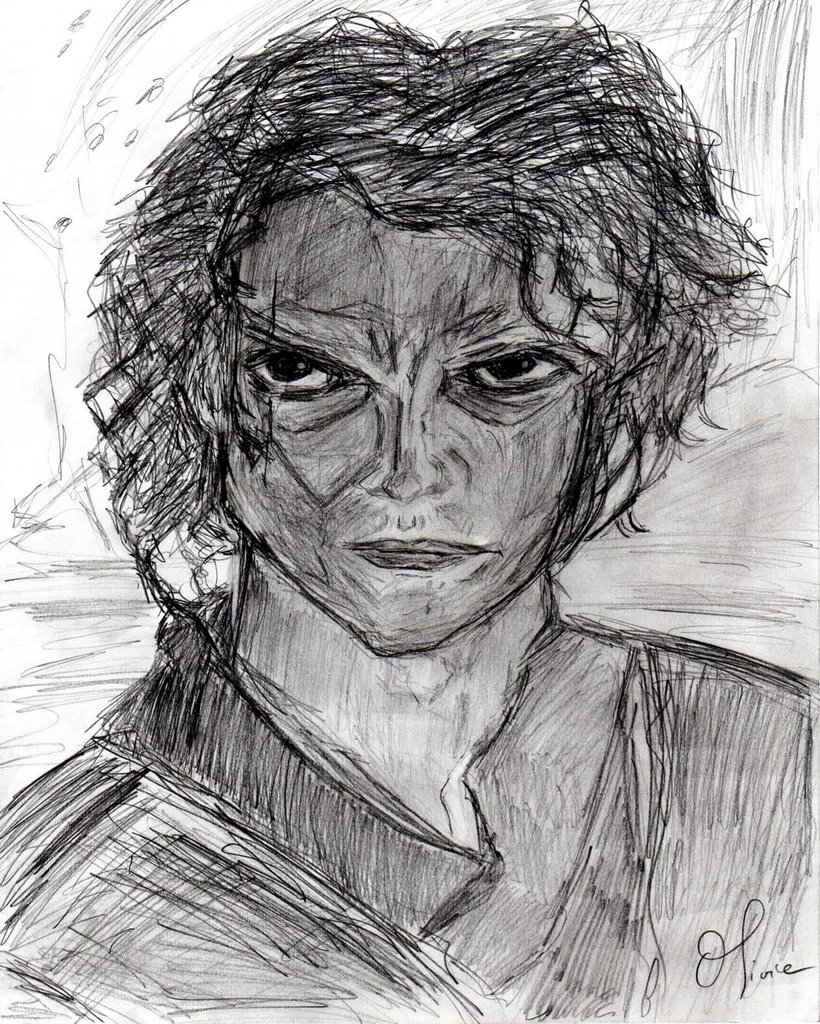
Another sketch- can you guess?


Check out my full-size sketch here!

Can you guess who this is based on?

If you can guess, add it to the comments. Otherwise, and only if you don't know, click here.

Wednesday, October 25, 2006

Seminary, the Institution

Inspired by Harry Maryles' recent post on the matter, I thought I would try to organize my thoughts with regard to seminaries.

As one who did not attend seminary, none of my thoughts can relate to the experience itself. I have not been there. I have not had my year in Israel, nor do I wish to have one- or at least, not in this capacity. Therefore, my thoughts can only reflect what I have heard from others, and my impressions from the frantic machinations of teachers and faculty.

Seminary, a popular trend (and almost a mandate) in today's Orthodox Jewish world, refers to an Orthodox Jewish female high-school graduate's "year in Israel" most frequently, and upon occasion a year in any Jewish institution of higher learning (located in places from England to Montreal to Cleveland.) When I refer to seminary, however, I refer to the most common phenomenon- the year in Israel.

How is seminary approached in high school? Well, as far as my experience allows me to judge, it is presented as a given. You will finish high school, and then you will attend seminary. Hence, the great majority of one's junior and senior year of high school is spent in attendance at various speeches where heads of seminaries (or their public relations department) stop by your school, inform you of all the attractions of choosing their school over anyone else's, and sometimes even conduct interviews. The excitement, worry, confusion and happiness reach fever-pitch. The only word you hear, rolling off of almost everyone's tongue, is seminary.

Seminary, as I understand it, has both pros and cons. Ideally, seminary is a place-

1. Where one engages in an intensive academic atmosphere, suffusing oneself in Torah and Judaic studies (sometimes, perhaps most frequently, to the exclusion of secular studies) for the period of one year

2. Where one is able to explore different avenues of thought and experience different types of religiosity and commitment to religiosity than those one has grown up with/ been previously taught

3. Where one has the opportunity to assert one's independance and learn to make choices for oneself

4. A maturation experience- not only in the fact that one is independant for the first time, but one most also learn to interact with others who may not be like them, in a culture that is different from theirs, and a different land

5. Suffusion in the rich experience of the country that is Israel. Tiyulim of various types (guided trips and hikes throughout Israel), Shabbatons (staying over for Shabbos in various places in Israel) and visiting relatives are all wonderful experiences

6. A time of introspection. This combines maturation, independance, and perhaps all the other factors formerly mentioned into one overarching idea.

Ideally, seminary is a wonderful experience for the female Jewish student. She is able to study Torah on a very high level (if she is interested in academics), or, in contrast, choose a school which focuses more on hashkafa (philosophy) and giving over love, warmth and acceptance. She is experiencing the land of Israel and all the riches it has to over. She forms close friendships with other girls and perhaps has some borderline problematic experiences as well (all part of growing up.) She learns about herself through learning about others. When she returns to America, she is prepared for college, having completed a step in her growth.

In contrast, however, there are cons to seminary-

1. Choosing a seminary for shidduch purposes. Many girls go to seminary in order for it to "look good" on their resume, so that their future husband will find them acceptable and marry them. (I personally find this to be a ridiculous bordering on sad practice. If the first question the man asks is what seminary the girl attended, does he desire to marry the girl, or the institution? What has seminary to do with one's character traits?)

2. Price. A year in Israel is expensive, and not everyone is able to afford it. There are certainly scholarships and the like, but not enough of them (and not everyone qualifies for them.)

3. Indoctrination. Many people go off to seminary confused, as it were, lacking a defined and clear understanding of Judaism and their own commitment to Judaism. Once in Israel, their seminary instills certain values in them. These values are not necessarily good. Spending a year away from home without a clear sense of self makes you very vulnerable.

4. A year without secular studies. One of the reasons (I have heard this whispered by the student body) that people who do perfectly on the AP English test receive no credit from Stern is because they spend a year in Israel, forget how to write papers, come back and do miserably in English classes. Taking this "gap year" or break may really be a disservice to students who want to be revved up and ready to go when it comes to college. Many students have told me they "forget how to work." To be more charitable, it may not be that people forget how to work as much as they work differently in Israel to suit the different types of classes there.

5. Family relations after seminary- Some people come back from Israel totally changed (and this can be either a good or bad thing.) Their family does not know how to relate to them anymore, because the person is revolted by and denigrates many of the things the family practices. This can cause tension and unhappiness between family members. (This is part of the phenomenon often referred to as "flipping out.")

6. Matching a person to the right seminary. This is much harder than it seems. Many times schools actively "push" for certain schools over others, and almost force students to attend those schools as opposed to any others. This can be reason for a pretty miserable experience.

At my school, there were certain seminaries that were "acceptable" to my administration, and others that were frowned upon (or even actively disparaged.) My school pushes girls to go to the frum seminaries- BJJ, for example, although this one only accepts the creme de la creme of the religious crop, Michlala, Darchei Bina and the like. Seminaries that teach Gemara (gasp) are often viewed as being of lesser quality (if of any quality at all!) Girls who want to attend Shalavim, Brovenders, and the like have to search out and complete applications for themselves, as the school hands-down refuses to help them in the application process. This is, in my opinion, very unfair.

Best of all are the long talks the principal has with the high-school students. "You don't want to go there...no, you really don't want to go there...I know best...I know this school would be better for you...do you really want to be in that kind of- environment?" This even borders upon the offensive when the principal takes it upon himself to tell your parents how he knows better than they do, and you should attend School X.

Seminary ought to be about choosing the school that is best for you, the school that completes you, that fulfills your interests and has what you are looking for, in the same way that the college one attends ideally ought to be the one that is best for you and not necessarily an Ivy League school (though, of course, an Ivy League school might be right for you!) The emphasis ought to be on your personality and which school will work for you. Instead, the emphasis that most Jewish high schools put on the matter concentrates upon the schools and tries to maneuver you to fit into them. Needless to say, that doesn't always work so well.

As a tangential issue, Jewish high schools as a whole, I believe (or perhaps it was only mine) put much more emphasis on finding the right seminary than finding the right college. In fact, my school only had seminary speakers. We had Rabbi after Rabbi come to talk to us about seminary, but nobody came to tell us about college and our options there. While my school claims not to discourage people from attending college, they offer little help- none, really. Many of my classmates (especially eldest children) don't really know how to go about college applications, and a lot of them are in seminary this year rosily thinking that "they'll apply to college later." While that may work, it's really wrong of the school (again, in my opinion) to mess with people's lives this way. Why should one year be so much more important than one's future career?

That, of course, leads us to the fact that many schools don't imagine that girls should have future careers. Acceptable schools like TI or Stern, fine. Other schools, like the University of Pennsylvania and the like, not so fine, but at least they have a large Hillel. Schools without large Hillels- the girls are doomed. They will all leave Judaism- that's the impression we receive, anyway. Or why go to any school at all? Go to seminary, come back home, marry some nice boy and file papers at some Jewish office. Why not?

But that, as I mentioned, is a tangential issue.

Regarding seminary- I am convinced that some people can go to seminary and have a wonderful time, learn a lot, mature, and come back home ready to pursue higher studies (or ready, if this is their hashkafic bent, to get married.) I am also convinced that some people go to seminary, hear all kinds of things and accept them as truth- because isn't this really religious learned person the one telling you these things?- and come back home to find their parents don't operate this way. And then, because they respect the teachers more than their parents, family relations are strained and unhappy, the parents curse their decision in sending their daughter to seminary, the daughter retaliates, and it's not happy. Those are extremes, of course. There are also people who fall into the middle category- people who weren't so happy at their particular school, but enjoyed Israel very much, people who were homesick but also had fun, etc.

Why didn't I go to seminary? This has to do with me, personally. My personality, my experiences, who I am and who I was. I didn't go to seminary because I was disgusted with all it represented- to me. To me, it represented superficiality, a kind of trophy you needed in order to marry successfully. I am frightened by the idea of going to a different country only to discover I hate my school, or my hashkafa is not in accordance with the school's hashkafa and I have to battle my teachers every day in order to remain true to myself. I don't want to have to deal with that- it drains me, and it exhausts me. I also do not feel that I need a maturation year. For various reasons, I've already had my maturation year (perhaps years?), two years worth of refreshment, intellectual entertainment, interesting topics and fabulous teachers. For me, the experience of seminary can only represent negative things- negative emotions and hatred. Even to be judged a certain way- because of going to seminary- disturbs me. And so, I could not, or perhaps would not go to seminary. There was no question, there was no discussion. I would not. The benefits I might have received had I gone to schools that would have interested me- and yes, I know they exist- like Brovenders- would not outweigh the evils for me. Even to be there- to be in a place where there are no secular studies, where the only thing I am learning is Judaic studies- would make my skin crawl. Having tasted of one extreme of Judaism, I personally need to avoid it- for the sake of my own sanity. I well understand how some people can come to hate their own religion. I myself have to battle that type of feeling- not hatred but disgust with various attitudes. Having been placed in an extreme environment- extreme for me- in terms of the Jewish high school I attended- I need to avoid it at all costs.

I have to say that I do not mark any great difference between myself and other Seminary-returnees, unless it is the fact that I don't have a group of chattering friends who follow me about and go into raptures when remembering various incidents that occurred in Israel. I know some people who have definitely grown from the experience and have figured out some things for themselves. I also know people who seem to be the same as they were when they graduated high school. And I know people who will quietly say that the year in Israel is overrated- when in truth they are scarred, but know that the majority opinion leans against them.

In the end, I say that you have to have a strong sense of self or a strong group of friends in order to go off to seminary and be able to hold your own. If you can make a list, mentally or figuratively, of certain values that are important to you, understand them thoroughly and realize that there is little in the world that can make you doubt these things- these are your unshakable beliefs- then you should be fine. Because then you'll go off to Israel and be able to judge, to take the good experience from the bad, to sift through what you're given. You have the confidence and ability to do so.

But if you are confused, vulnerable, don't really understand your own religion or commitment to it, are trying to escape from a dysfunctional environment, or are in any way fickle- think hard and well before you go. Figure out why you're going. Is it peer pressure, or do you really want to go to seminary? Try to figure out what's important to you before going off to have your entire belief system (possibly) shaken or remade. There are people who go off to seminary, thinking that all is fine, come back with a niggling sense of unhappiness but assume the problem is with them, and then, only years later, realize what caused them this unhappiness- and understand what really went on where they thought they were learning. You don't want to be one of these people.

Everything I have said could really go for any school- elementary, high school, and probably most accurately college- but seminary is harder because you are physically removed from your support system, your family, whomever you usually talk to when you are trying to work things out or understand what you think. Of course, if you go to college out of the country, you deal with the same situation. So, as Socrates said, "Man, know thyself." And all shall be well.

Tuesday, October 24, 2006

The Dragon Queen


(Disclaimer: This is a story. A fairy tale, if you will. My way of relieving stress because midterms are here. Thanks. )

They begged me to give up my life today.

They came before me, garbed in rich, royal clothing, bejeweled, gems glittering on their fingers, encrusted on their robes.Their shirts were hemmed with golden thread; their belts gleamed of silver. Their boots clanked strongly upon the floor.

And yet they were ashamed.

They entered my chambers hesitantly, their heads bowed, their entire demeanor subservient. They knelt before me, and many of them hid their eyes.

I was in the tower chamber, standing before the window. My white gown whipped closely about me and my head pounded. I was consumed by thought, worrying about my people, about my land. I felt a fierce stab of anger at my inability to be of use. I raised a hand to my forehead and closed my eyes, allowing myself to feel the cold wind on my face, my eyelashes fluttering against my cheek.

It was at this moment that they entered, bearing candles and candelabras. They stopped for a moment in hesitation; I heard a sharp voice berating the others for their callousness. I turned from the window and looked upon them.

“Yes, my people?”

They knelt before me, placing the baskets they bore upon the floor. The contents were pitiful. A few stalks of wheat, an apple, this was all they had left. What use their fine clothes, what use their riches, when none of this could buy them food?

Kiergon rose. “My lady,” he stated, and then looked into my eyes. He was strong; his eyes held my gaze and did not break before me. Strange eyes, his, black and pooling, so that I do not feel like I can truly read him. He wore a heavily embroidered vest of maroon, interwoven with the signs of the zodiac, the constellations. His black curling beard suggests his nature to be warlike and vicious, but I know he is a man of sound judgment, one who may be trusted.

“My lady, we are starving. We have worked the land, tried the various remedies recommended us, have even resorted to asking the local witches and wizards for help. To no avail.” He paused, took a breath and continued. “This,” his hand made a sweeping gesture, taking in the baskets laid upon the floor and their pitiful contents, “is all that remains to us.”

I looked at him with equanimity, waiting to hear his request. Another man shuddered, and muttered something under his breath about my “unblinking amber eyes.”

“We feel, therefore,” Kiergon continued, “that it is up to you to appease the dragon.”

I smoothed a piece of hair behind my ear, and waited in silence.

“I mean,” he said, for the first time betraying a lack of composure, “that…” he gestured with his fingers, then stopped. I noticed that he was looking at me. Truly looking at me. He is assessing me, I thought calmly, and waited to hear his request. He cleared his throat uncomfortably, looked at the other men still kneeling upon the floor, and finally made a sound of disgust. “My lady, if there were any other way…”

“Speak freely,” I said, clasping my hands loosely before me.

“My lady, the dragon has cast this curse upon us. It is the dragon who makes us suffer, who causes this famine, this unnatural hunger that cannot be dispelled. The witches and wizards have made no headway with this. The dragon desires one thing only- blood. Blood of a royal maiden, a virgin. A beautiful maiden.” He met my eyes squarely. “My lady, he desires your blood.”

A little shiver crept up my back. I felt the air around me tense, as the kneeling men looked up at me. All their eyes focused upon me, a maiden of fifteen, who with one breath could order them all killed, executed for their treasonous request. Some of them surreptitiously reached for their swords. Ah. I saw how it was to be. They planned to overpower me and force my acquiescence. They planned to take me in chains if I would not agree.

I calmly looked at Kiergon. “Is there no alternative?”

He wet his lips, then raised a well-formed hand to his beard. “My lady, I do not think there is.”

“Very well,” I said, my amber gaze steady. “I must consider this. I will give you my answer in the morning.”

I sensed a man surge to his feet, anger propelling him forward. My guards instantly caught hold of him. One held a blade to his neck. My other subjects quivered in fear, still abject and kneeling.

“Do not kill him,” I said coldly. “I will excuse him. He is not rational.”

The man looked at me with hatred. He would rather have died, I believe, for in his last moments he would have been able to justify his desire for my blood by claiming I was the cruel one. I denied him this satisfaction.

“You are dismissed,” I said softly. “I must reflect upon your request.”

“My lady,” Kiergon stated, then stepped forward. I raised a brow.

“Yes?”

“My lady, I warn you not to trust to the mercy of your subjects. They are moody, starved, and will be led by the evil wishes of one man.” He turned to look at the man who would have killed me. “I will not answer for them. Do not- do not take overly long to reflect upon this.” He turned and strode from the room.

This is amusing, I thought bitterly. When times are good, they laud me, bedeck me in flowers, call me by pretty names and each try to win my respect and good favor. Now that we are cursed, they desire my death.

I retired to my bed-chamber, where I now sit and reflect.

The lights are dim. I look into my fire, and I question myself. Is this my duty? Must I do this for my people? To be consumed by a dragon…to go willingly to this death…do I have the courage for this? I can hide; there are those who would hide me. There are those who are yet loyal to me. Perhaps I can barricade the palace. But of course, all these efforts will simply allow me to avoid my fate, as opposed to solving the problem that exists.

But my life- but my life! I love my life, I love all that I have seen in my fifteen years. I love the sun upon my hair, the moon that dances over my subjects, the stars, the breeze that wafts through my window. I love my hidden pleasures, the dolls I keep still for memory’s sake, for the sake of the time before I became Queen. I even love simple things- the taste of hot chocolate before I go to sleep, the flickering light on my face from the fire. I want to pull a comb through my hair, to feel my hair resting upon my shoulders, to cover myself in warm blankets and seize life as mine.

Why should it be my concern that a dragon desires my blood? I am the Queen! Cannot a Queen override a dragon? Can I not feed my people in any other way? Is there no other choice? Is there truly no other way?

I feel the tears trickling down my face. I am crying because I am doomed, because I know, as I think, that there will be no other way. They will offer me, whether I will or no, and if I must be offered then better to go willingly. I wonder whether they will stay to watch the dragon consume me. Perhaps they will have to assure themselves that I have been thoroughly eaten? A vile thought, that. I am bitter, bitter and cruel toward my subjects, when I know that were I in their place, suffering the deprivation and hunger that consumes them, I too would desire my own death.

It is not that I have eaten well. I have not. I too have suffered hunger. But I am younger, stronger. It is not the same.

But how I resent this duty, this duty that makes the death my own!

A voice. It is Damien. I fly from my bed and open the door, weeping openly now.

“Oh, Damien, Damien!” He hugs me as I cry. He is my brother, only twelve, but he understands the ramifications of what has been decided. He looks up at me with stern eyes, eyes that understand too much. Of course, I think to myself, if I am dead, he will be King. And perhaps one day his subjects will demand his death as well.

“Lina,” he says, and his voice is warm, filled with love. “Lina, do you want me to stay with you?”

“No. No. Let me bid you farewell now, Damien, and I will prepare myself for the morrow.” I gather him into my arms and kiss the top of his head, his soft black curling hair. His eyes are huge with fear and confusion. I chafe his hands. “You are cold, Damien.”

“Lina- if you want- I- I won’t let them.”

My heart almost breaks at his kindness. “No. No. Damien, you must do what they tell you, so that they will not have cause to hurt you, too. Be a good king. A wise king, one who is beloved throughout the land.”

“I shall force the minstrels to sing of you, always.”

I push him out of the room, then, and sob wildly. A song for minstrels? Is this what I have become? Then I choke down my sobs and force calm upon myself. I will be calm. If I must die, I will die with dignity, by my own choice and through my own words.

I gather my clothing, donning my finest gown. It is long and wraps around me softly, white of course, as all my clothing is. I wear a veil that is pinned to my hair with a pearl clip. I have bathed already, anointed myself with my finest oils. I look like a bride.

I slip my feet into the ceremonial white shoes and accept a necklace of opals. Opals are my favorite stone, white but filled with secret fire, with flashes of colors that radiate from its heart. I am the opal, I know. I attach the earrings to my earlobes, shaking my head a little as a last vanity, watching their sparkling colors in the mirror. I have not eaten. I pull my veil forward and exit the door.

“Kiergon!” This is an imperial command, a summons. “Attend me.”

Kiergon has been waiting respectfully outside the castle. He awaits my answer.

“I shall be your wiling sacrifice,” I say coldly. I must be cold; it is the only way I can prevent the tears that threaten to burst forth. I am perilously close to giving way.

He bows his head, relieved. I see the look of fleeting shame that passes through his eyes, and pride gives me nerve. I stand straighter than he does.

“Where are the others?”

“They are coming.”

I see men, coming, attired in armor. They bear weapons, prepared for battle.

“You would brook no resistance,” I say dryly.

He does not make me an answer.

“Let us go, then,” I command. “I shall wait by the sea.”

They accompany me amidst trumpets and fanfare. All my subjects have come to see me off. Once by the sea, they look at the sky fearfully, worrying that the dragon will suddenly swoop down and mistake one of them for me. They try to seem lighthearted and happy, but a bitter awareness tinges the entire affair. I stand, suddenly. I want none of this shadow-truth, no pretense that all is as it should be. “Go!” I roar, almost a madwoman. “Go and let me serve to save you from famine.”

I see Damien look at me with unhappy eyes. “You, especially,” I turn to him. “I do not want you here to see this.”

It is perhaps my last order as Queen. “Yes, my lady,” he says, and walks alongside the villagers, descending as they go back to the town.

That is when the men descend upon me. Men made wild by fear take ropes and bind me to a large boulder by the sea. It has been half-destroyed by the elements so that it almost resembles a gallows, a stony outcropping that meets me in a desperate embrace. The men lash my hands behind me and bind my ankles. They force a rope around my waist. Some of them look at me with hatred, others with pity. Some seize the moment to caress me, unwanted caresses that make me stiffen. I choose to ignore them. Perhaps I should give thanks that the dragon requires a virgin; at least they will not rape me.

When I am so tightly bound that even to move a finger causes pain, they step back and admire their work. The sun has fallen; it is already sunset, descending into dusk. The darkness cools their ardor. They are satisfied with the job they have done. They walk away from me, back to the village, but not before some satisfy themselves by jeering at me. I cannot speak, as a gag has been wedged in my mouth. I watch them with my amber eyes, still evaluating and assessing. Dull thoughts come to mind as I try to distract myself from the pain of the ropes that bind me. The remarks I hear now enlighten me; I know now who among my subjects has never been loyal to me, and who is driven to this simply through desperation.

They move away. They will not stay here for the slaughter; even they are afraid of the darkness that falls across the sky. They will come back tomorrow to retrieve my body, perhaps to bury it…if anything remains to be buried.

At least they have not blindfolded me; one even removed my veil and took joy in trampling it. His face was ugly when he did so, contorted with rage and hate. But I am glad of it now, glad because it means that no obstacle blocks my view, that I can see. I look out at the sea, observing the shining peaks formed by the light upon the water, the moon rippling across the deep unending blackness. I wait, my every nerve listening, the slightest sounds causing an immediate thrill of apprehension and dread to tingle through my body.

I hear a strange piping sound. I cannot help it; I struggle to pull free. I fight the knots and ropes that bind me until they chafe me, until I bleed. Blood trickles through my mouth.

I can make out the figure of a boy. He seems strange, a kind of piper, piping away upon his flute. His clothes shimmer in the moonlight, made of a strange fabric that is simultaneously delicate as grasshopper’s wings and iridescent, glimmering with colors. He is handsome; his features cleverly shaped. He stops a moment to look at me. Bound as I am, it only now occurs to me how strange a sight I must appear. A bride or an offering, what am I? For I am swathed in the traditional garments of the bride, and yet I am covered with ropes that chafe and choke me.

He comes closer. I want to laugh, but cannot, of course, as the gag is in my mouth. I want to wave him away, to somehow motion that a dragon will come for me, and he had best not be here when it does come. But I cannot move, not even a finger. I blink my eyes at him several times, willing him to understand me, but all he does is come closer until he is looking directly at them.

“Amber,” he says, smiling. “You have beautiful eyes.”

He pulls out a knife and proceeds to cut my gag. It takes time before I can form any words to speak. He begins to work on my other bonds but a frantic gesture on my part stops him.

“You…cannot,” I croak, my voice hoarse, my tongue slick with saliva. “I am an offering to a dragon, an offering on behalf of my people. You cannot cut my bonds.”

“Certainly I can!” he replies jauntily. “Surely you don’t want to meet the dragon.”

“What I want doesn’t matter,” I answer. “My people have been cursed. There is a terrible famine, and noting we have tried has availed us. I must do this. It is my duty.”

“Who is to know?” he prodded, turning away from me as he sharpened his knife upon a stone he removed from his pocket. “Your people will assume the dragon has taken you away. Even if the famine does not abate, you have fulfilled your duty. Surely you want to live?” He gave me a sly glance.

“Of course I want to live!” I answer, feeling desperate. “But…I must, I must do this. What kind of Queen would I be if I would deceive my people?”

“Are your people worthy of such loyalty? Surely they couldn’t have been kind when they bound you here today.”

“They were mad!” I answer resolutely. “Mad from fear and hunger. They would not have treated me so otherwise.”

“Are you sure?”
I know that the boy speaks the truth; that it is possible that my subjects would overthrow me even were the circumstances good.

“What is it to you?” I sneer in my best queenly voice. “You are no king. You are a mad boy who wanders the hills at night with his pipe. Surely you ought to go away. Do you want to die, too?”

“Oh, make no mistake,” he answers airily. “Many have died here.”

“All the more reason for you to go!” I turn away from him and look back out at the sea.

“Then you are truly willing to meet your death?” His voice gentles, seems soft and kind. “You know it is not necessary.”

Sweat shines on my forehead. “It is necessary,” I say firmly. “And stop tempting me!”

“If you are sure…” he says, and allows his hand to fall away from the ropes. “Shall I play for you?”

I make no answer and he begins to play, a haunting, soulful tune that disturbs me and ruins what little peace remains to me.

Doubts accumulate in my mind. Here is a boy offering me a chance to escape. He has a knife; he is willing to cut my bonds. No one will know but me, and why should I die? Why must I die? Whence comes this grand posturing where I pretend that I want to die, that I desire to serve my people? I am not that kind of person! I do not want to die!

I begin to struggle against my bonds, then force myself to stand still. I speak, jarring the music. “You had best leave,” I say.

“The dragon will be coming.”

“As you wish.” He bows mockingly to me, sweeping the cap off his head, then replacing it and continuing to play as he disappears into the forest.

That is when the tears come. Great tears that slip down my face, tears at my stupidity, my idiocy, my desire for death. I hear a great beating of wings and strain my ears. It comes nearer and I see the dragon, a huge shape in the sky propelling himself toward me.

I compose myself. I stand straight, the tears still wet on my face. I follow the dragon with my eyes.

He lands before me, a noble and impressive creature. He is huge, and my eyes widen in shock as I try to take in his size. His scales are green and golden, though some appear iridescent, similar to the fabric the piper wore. His claws are silver. His eyes are large, but the darkness prevents me from seeing their color. I wait for him to eat me.

He opens his mouth but uses it to speak, in a surprisingly human voice. The tone is deeply sad, almost dolorous. I am confounded.

“I am sorry that you have come.”

I find my voice. “Sorry? When you forced it, by virtue of your famine?!”

“I am sorry, then, that you believe the famine is of my doing.”

“What do you mean?”

“This famine is not caused by me. It is a curse by a powerful witch, a woman who wanted to end your power, who thought you rivaled her as Queen.”

I am shocked. “I know no such woman! Whom do you speak of?”

“Your sister.”

I cannot believe it. My sister was said to have died years ago from a tragic illness. “My sister is dead.”

“No, you believe she is dead. In truth she is deformed, victim of a hideous disease that scars the skin. Your parents were appalled by her and hid her from you, giving her to others to raise. She has grown up with great hatred for you and your parents, believing that the throne you hold is hers.”

“But I never knew—“ Protests fly to my lips. How unhappy my sister must be!

“She does not care. She is spiteful, angry, ruled by wickedness. Because life has been unfair to her, she believes that all must suffer. She desires beauty above all else. Were she beautiful, she could rule. I believe she would rule justly. She has tried countless unguents, lotions, potions. None have aided her.”

“What can be done for her?”

“Nothing. You must kill her—“

“Kill her!”

“Or she will continue to torment your people.”

“Is there no other way?” I looked into the wise eyes of the dragon. How wrong we all had been! This dragon did not desire my flesh, would take no joy in feasting on my blood. He desired only to help me.

“There is one other way.” He paused. “But I fear you will not like it.”

“Tell me what I must do.”

“Beauty- freely given- can cure her.”

“What?” This, a shocked whisper, as I considered myself as a drained, ugly hag. “I must give her my beauty?”

“If you bestow beauty upon her, she can return, and in your image, she may rule.”

“In my image! So others will think her to be me!”

“Yes.”

“I cannot bear it.”

“Then you must kill her.”

“I will not kill her.” These words, torn from me, almost a low moan of pain. “Will you take me to her?”

“I shall.”

“May I- may I ride upon you?”

For answer, the dragon reached for my bonds, which shivered and fell away at his touch. Free, I rubbed at the angry red marks that covered my skin, especially my wrists. As I stepped forward, I almost swooned.

“What have they done to you?” The dragon’s tone was angry. One claw rested on my hand, prompting me to turn it over. The dragon’s tone darkened as he looked upon the bruises. “I will have to carry you. You cannot ride upon my back like this.” He reached toward me with a gentle paw, then paused as he saw my necklace of opals. "Opals," he mused, his eyes glimmering a bright green, "opals are the stones of tears. Surely you can heal yourself?"

He removed the necklace and placed it in my hand. I looked at it dumbly, confused. "What- what would you like me to do?" My voice was breathy, whispery, edged with confusion and slight fear.

"Heal yourself. Can you not do it?"

"With a necklace?"

He suddenly seemed to understand the reason for my confusion, and perplexingly, simply stepped back and folded his hands. "Opals are the stones of tears," he repeated.

I took the opals and laid them on my skin. Nothing happened. I felt awkward, foolish, glancing at my flesh and the angry marks upon it. Frustrated, I contemplated giving up. Instead, I rubbed the necklace, pushed at it, even breathed on it. When I did that it misted over a little, and I felt a slight amount of relief. Perhaps the opals simply needed water?

"Of course!" I exclaimed suddenly, realizing what the dragon must have meant. "Opals are the stones of tears. Surely I need only shed a tear, and then they will heal me!"

I tried to cry. Ironically, I could not. Before had been my time of weeping, back at the castle, with Damien, when I realized I had no choice in this matter; that I would go to my death whether I would or no. I had bit my lip and remained silent while the men tied me to the boulder, had calmed myself and allowed myself no sign of weakness. I had not cried. Now I was too scared for tears, unable to force them.

"I'm sorry," I said apologetically to the dragon. "I cannot cry."

"Cannot?" he said, and looked at me. It seemed as though he were evaluating me, reading me and my thoughts. I tried to shield myself, to hide myself away, but it did no good. He gave me an odd look, which softened into understanding. "Very well then. Allow me."

I dropped the necklace in his paw. He raised it up and proceeded to shed a tear. A dragon's tear is a beautiful thing, a kind of liquid that is covered over with a sparkling sheen, clear and yet colorful, like a bubble that might float upon the wind. The tear slipped onto the necklace, and then I caught my breath.

The necklace...ignited. Sparks of light flew off of it and began to form around the individual stones, flames and fire in all the colors of the rainbow. He motioned toward me but I hesitated to touch it. "Won't it...burn?" I asked.

"No," he said, and draped it around my neck.

Instantly I felt a stange sensation, as though the necklace were eating away at my skin, burning away all the marks and scars and memories of the day. Its fire consumed my bruises, purpling skin became fresh and clear once more. The aches in my back, the rope burns and marks on my hands, the mottling flesh of my body...all disappeared. All that was evil and unwelcome fed into the necklace, which consumed it in startling sparks of flame. The necklace took away my pain and even refreshed me. When at last I felt recovered, the necklace's fire began to fade away, remerging with the stone so that when I looked at it, all I could see were the secret colors hidden in its depths.

I looked at the dragon. "And all that was needed was a tear?"

"Well," he said, and attempted to appear humble, contrite. "Well. A dragon's tear is different from that of a human's."

It was only then that I realized how great a favor had been bestowed upon me, and I knelt before the dragon in thanks. He coughed and motioned me up.

"I can ride now," I said, and he knelt before me.

I clambered onto his back, glittering with its collection of greeny-gold scales and the iridescent colors of the cloth the piper had worn. I loosely clasped my hands around his neck, so that I was half-lying, half-sitting upon him, cocooned between his wings. He reared upward, as a horse does, and for a moment I was afraid, terribly so. He felt my fear and turned his head, giving me an encouraging smile. I smiled back at him.

And then we were off.

How to describe flying? A rich sensation, a whirlwind of moments. He dipped and soared over castle spires and towers, flirting with clouds, skimming the wind with his wingtips. His skin, initially so rough to my unpracticed hand, grew cooler and became soft. Sometimes he descended and winged his way through caves, showing me mysterious fish that glowed in numerous colors, and elaborate paintings done by creatures I had never heard of. He taught me his ways in that ride, so that even when I slept, curled upon his back (for of course I was very tired) I felt as though I were learning.

At last he alighted before a small house, not a hovel but no palace, quaint and traditional. It was made of black stone, though the steps were of white marble, and beautiful pomegranate trees stood before the door. A sign which I could not understand was engraved upon the door; it gave me a feeling of uneasiness if I looked at it too long.

"Lina," the dragon says, and I turn to him, accepting the fact that he knows my name though I have not told it to him, "this is your sister's house."

I clench my fists and walk toward the door, as the feeling of unease grows stronger. I turn my eyes away from the charm engraved thus and instead slam my hand against the stone three times. There is no answer. I push at the stone, then, and enter the room.

There is a loom in the center of the room, a great loom with an elaborate pattern. The images are skillfully rendered, but they give a feeling of unhappiness, as though the man who is at the center of the tapestry had died a terrible death. Herbs hang from the ceiling. They give no smell and look pleasant enough, but I shudder as I recognize that one of them is a terrible poison. There are shelves at another corner of the room, stacked with wooden bowls and utensils. Everything is clean and neat, a fire is burning in the hearth. My sister sits in the center of the room.

She has very pale skin and long black hair. Her eyes are green, like the dragons, but the green is tinged with yellow. Cat's eyes. Unsettling eyes. She wears a long red robe made of the richest velvet. Her scars are obvious and stand out against her skin. Her disease does not cause putrid sores or half-eaten skin. There is simply a network of scars, raised flesh that is even whiter than her own skin, that crosses her entire face, her hands, her skin. She has been born scarred. It is frightening to look into eyes and realize that even her eyelids bear these scars. It is disturbing in the extreme.

"Hello," I venture, feeling foolish. I am only fifteen; she is obviously older, wiser, a skilled witch.

"Lina." Her voice holds no condemnation but simply quiet, as though she expects me to explain my appearance. I do not hear revulsion, hatred, cruelty. I hear emptiness.

"Yes. I- I did not know of your existence until now. I have come to ask you to remove the famine you cast upon my people."

She waves her hand, a dismissive gesture. "You have come to kill me, as is your right. But know-" and then her green eyes glowed, as though with pleasure, "that my death will not remove the famine."

"I have not come to kill you." I say this with queenly composure, only to remember I am no longer a queen. "I have come to request the removal of the famine."

"Nothing you can give me will induce me to remove it."

"What if I give you a place in my home? You would be treated as royalty, a foreign princess come to join us at court. You would have whatever you wanted- gems, jewels, cloth, suitors..."

"No."

"What, then, if I offer you honor? I would honor you beyond all others, and tell the story of how you courageously found the witch who had cast the famine, and forced her to remove the curse."

"No." A wry smile twists her face. "There is nothing you can offer me."

"Perhaps," I say gingerly, "a cure?" I take off my necklace of opals. "If you shed a tear upon this..."

"NO!" she roared then, and rose from her seat, flinging her distaff from her. "Do you think I do not know of opals? Do you think I have not tried? I have tried everything! Opals, the rarest stones, the rarests plants, herbs, even poisons, diluted in small amounts of water, to try to burn away the scars...lotions...everything that exists. It will not work. And you-" here she sneered at me- "you stole my throne, though you did not know it. You are beautiful and did not even realize I existed! You did not care to know-" She caught her breath, then paused. "Well, now you know. Now, when I have you in my power, you know."

I turned, as though to approach the dragon who waited for me outside. At that moment I heard a noise, and the piper I had met earlier in the evening approached through a door. He bowed to my sister, his iridescent clothing still shining. "The herbs you requested, mistress," he said, and placed them before her.

"Foolish Yates," she said, waving him away. "Do not disturb us now."

"Yes, mistress."

"Wait!" I cried out. "You- you are the piper!"

My sister looked at me cunningly. "You know him?"

"Certainly! He is a piper, one who plays his instrument with considerable skill.He came-"

"Is this so?" my sister smoothly interrupted. "How interesting for me. How come you never allowed me to enjoy your...skill? Go fetch your pipe and you shall play."

"I have no pipe, mistress."

I started at the lie. My movement betrayed him as my sister, eyes narrowed to slits, said, "Fetch one, then, from my chambers. The engraved one, with the gold filigree."

"Yes, my mistress."

He turned away, but not before I saw the green fire in his eyes. He was angry with me. With good reason- I had had no right to betray him or his secret to my sister. Worse, now that she knew he could play, she would probably force him to play for her pleasure all the time, no matter how tired he was. I bit my lip in thought, then remembered that I had come here to offer her my place as queen.

But could I, in good conscience, give her my beauty? Would she not be a cruel queen, as cruel and bitter as she was a witch now? Possibly not. I would have to send word to Damien that she was not me, regardless of her form, and that he should not trust her.

Unless she was given what she desired, however, she would destroy my subjects, starve them utterly until they all died. Doubtful she would give them a proper burial. She would probably allow them to lie in the snow, frozen into grotesque shapes. They did not deserve such treatment. Or did they? They had been cruel to me, would have allowed me to die, eaten by a dragon. But no. They had not been thinking rationally. I am sure they had not been.

Yates (was that really his name?) returned with the pipe. He set it to his lips and began to play, a haunting, desperate melody that made me feel hurt and vulnerable. I noticed my sister stiffen with the music, as though trying to hold something back. The liquid notes seemed to torture her, until finally she commanded, "Enough!" in a tone that brooked no argument.

"Sister-"

"My name is Maeve."

"I have one more thing to offer you."

She eyed me suspiciously. "And what is that?" Regally, she seated herself upon her chair and spread her velvet robes.

"I will give you-" I took a harsh breath, "my beauty."

Her eyes opened wide in shock, then narrowed. "That is an old magic," she murmured to herself, "but yes, it could be done- provided the giver is willing- and then, with her beauty and wearing her form- I could rule! Yes, this is all I have ever wanted. Yes, yes!"

"Very well," she answered then, her red lips curving into a ghastly smile, "you will give me your beauty and I will end your famine."

"It must be signed in blood," the piper nonchalantly observed.

She wheeled on him and raised her hand as if to strike him. "Why, so it must," she then said, her tone considering. "After all, they will be my subjects now- I would not want them to starve."

She plucked a sharp silver knife from atop her black bureau, and held it to me. "Cut yourself with this," she ordered, "and sign your name upon this sheet," she extracted a sheet of vellum from another cabinet, "with this," and extended a peacock quill.

"Do nothing before she does," the piper cautioned.

Her pale face darkened. "You will be silent, Yates," she said, in a tone that brooked no argument. Still, she saw I made no move to do as she had commanded. "Oh, very well. I will sign the document first."

In a flash she raised her sleeve and cut herself, a fine line across her wrist. She shook a few drops of blood onto the paper, then dipped her quill into the welling wound. She signed her name artistically, "Maeve," elegantly across the page. In ink, she then clarified the terms of her bargain- I was to give her my beauty, and she would lift her curse and end the famine. She handed the knife to me. I wiped it upon my white robe, then, upon instinct, touched it to my necklace, which lit up instantly. The silver of the knife glowed red, then cooled. It had been healed from whatever malignancy Maeve had placed upon it.

I lifted one wrist, cut myself, and wrote my name, Lina. Then I waited.

"Who will do the binding?" Maeve intoned ritualistically.

"I will." The piper stepped forward and caught both our wrists, then placed them against each other. "Do you, Lina, agree to give Maeve your beauty?"

"I do."

"And do you, Maeve, agree to end the famine you have caused?"

"I do."

"Then let the binding," the piper intoned, "begin!"

He threw our wrists apart from one another, but they were caught, held together by a magical connection formed of blood. A silvery gleaming string seemed to stretch from her wrist to mine. I felt myself collapse as my beauty was sucked from me, felt myself age, my skin papery and frail. My hair whitened and I writhed on the floor. My body was expelling all that was beautiful within me. I felt myself gasp and retch, and finally, unable to stand any more, I fainted.

I arose with the piper's help. I looked across the room and saw myself- or saw myself as I had been, as I once was. My glowing hair, my countenance, my hands. Maeve looked delighted with herself. She was skipping around the room, dancing with happiness. The red robes she still wore were too large for my small fifteen-year old body; she was engulfed by them but did not seem to care. "I am Lina now," she said, and though her voice remained different than mine, it too had an odd quality of the beautiful within it. "I am Lina, and I am Queen!" She whirled around to look at me. A sneer began to form, but then, puzzled, she stopped, realizing she could not complete it. "I am truly beautiful," she whispered, "I have good inside me as well!"

"Have I given you my soul?" I cried, or tried to cry. My voice was a parched whisper, that of an old crone's, a hag's.

"No," the piper said, steadying me. "You have not given her your soul, only a part of your beauty. She has taken some of your inner beauty as well, but you have enough for both of you." He smiled kindly at me.

I walked to Maeve's mirror and nearly fainted again. My skin was ugly, wrinkled, old and bony. My face was old, my jowls hung down and my lips were coated with spittle. My hair was sparse and white. I was an old crone, a hag. Dismay splayed across my features. I wanted to cry, but would not.

"Come, then," the piper said. "It is time." He walked me outside, as though to look for my dragon. The dragon! He was not there. Frightened, I looked back at the piper. "I shall go look for him," he comforted me, and set out into the forest.

Maeve- or Lina, I suppose, for such is how she would be known- danced outside. "I will be a good ruler, Lina," she told me. "I know I will be because I have some of you inside me. I cannot be cruel without cause, now."

The dragon emerged gracefully from the forest. He motioned to Maeve and I, setting us upon his back. "I will carry you to your kingdom," he told Maeve. "You can tell your people how you came upon a white crone who tamed the dragon for you and prevented him from slaughtering you. She even subdued him so that he would return you to your people. Tell them that she has healed the land from its hunger, has stopped the famine. Warn them that they must act kindly toward one another if they wish these blessings to remain."

Maeve nodded her head in deference. Even she was cowed by my dragon!

"But where is the piper?" I asked.

"He has probably wandered off," the dragon stated.

"Should we not look for him?"

"He would not wish it," the dragon stated firmly.

We rose into the air, the dragon stopping near the sea to set Maeve down. Damien was there, having left the castle to check on me. He had been crying, it was clear, thinking that I had been eaten. His adoring eyes fixed on Maeve, thinking her to be me. He ran to her and threw his arms around her, kissing her all over. Her shocked expression became kinder as she realized who he must be.

"Lina! Lina!" he sobbed, hugging her wildly. "You're alive!"

"Certainly I am," she said laughingly. "Damien, this lady saved me. You may thank her." She motioned to me. I winced, thinking of my ugly, aged body.

"Thank you," he said in wonder, and knelt before me. "Thank you." He turned back to Maeve, inquiring, as though he did not want to know but felt it was his duty to ask, "and the famine?"

"Ended," she said laughingly, tossing her hair. "Come and we will return to the city."

She tooks his hand and the two of them made their way back to my kingdom.

I remained, looking at the sea. It might be better, I thought, than living this way...

"No," said the dragon firmly. His tail lashed around the boulder as he, too, stood facing the sea.

"But-" I said, and then the tears came. Human tears. They fell upon the opal stones, which lit with brilliant fire again. I felt my age melt away. I felt like myself and yet not myself. I felt strange. I looked down upon myself and realized my skin was smooth. Pale, whiter than it had been, completely white, almost. My hair was long, almost to my waist, and pure white. But I was young, with a young woman's body, and my eyes

"Glow amber," the dragon said, and then his body melted away. I watched, astonished, as he transformed himself into my piper. "I am the piper," he said. "I am both piper and dragon and long have I looked for a queen. A queen with courage, a queen who would stand and face her duty. A queen who would not run from a dragon. A queen who would save her kingdom, knowing that she went to her death, a queen who would give away her beauty even though it were her most prized posession. A queen," he said, his green eyes blazing, "like you."

I knelt before him in awe, amazed. "Will you be my Queen?" he asked.

For answer, I kissed him.

It was like no kiss I had ever experienced before. A sweet kind of experience danced within it, a kiss that spoke of the dragon's passion and his forbearance, his kindness and his gentle nature. I leaned toward him and we cried, our tears mingling as they fell upon my opals. They melted into my body and I grew in stature and size. My scales were white but opalescent, shimmering with colors just as his did. My amber eyes remained with me. He extended his wings and shook them, and I did the same, so that we two might fly. As dragons we would fly, as humans we would walk the earth. Together we would experience the world.

I am the Dragon Queen.

Tuesday, October 17, 2006

Who did Caleb Marry? Miriam? Bitya? Both?

That's odd.

That being my thought upon realizing my Chumash teacher mandated that Caleb, yes, the Caleb who is so famous for acting as the spy who did not turn traitor, as it were, was married to Miriam. Miriam being Moshe's sister, the prophetess.

After class, I mentioned that I had learned (well, more precisely read, this morning, in fact) that Caleb was married to Bithia (Bitya, Batya, Bas-Phaorah, whatever variant you prefer.)

My teacher gave me a very kind but slightly skeptical glance, and mentioned that there are many Midrashim, and surely I was quoting one of them. But I stated my basis and proof for this concept came from a verse in Chronicles I, and that was when she politely stated, "Well, it's very hard to understand Divrei Hayamim."

I have great respect for my Chumash teacher, but I knew that I had just read this...this morning. So I came home to try to look it up. Except I can't for the life of me find a Tractate Megillah in English or print large enough for me to understand in the Bait Midrash, so I figured I would ask you dear people what is going on.

Who did Caleb marry? Bithia or Miriam? Moshe's adopted mother...or his biological sister?

The fact is, the Gemara seems to bring down two opinions (and both from verses in Divrei Hayamim!), and they vary (a lot.)

Here's the first one, found in Sotah 11b and 12a:

    ...David descended from Miriam, as it is written: And Azubah died, and Caleb took unto him Ephrath, which bare him Hur,39 and it is written: Now David was the son of that Ephrathite etc.40

    And Caleb the son of Hezron begat children of Azubah his wife and of Jerioth,' and these were her sons: Jesher and Shobab and Ardon.41 'The son of Hezron'? He was the son of Jephunneh!42 — [It means] that he was a son who turned [panah] from the counsel of the spies. Still, he was the son of Kenaz, as it is written: And Othniel the son of Kenaz, Caleb's younger brother, took it!43 — Raba said: He was the stepson of Kenaz.

    Folio 12a


    There is also evidence for this, since it is written, [And Caleb the son of Jephunneh] the Kenizzite.1 Conclude, therefore, that Azubah is identical with Miriam; and why was her name called Azubah? Because all men forsook her ['azabuhah] at first.2 'Begat!'3 But he was married to her! — R. Johanan said: Whoever marries a woman for the name of heaven,4 the text ascribes it to him as though he had begotten her. 'Jerioth' — [she was so named] because her face was like curtains.5 'And these were her sons' — read not baneha [her sons] but boneha [her builders].6 'Jesher' [he was so called] because he set himself right [yishsher].7 'Shobab' — [he was so called] because he turned his inclination aside [shibbeb].8 'And Ardon' — [he was so called] because he disciplined [radah] his inclination. Others say: Because his face was like a rose [wered].

    And Ashhur the father of Tekoa had two wives, Helah and Naarah.9 Ashhur is identical with Caleb; and why was his name called Ashhur? Because his face was blackened [hushheru] through his fasts.10 'The father'- he became a father to her.11 'Tekoa'- he fixed [taka'] his heart on his Father in heaven.12 'Had two wives' — [this means] Miriam became like two wives. 'Helah and Naarah' — she was not both Helah and Naarah, but at first she was Helah [an invalid] and finally Naarah [a young girl].13 And the sons of Helah were Zereth, Zohar and Ethnan.14 'Zereth' — [Miriam was so called] — because she became the rival [zarah] of her contemporaries [in beauty]. 'Zohar' — because her face was [beautiful] like the noon [zoharayim]. 'Ethnan' — because whoever saw her took a present ['ethnan] to his wife.15


If you want, you can read the original Aramaic here.

Rashi has an interesting statement- Caleb married Miriam 'leshaim shamayim' because he knew that the sons often resemble the mother's brothers, and since Miriam had outstanding brothers, he hoped to have outstanding sons. As it is, Miriam became an asset to him- she recovered from her first illness and tzaraat/ leprosy and became so beautiful that other men paid attention to her.

But here we have the problem, Megillah 13a:

    בדברי הימים אמר הכי כל דבריך אחד הם ואנו יודעין לדורשן (דברי הימים א א) ואשתו היהודיה ילדה את ירד אבי גדור ואת חבר אבי שוכו ואת יקותיאל אבי זנוח ואלה בני בתיה בת פרעה אשר לקח מרד אמאי קרי לה יהודיה על שום שכפרה בע"ז דכתיב (שמות ב) ותרד בת פרעה לרחוץ על היאור ואמר רבי יוחנן שירדה לרחוץ מגילולי בית אביה ילדה והא רבויי רביתיה לומר לך שכל המגדל יתום ויתומה בתוך ביתו מעלה עליו הכתוב כאילו ילדו ירד זה משה ולמה נקרא שמו ירד שירד להם לישראל מן בימיו גדור שגדר פרצותיהן של ישראל חבר שחיבר את ישראל לאביהן שבשמים סוכו שנעשה להם לישראל כסוכה יקותיאל שקוו ישראל לאל בימיו זנוח שהזניח עונותיהן של ישראל אבי אבי אבי אב בתורה אב בחכמה אב בנביאות ואלה בני בתיה אשר לקח מרד וכי מרד שמו והלא כלב שמו אמר הקדוש ברוך הוא יבא כלב שמרד בעצת מרגלים וישא את בת פרעה שמרדה בגלולי בית אביה אשר הגלה מירושלם אמר רבא שגלה מעצמו


So now I'm confused. My first idea was that maybe these weren't the same Calebs, but they appear to be, as the reason for his wedding Bithia appears to be his rebellious nature (although rebellious in a good way, of course.) This is indeed the Caleb of the Spies.

So...did Caleb marry Miriam? Bithia? Both, at different times of his life? Both simultaneously? (I mean, there must have been an age difference there...Moshe's adopted mother and his sister? Not that it's impossible. In fact, for that time period, it's probably quite logical. Just not something my contemporary mind would immediately grasp.)

Anyone with answers, I'd be most appreciative.

Monday, October 09, 2006

Dress Robes, Finery, Clothing and Advice

Hey everybody!

Hope everyone is having a wonderful Sukkos. I am having a very good one thus far, with some very nice weather.

I actually need some help.

I shall be attending a wedding in the semi-near future, and need to purchase a gown/ outfit for the occasion. It can be any color except white or off-white. I am not a very tall person, so I'm probably thinking of clothing for petites.

I assume that New York, if anywhere, is the place to find beautiful modest (by which I mean a relatively high neckline, skirt that reaches or covers the knees, and preferably sleeves, opaque, that reach to the elbow or beyond) clothing. Unfortunately, I do not know where in New York to look. Of course, there are all the exciting brand-name stores, but the majority of those clothes would need to be altered, and if there is some brand, or store, or place where I can buy dressy clothing without having to alter it, that would be ideal.

So...can you recommend stores/ places/ people to contact? Do they have websites, do I show up, do I make appointments- how do I go about this? If you're uncomfortable commenting and leaving information here, you could email me.

Thanks!

Sunday, October 01, 2006

Yom Kippur

God, my God! Today you receive me, having thrown open your gates.
And I meet you with both plea and prayer.
With joy, both fierce and violent as I hope
to live for yet another year.
Joy and fear, they both are mingled.

Look then, shall I tell You of what I am reminded?

Here it is.

Our tunes, our songs, our soul-stirring liturgy-


My Soul is Dark

My soul is dark - Oh! quickly string
The harp I yet can brook to hear;
And let thy gentle fingers fling
Its melting murmurs o'er mine ear.
If in this heart a hope be dear,
That sound shall charm it forth again:
If in these eyes there lurk a tear,
'Twill flow, and cease to burn my brain.

But bid the strain be wild and deep,
Nor let thy notes of joy be first:
I tell thee, minstrel, I must weep,
Or else this heavy heart will burst;
For it hath been by sorrow nursed,
And ached in sleepless silence, long;
And now 'tis doomed to know the worst,
And break at once - or yield to song.

~ Lord Byron

And so out of our stormy tears
and loyalty, our allegiance pledged
not ten days ago- comes a deep joy, God, a song,
a song in Your honor.

And this song is wholly heartfelt.

We praise you, God, and all your world.
We have appointed you as king
and today we come to you with supplications.
And even as we do- but look-
and see what this reminds me of:

130. God's World

O WORLD, I cannot hold thee close enough!
Thy winds, thy wide grey skies!
Thy mists that roll and rise!
Thy woods, this autumn day, that ache and sag
And all but cry with colour! That gaunt crag 5
To crush! To lift the lean of that black bluff!
World, World, I cannot get thee close enough!

Long have I known a glory in it all,
But never knew I this;
Here such a passion is 10
As stretcheth me apart. Lord, I do fear
Thou'st made the world too beautiful this year.
My soul is all but out of me,—let fall
No burning leaf; prithee, let no bird call.

~Edna St. Vincent Millay

For all our passion, all our prayers,
spoken fervently with our last breaths
as we stand before you, our nerves taut,
sensitivity heightened to all that is Yours.
One more beauty- and could we not faint?
One more echo, one more word- God even in kindness
you can thrill us so that we fall.

A strange creature, man! Dialectical, they say,
both strong and frail, weak and mighty-
yesterday we came in weakness
to beg for our lives,
today we come to rejoice,
for you have granted them to us.

Come then, God! Adorn your world
with all its flowing, fruity flowers,
and gaze down upon us with loving smile
as if to say, "How sweet their songs!
How kind their praise! How golden their words!"
Find favor in all that we offer to you
and look in our hearts if you cannot clearly see
our actions or voices.

Be merciful, we cry, and yet
not mercy tempered with shame.
For we stand before you as angels today,
angels and the dead, powerful or
shrouded. We are dressed in white
to behold your glory, your kindness, your wrath.

God is King!
And also our Father.
You, too, have many names.
As we are dialectical
so are you whole,
but still filled with qualities.
Choose then, the quality that best suits us,
justice or mercy- and seal favorably!

So that we all live, remain alive
in your world of glory, your world
so beautiful, that it might,
perhaps, blaze its splendor
to take our breath.