Thursday, March 30, 2006

TextWord, Abridgements and False Advertising


What do you, dear readers, know of the company called TextWord?

It is a company that claims to "cleanse" literature, allowing us all to remain pure and clutch at our "traditional values." In 'The TextWord Story' they explain, "TextWord Press emerged in response to a critical need expressed by private and parochial high school principals across America. "Give us an academically superior high school literature series that is free of material that conflicts with our values," they urged. [emph. mine] The result is our Implications of Literature series, a breakthrough in literature/language arts integration. The series features content chosen for time-tested literary quality, providing a classic and traditional values-oriented curriculum."

I had the unfortunate experience of being made to read the TextWord edition of Julius Caesar while at Templars. To their credit, Templars has resumed using Folger Classics, after that one regrettable lapse. However, their reason for switching back to Folgers is not the correct one- they're doing it because the TextWord edition made it "too easy" for the students; I would do it because you're simply not reading Shakespeare otherwise.

The method of editing these people employ is completely ridiculous. Every time the words "ye gods" or "thy gods" appear, they are suddenly taken out. What is this? Are you holier than the Torah? If the Torah discusses idols, idolworshippers, and other gods, why do you suddenly decide this conflicts with Jewish teenagers' "traditional values"? All mention of sex and sexuality is also excised. Most importantly, there can be no violence depicted. {Clarification: No self-mutilation, like Portia's wound, but apparently suicides and Brutus'/Julius' violent deaths are okay. The logic in this? I don't know.} This makes for an interesting reading of the play.

The following is an example of the idiotic re-bawdlerization (but worse!) or rather, Jewification of Shakespeare.

The words in print are those that are in the work itself, while the words in bold are those that disappeared, were replaced by ellipses, and simply vanished from Shakespeare.

Here's a "gods" example from Act 1, Scene 3.


    CASCA
    Are not you moved, when all the sway of earth
    Shakes like a thing unfirm? O Cicero,
    I have seen tempests, when the scolding winds
    Have rived the knotty oaks, and I have seen
    The ambitious ocean swell and rage and foam,
    To be exalted with the threatening clouds:
    But never till to-night, never till now,
    Did I go through a tempest dropping fire.
    Either there is a civil strife in heaven,
    Or else the world, too saucy with the gods,
    Incenses them to send destruction.
Is this not ridiculous? The Romans and Greeks believed in many gods, removing all references to them is surely not remotely logical? Are you trying to rewrite history? Why? What does this have to do with "traditional values?"

Now a violence example:


    BRUTUS
    Kneel not, gentle Portia.

    PORTIA
    I should not need, if you were gentle Brutus.
    Within the bond of marriage, tell me, Brutus,
    Is it excepted I should know no secrets
    That appertain to you? Am I yourself
    But, as it were, in sort or limitation,
    To keep with you at meals, comfort your bed,
    And talk to you sometimes?
    Dwell I but in the suburbs
    Of your good pleasure? If it be no more,
    Portia is Brutus' harlot, not his wife.

    BRUTUS
    You are my true and honourable wife,
    As dear to me as are the ruddy drops
    That visit my sad heart

    PORTIA
    If this were true, then should I know this secret.
    I grant I am a woman; but withal
    A woman that Lord Brutus took to wife:
    I grant I am a woman; but withal
    A woman well-reputed, Cato's daughter.
    Think you I am no stronger than my sex,
    Being so father'd and so husbanded?
    Tell me your counsels, I will not disclose 'em:
    I have made strong proof of my constancy,
    Giving myself a voluntary wound
    Here, in the thigh: can I bear that with patience.
    And not my husband's secrets?

    BRUTUS
    O ye gods,
    Render me worthy of this noble wife!

    Knocking within

    Hark, hark! one knocks: Portia, go in awhile;
    And by and by thy bosom shall partake
    The secrets of my heart.
    All my engagements I will construe to thee,
That's from Act 2, Scene 1

I can understand (although I don't agree) with someone's decision to remove the insinuations of sex and relationships between a husband and wife. But why in the world would you remove the lines, "Think you I am no stronger than my sex, Being so father'd and so husbanded?" from the text? Obviously, sex is referring to gender in this passage. What is wrong with Portia asking Brutus whether he believes she is no stronger than her gender? The only reason I can come up with is that the editor indiscriminately removed all references to sex, which I find truly laughable.

Here's the real kicker to the whole situation, however- unless you know the company and have seen their website, you won't know the version you are buying is adapted/ abbreviated/ lacks certain passages. Nowhere on the back book jacket or online (unless it's the actual site itself) does it explain this.

The front cover doesn't say "Abbreviated/ Abridged" but simply "The TextWord Edition."

Even in TextWord's description of their own product, they do not mention this, but simply state the many pluses and advantages to having it.

The Amazon link doesn't say anything about this fact, and the woman who wrote the second review only discusses the special features- leaving out the fact that certain passages have vanished completely.

Barnes and Noble has the same description for the TextWord version as it does for every other Julius Caesar version.

So tell me, isn't this false advertising? If the book is available from major retailers such as Barnes & Noble and Amazon, is unmarked (nowhere does it say Edited/ Bawdlerized/ Jewified/ Abridged) on it, then how can it be sold? Why is this less of an infringement on "traditional values" than the actual words of the text are? Isn't this misleading and wrong?

Now, it is possible that this is not done deliberately- that TextWord believes the changes are so insignificant to the book that this really is the same Julius Caesar. The thing is, if they state so clearly on their website that what they are doing is being done in order to mantain "traditional values" doesn't that mean they are fully aware that for some people, they have made major changes? And if so, why isn't that written anywhere? The words 'TextWord edition' on a book is not going to convey this meaning to unsuspecting customers looking for a helpful edition on Amazon. They'll just think it's the same thing as 'Puffin Classics' or 'Penguin Classics' or something- it would not occur to them that by the very fact that it's made by TextWord, this means it's been edited.

If something very significant like this, however, is not mentioned anywhere on or in the book...isn't that false advertising? And isn't this all rather ironic, considering the goal in mind?

I found a nice website apparently based in Jerusalem- something called the Schechter Institute (and no, I have no idea how religious this place is or isn't) and saw this interesting article about Jewish Business Ethics. It discusses the origins of false advertising. All his examples, however, focus on someone DOING something to mislead another person. In the case that I describe, where passivity is the problem (i.e. nowhere does it say the book has been modified in any way) is that still called false advertising? And if not, what's the correct term?

Anyway, here's an interesting Gemara from the aformentioned website.

    Our Sages have taught: one should not sell a sandal made from the leather of an animal that died of disease as if it was made from the leather of an animal that was slaughtered, because he is misleading the customer" (Hullin 94a).


I like that. I like that a lot.

Anyhow, what are your thoughts on TextWord? I suppose that in the end, if this is the only way certain students are ever going to read Shakespeare, then I approve (because at least they're reading) but I disagree with the ideas behind it/ prompting it. I also find the attempt to rewrite history ridiculous. Moreover, according to these people's specifications, no Jew could ever read Madame Bovary, Anna Karenina, The Awakening or Tess of the D'Urbevilles (not that I mind that one) even if the books are aimed against the flagrant flaunting of sexuality as Gustave Flaubert's book was:

from the Trial of Madame Bovary:

    You are not the kind of men who condemn books on a few lines; you are the kind who judge the intention and the execution above all, and you will ask yourselves the question with which I opened my defense and with which I now close: Does the reading of such a book give a love of vice or does it inspire a horror of vice? Is not so terrible an expiation an inducement and an incitement to virtue?

So, thoughts?

Monday, March 27, 2006

Keren HaYeled: Project Lake Michigan

It has come to my attention that Keren HaYeled, apparently one of the of the oldest and largest orphanages in Israel, will be launching a U.S.-wide fundraising campaign by publicizing a record-breaking stunt two young men are attempting- kayaking across Lake Michigan, 100 miles in 16 hours.Whether or not they succeed, I think you will find this website interesting and informative.

I particularly like the idea that they are open to every Jewish child.

The site and mission statement is up and available at Project Lake Michigan.

Sunday, March 26, 2006

Pure

They Are All Gone Into the World of Light.

There is so much in this world that is beautiful, and persistent, that fights the darkness and struggles to live. There is so much to see and yet I have eyes for so little; I notice only the obstacles, the problems, those who try to thwart me and destroy me.

And then one day there is something that shocks and thrills me, or fills me with a deep, sudden sadness, something that cannot hold me by my rational mind but by my feelings, that keeps me spellbound and enchanted with all that is terrible and wonderful, and that fades away in the pure light of reason.

I am purified through this feeling; I am cleansed when I can understand another as deeply as I understand myself. It is books and movies that inspire such emotion within me, and that leave me feeling cleansed, so that I hug the book to myself and swear that I will never let it go.

But it is not the book I will not leave so much as myself, the part of myself that I have found in the reading of that book, the part of myself that I value most and which is the most secret. I am vulnerable in front of others, and I cannot expose myself to the gaze of people who would frighten and attack me. I exist within my own imagination, and it takes tremendous effort to express a true thought or feeling in front of others. We are always so, afraid of rejection or of misunderstanding, but most afraid that the part of ourselves which is the most precious should be laughed at and mocked, worse yet, dismissed.

I'm scared. We all are. Are we ever ourselves in the company of others? How much can we reveal? How much before the other person laughs, a cruel form of torture that we cannot take? How much before he grows acutely uncomfortable, and makes up excuses to avoid you? How much can you say, and why is it that we keep the purest part of ourselves hidden?

I think it is because, if we brought it into contact with the world, it would be broken.

Who would understand your tears if you cried for someone who didn't exist? Who would understand that you cried for all the people who did and were embodied by that one character? There is always one person, special, kindred to your heart and soul. This person understands you, but he may not like to understand you. There is no choice, however.

The most intimate relationship we can form is when we expose this vulnerable part of ourselves to another, remove all masks or pretences, forget to consider what the other will think but simply continue as you truly are. It is the most frightening thing we ever do. We allow another to see us, to observe our nakedness, not of physical bodies but of our minds, hearts, souls. We do not need to speak to make ourselves heard. It this action that is so eloquent, and it is because it is so rare that it is always suspect, for people will give themselves over to base, vulgar ideas to avoid understanding.

How many people have we met that know us in this true sense? We are lucky if there is even one. One to see us as both our better self and the worst demon, the human being in his entirety. One to view us without shame. And one to whom we can be revealed.

And beyond people, who is it but God?

What is God? Who is He? This is the question the youngest child asks, though it may not be formed on his lips. How do you explain? What do you teach? How to comprehend? As a child, God was my father. He watched me and cared for me and I thanked Him each night. He was the heavens in all their vastness, the stars that glimmered down at me. He sent me the snow that glittered at my feet, and looked down on me all the time. He was my guardian.

As I grew older, God became more than a father. He was a King, mighty in judgment, someone I feared and served. He was my liege-lord and I the commanded, the Gandalf to my Frodo, but more than that, somehow. God became nobility and glory and I His vassal, but there was no duty that made me feel more proud.

And then I became angry with God. Angry because people I knew died or passed away. Angry because of Templars and the teachers I saw there. Angry because I encountered superficiality and hypocrisy and stupidity, and He did nothing to stop it. And what did I do? I screamed. I shouted at God,for he was my God and I was his, so there were and could be no barriers between us. He knew my thoughts and my every emotion, and my screams were a prayer, a way of protesting and speaking. I am allowed to be angry with God, because anger is only a continuation and a part of love.

I was so angry when my Grandpa died. It was close to my birthday, and I was horrible to everyone that day. I was angry because he couldn't be there. But I felt I could express my anger- I didn't need to bottle it up or repress it, because I felt that God listened to me, and that he was sad for me. I felt a tear drop from his eye and roll before my feet. There was a strange and awful knowledge that God carried, and that burden was far greater for Him than ever it was for me. If my Grandpa could have been with me, God would have given him to me. But it was not the time for my Grandpa to be mine.

Everything- all my thoughts and words, my stories, my feelings, my anger and hatred, my love and my life- has been given to God, shouted at him, stormed from the tallest turrets. I have been defiant and defied God at times, I have railed against him, I have accused him, but I have also loved him. And it is because of that, because of my personal "romance with the Creator" as Rabbi Soloveitchik wrote, that I go on.

All my faults and all my strengths are revealed to God. He sees me as a person and as I could be, with my potential and ability shining through. He sees me as I am when I read books and feel a curious ache, a phantom pain that settles upon me, and when I shirk my responsibilities, am lazy or idle or cruel. He knows me intimately. I am his Creation.

If I see beauty in God, it is reflected in me, if I see the darkness within Him, then that is mine as well. For am I not the image of God? He stands mightier than I am, but he has many different personas- father, lover, creator, master, king- who could name them all? In my anger, he is my master, when I am loving, he is my father. But above all He is mine, intimately mine.

And so that is why I don't need the warnings and gates and chains to surround me. At least, I do not need them yet- I cannot be so cocky as to claim I will never need them. My parents raised me to know God, and to feel accepted by Him no matter how I am. I feel shame and guilt and responsibility for my actions, but God is a Judge, and it is not feelings that touch him. He cannot hate me for my actions, but he can judge me for them- and I know the verdict and sentence before they are ever pronounced.

I do not know how many of you will understand this. I do not know how many will think this nothing more than the pretty but naive wonderings of a little girl. In truth, it does not matter. There are moments where we are all transcendent- either through superb joy or pain. You have all experienced the wonder and awe that dawns on you then, the way you look at the world with new eyes, the unhappiness you feel on behalf of another. This is what I speak of.

I love McMurphy, and Alan, and Vicky Austin. I love my family and my Mermaid friend. And I love God.

Even when I don't understand the reason why. Because I don't feel helpless. I feel like I can talk to God, scream, shout, write or laugh. And that God watches me and sees what I do. That he cares about people, and about me. Perhaps this is a gift that has been given me. I know some who would consider it the height of selfishness. Either way, I am ecstatic, bathed in golden light, my hair shining in the sun.

I like the idea of a little girl walking along the seashore, the wind in her hair and her hand outstetched. She is walking with someone, someone very special who holds her hand. And as her beaming eyes look upward, she smiles- because she is walking with God.

And maybe that little girl will drown, or be hurt, or in some way be made to feel pain. And she will ask why, and she will wonder and stand confused and bewildered. And she will not have the answers. But she will have the ability to ask these questions- of God.

Someone once directed me to Rilke, specifically to Letters to a Young Poet. There is a quote there, a very beautiful and profound quote. This is the quote.

"Live the questions now. Perhaps then, someday far in the future, you will gradually, without even noticing it, live your way into the answer."

The person who told this to me no longer believed in a personal God. But I do. And I hope to live the questions, and through my life, to live the answer.

Wednesday, March 15, 2006

Purim in Chicago

Pipe-cleaners (above)


There's something really nice about the Chicago community.

What's nice about Chicago? The people are warm and welcoming. People say hello to you in the street, and they stop you as you are delivering baskets of shalach manos in order to give you shalach manos. People smile when you come to the door. Everything is an exchange; it's almost unheard of to go to the door and leave without a package or a coin. Usually quarters for the messenger.

In Chicago, we have a tradition. People send each other shalach manos through "The Yeshiva." What's the yeshiva? It's the HTC (Hebrew Theological College). You sign up early, highlight the names of the people you want to send shalach manos to, sometimes initiate reciprocity (if someone sends to you through the yeshivah, you will automatically send back to them- and be charged for it.) It's a wonderful service for those people who are elderly and can't run about delivering shalach manos, or busy people, or those who have too many people to send to.

But it's a mixed bag. On the one hand, all the children always look forward to getting "The Yeshiva's" package. Why? Because it's easily the biggest one. There's a large basket, always made of cardboard, blue and white with purim designs (gragger, megillah, etc) and inside are the packaged contents. There's always a cute song and a theme as well (the foods are connected in some way.) Oh yes, there's also a dvar Torah. And this entire package is covered in very strong thick plastic. Tied around this, securing it, is a pipe-cleaner. The pipe-cleaner is one of any number of colors. This pipe-cleaner and the sticker on the envelope tell you how popular you are.

Colors range from yellow, brown and blue to...well, I'm not sure to what. I still don't know what the most popular color is. The basket you receive is larger based on the number of people who are sending to you.

What's inside the basket? This year they were pretty clever. The theme included sliced salami, honey mustard, pickles (or pickle-shaped cookies) and "Guzzle sauce" which is apparently "like ketchup" but tangier. Aside from this, the package included Zelda's Hot Chocolate with marshmellows, chocolate-covered wafers, Schick's hamantashin, Lasagna chips, Illinois Nut red-hot hard candy (in balls), Manhattan mint cremes and more.

So what's the down side to all this? Personalization. It's nice to see people who put the hard effort into personalizing and creating their own baskets. It's also nice to receive a small basket that's specially made for you as opposed to a large basket for the whole family. People can be very creative with their shalach manos (and I don't just mean purchasing fancy things or "theming" the contents by color.) I'm talking about down-to-earth, arts-and-crafts, homemade clever ideas. One of our friends once gave us Shalach manos in the Kodak package you get when you pick up your pictures from the store. Inside was one "roll" (though not of film) and other entertaining things. And I'll never forget my father's friend, who gave us chili...inside of warm, hot bread baked as a crusty and delicious container.

Also, as far as we children are concerned, it looks like you have more if you see lots of small packages filled with shiny paper, cellophane and glitter as opposed to one large package that dominates the floor, or table, or wherever you place your bags.

While we're on the subject, "more matter with less art." (Quote from Hamlet) I couldn't care less whether you're giving me a really decorative, elaborate package or a paper plate so long as the contents are good- i.e., whatever it is you are actually giving me. The motto of our shalach manos is (or aims to be) substance. How pretty it is? Not important. That's bonus points, but it's not the main point. Speaking of which, last year, our neighbors gave our family a beautiful shalach manos with only two foods- a bottle of wine and a delicious coffee cake. We appreciated it very much (it was wrapped beautifully, too, in pink cellophane. I'd rather have that any year than the most elaborate, decorated box or container that contains a small piece of chocolate. Those shalach manos remind me of the "Black Hole" gifts featured in the back of Consumer Reports.

Purim in Chicago is filled with glee and fun. It can be slightly competitive, but never too much. Children run amok and exclaim with delight; I have seen many "repackagings." Repackaging is when you frantically scramble for the snacks you have gotten, reassemble them, throw them into an unmarked bag, tack on a note and give it to someone waiting at the door (hoping he doesn't notice.)

The competition when it comes to the bags and packages is only slight; the packages do not include vintages or antiques- the idea is that Purim is fun, not another way to show off.

(P.S. Does anyone have a copy of the Likutei Tipshim? Anyone? I adore that. And unfortunately, I didn't have a chance to get one.)

Thursday, March 09, 2006

Nobody Left to Hate


I've been thinking about a comment I read on someone else's blog, a comment that really disturbs me. I've been weighing the pros and cons of discussing this specific comment on my blog, and have decided that it is worth it for me to mention it.

This is what the comment said:

    The very worst people in America are the ones who are most attracted to Hollywood, the writers, directors, actors, the ruthlessly ambitious, the most narcissistic, the most contemptuous of religion, the self-absorbed, the biggest know-it-alls, the least susceptible to any appeal to reason or decency.
    Email me if you need the source.

The reason I am so disturbed by this comment is not necessarily because of the statement (although I do disagree) but by the gross generalization, and moreover, by the hatred I see in this person's words. The vitriolic, angry, venomous response of someone who does not only disagree with the values of the aforementioned "writers, directors, actors" but who blames them all, and categorizes them as "the very worst people in America."

The very worst people in America?!

I confess I am shocked.

There are people in America who burn down synagogues. Who create white supremacist websites, or act in a racist fashion, who are anti-semitic and anti-Zionistic. There are terrorists in America, people ranging from the Unabomber to undercover groups we the public know little about. There are people who deny the Holocaust in America. There are people who beat up homosexuals in America. There are abusive husbands in America. There are murderers in America.

And yet, it is the "writers, directors, actors" who are the worst people in America. And why? Because they are "contemptuous of religion." Because they want to make "gobs of money." Because they are "self-absorbed."

Are these reasons to categorize them as the worst people in America?

Look at these people. Look at what they do. They are involved in movies that change people's lives, movies that make people think; they support various causes and they use their fame to start and become involved in charities.

Can we criticize them? Certainly we can! Can we find fault with them? Definitely! Can we come up with myriads of ways that what they are doing is wrong/ suggest ulterior motives for their actions, like claiming that they act or direct simply for the money and not for the cause? Of course. But does this accomplish anything? And moreover, are we in their position? Who are we to judge?

I am sure there will be those of you who will say, "Chana, you know that's not what the commenter meant. S/he used the word 'worst' in order to denounce them; it was a strong form of the word, but s/he didn't really mean these people are the worst people in America."

And all I will ask you is- if s/he didn't mean it, why did s/he write it?

Words are important.

Words can kill.

The phrasing of a sentence, the tone of a statement, the delivery of a remark- everything revolves around words. Our voice is our most powerful instrument. The way we speak, the words that come to mind, the language we use- all of this reflects not only upon us, but upon our message. And it's easy to say "that wasn't what I meant." But if you didn't mean it, why did you say it? Why did you write it?

In my opinion, the way we write reflects on us. The way we speak reflects on us. And our words reflect upon ourselves as people. And what these words seem to say- what this comment seems to say- is that the writer is dismissive of these people. The commenter believes these people are worthless, of if they have worth, it is only because they object to the truth, and hence are an obstacle in the commenter's drive to enforce his/her own views.

This post is not meant to denounce the commenter. I don't want this to be turned into a bashing-this-person lovefest. I do, however, want to draw a lesson from this.

I've picked what I view as an extreme example- somebody making a large generalization, and reacting to a body of people with what I think most would agree is undeserved anger and hatred.

But we all do this. I have done it. I've been caught up in the moment and I've been angry, and when my opponent or fellow classmate persists in disagreeing with me, I'm upset. But I'm not upset with myself, rather, I'm upset with that classmate. Inwardly I'll call the person lots of names, and maybe I'll pat myself on the back because I know I'm so much smarter than that person. Or maybe because I know I'm right.

And when somebody calls me on this behavior, I'll become defensive, and ask questions like, "What are you talking about?" or say that I was fully justified in answering/ acting as I did, because after all, I was right. Most times, however, the fact that I'm becoming defensive is based upon my own feelings of guilt. Because I know- somewhere, within me, even though I don't want to admit it- that this person is right. That I have been unkind. But I won't admit it because I have a lot of pride, and I don't want to have to say that my behavior was wrong.

And the hardest thing of all is to realize that you are right (especially if this is about something unquestionable, i.e. the correct answer to a math problem), firmly believe that you are right, and still act in a kind fashion towards the person who is confronting you/ refusing to listen to you/ doesn't care for your opinion. Because you are frustrated.

I should clarify now that there is a difference between someone who simply does agree with you, and someone who verbally abuses you. There are times when one is fully justified in feeling angry towards another person and even hating another person. This is when one has been provoked by verbal, emotional, sexual or any other form of abuse. When someone else belittles you, bullies you, puts you down and mocks you- you must defend yourself. And if you cannot succeed in changing the situation, there are times when you must remove yourself from that situation. This is not cowardly and this is not an escape. It is self-defense.

But that is not the same as feeling anger and hatred toward somebody because they don't agree with your point of view. That is a human reaction, but it is also a reaction that I believe we- or I- can learn to control, or at the very least, restrain. I can refrain from acting upon this, and as I grow, I can try to learn to listen.

It's difficult for me to listen. Or rather, it's difficult for me to listen when someone is dashing all my ideas to the ground, disagreeing with me in a loud and articulate fashion, or telling me that my opinion/ my ideas are wrong. There are times that I've mastered the impulse to respond angrily, and I'm proud of that. There are also times that I've sulked and grumbled and gone home and mulled over the conversation, and felt slightly ashamed of myself. But I didn't know how to fix it, and I still don't entirely know.

There is, however, an idea that is central to Jewish law and to the Torah, an idea that is prevalent in many cultures and could even be perceived as an innate moral value/feeling- or perhaps in a scientific manner, as the best bargain or tradeoff one could make:

On another occasion it happened that a certain heathen came before Shammai and said to him, 'Make me a proselyte, on condition that you teach me the whole Torah while I stand on one foot.' Thereupon he repulsed him with the builder's cubit which was in his hand.12 When he went before Hillel, he said to him, 'What is hateful to you, do not to your neighbour:13 that is the whole Torah, while the rest is the commentary thereof; go and learn it.'

Shabbat 31a


    and also:


      יז לֹא-תִשְׂנָא אֶת-אָחִיךָ, בִּלְבָבֶךָ; הוֹכֵחַ תּוֹכִיחַ אֶת-עֲמִיתֶךָ, וְלֹא-תִשָּׂא עָלָיו חֵטְא.
      17 Thou shalt not hate thy brother in thy heart; thou shalt surely rebuke thy neighbour, and not bear sin because of him.

      יח לֹא-תִקֹּם וְלֹא-תִטֹּר אֶת-בְּנֵי עַמֶּךָ, וְאָהַבְתָּ לְרֵעֲךָ כָּמוֹךָ: אֲנִי, יְהוָה.
      18 Thou shalt not take vengeance, nor bear any grudge against the children of thy people, but thou shalt love thy neighbour as thyself: I am the LORD.

      Leviticus 19: 17-18


    I have formerly mentioned that there are certain situations where one has been hurt (in the Torah we see it by the go'el hadam, rape, incest, and nowadays physical/verbal/emotional abuse) where this ideal/ law would not apply. But I do not refer to those situations.

    The Torah states this law in the positive: "Love thy neighbor as thyself."

    Hillel states it in the negative: "What is hateful to you, do not do to your neighbor."

    There are many commentaries and sources that deal with these verses, and each explains them differently. I will not deal with them in their complexity, so feel free to look at some other explanations here.

    I would like to suggest that the Torah states the ideal, while Hillel deals with the practicality. The ideal is for Jews to actually feel a sensation of love towards other Jews, but if one cannot fulfill this, then at the very least there should be an absence of hate, and if that is impossible, then at least one should not act upon that hatred, namely not to "do" what is hateful to you to your neighbor.

    And yet so many Jews hate other Jews.

    Oh, perhaps they wouldn't call it hatred- many people hide their anger and hatred behind shields of observance, claiming that they must give "rebuke," or that certain people are past all forgiveness, even considered "open sinners" who lead others astray and therefore must be stopped through any means possible; others simply state that certain people in and of Judaism are misguided, but it is their tone of voice when they say this word that makes it into an epithet rather than an observation.

    I would not call this hatred "si'nas chinam," because oftentimes it does not feel like chinam. Oftentimes people hate their fellow Jews because they believe they should and ought to hate them. Maybe it is because they feel these Jews are leading others astray, or perhaps it is because they are projecting their own faults and blemishes upon them. This is not hatred based on nothing; this is hatred based on incorrect analysis and understanding of the law.
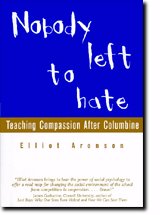

    There's a brilliant book by Stanford professor and psychologist Elliot Aronson called Nobody Left to Hate. The idea behind the book is to deal with the aftermath of Columbine, not merely through proposing "quick-fix" solutions but through thinking about the long-term causes of the problem, and attempting to fix those as well. Aronson gives an example at the beginning of his book to demonstrate the way in which one should fix a problem. This is a quote from the review:

    "Aronson invites us to consider the steps that British epidemiologists took in the mid 19th century when confronted with a cholera epidemic. Upon determining that the cases clustered around a particular contaminated well, they first removed the pump-handle, so that no more water could be drawn from it. They did not stop with this measure, however; they then addressed the root cause of the epidemic, that is, the contamination itself, which arose from the proximity of latrines to the water supply. In analogous fashion, Aronson acknowledges the need to curb media violence, enact more stringent gun-control measures, and in some schools perhaps even resort to the use of metal detectors (although, in the latter case he is quick to note that doing so increases rather than decreases the oppressiveness of the learning environment). But he insists that we must address the root causes as well and transform our schools in a more fundamental fashion. That is, we must take steps to curb taunting and ostracism, to develop empathetic skills and values in students, and to create learning environments that actively encourage cooperation and tolerance. "

    This approach is one to be valued and encouraged. Not only is there a "quick-fix" solution, but one takes into account the long-ranging factors, terms and causes of a problem. Blame is only used as an avenue towards constructive criticism and not as a way to escape from the effects of a problem or situation.

    From Chapter 1 of his book:

      The need to blame is fully understandable. But if we truly want to address the problem, if we truly want to prevent future tragedies of this kind, then it is vital to make a clear distinction between two kinds of blaming: 1) The blaming that is aimed at finding the cause of the disaster so that we might come up with a workable intervention; 2) The blaming that is mere condemnation. Condemnation is a great indoor sport. It somehow makes us feel less helpless if we can unmask a culprit who we can then proceed to vilify. If we decide that the culprit is a school administration that was asleep at the switch, then we can demand that the school principal be fired. But firing a principal will not solve the problem. If we decide the culprit was lax parenting, then perhaps we can humiliate or sue the parents of the killers. But humiliating and suing the killers' parents will not solve the problem either. This kind of blaming is a simple knee-jerk response. It won't do us much good in the long run.

    Aronson is discussing Columbine, but his strategies can impact and affect our lives and situations as well. Most times, people assign blame as "mere condemnation." The comment that I addressed in this post, namely that referring to the "worst" people in America, simply assigns blame in a condemnatory fashion. The commenter does not discuss a plan in which to reform the aforementioned people, does not demonstrate ways in which we could attempt to fix [what the commenter views as] the problem. The comment is made in anger, lashing out at Hollywood and its morals/ values without considering the grand scheme of things, the good that Hollywood has done for us and the world, and the fact that there are far worse people in the world.

    What intrigues me most about Aronson's book, however, is his concept. It's extremely radical, and yet it is the same concept that exists within Judaism. As he put it,

      ...this book is about creating an atmosphere in which there is nobody left to hate. It is intended to provide parents and teachers with the tools to make schools more humane and more compassionate places, without sacrificing the basic academic material students are supposed to learn. There is nothing mutually exclusive about learning biology, literature, and calculus while also learning important human values. On the contrary, there is every reason to believe that the one will enhance the other.

    This is an incredibly radical concept. The idea that there could be a world where there would be "nobody left to hate."

    I do not believe that practically speaking, we will ever achieve a world where we all agree. I do not even think we will achieve a world where we will all listen to one another. And I do not really think that hatred can be eradicated from our world, at least not so long as existence continues in the form and manner that it always has.

    But I think this concept is worth thinking about. The concept of this book is that we could work to create- even within our small, limited or confined space, within our home or workplace or school- a place where there would be "nobody left to hate."

    Where people would be more "humane and more compassionate."

    I don't want to apply this concept to the entire world. But I would like to try to apply it to the Jewish community.

    I think that we can disagree with one another, even think that there are some people who are completely mad out there, and still not hate one another. Or at least, not hate one another because one person is Reform and one person is Orthodox. Because one person is homosexual and the other is a Hollywood actor. Because one person is an Atheist and the other Reconstructionist. Instead of trying to come up with labels to divide us all and separate us, instead of trying to compile and create lists of our differences, we should be focusing on the thing that unites us all.

    We are all of us Jews.

    And in the broader sense and scheme of things, we are all human.

    And there is a way, yes there is a way, that we could love each other even if we disagree. That you could be an atheist and think everything I do is foolish and outdated, or an agnostic and consider believing in God backward, you could be a fervent religious adherent, or you could feel reverence toward the beauty of our world but see it in ways different than I do. The name-calling, labels, distinctions and differences do not help us. We are all the same where it truly matters.

    We are all Jews.

    And since we share that common identity, since we share that fact, there must be a way to disagree with somebody's ideas without devaluing the person. Certainly, you might say that the person's ideas define the person. But I think that in a rational, well-mannered discussion or conversation, we should be able to distinguish between what somebody writes and the person himself. We should be able to say, "I disagree with your philosophy/ belief system/ values, but that does not mean I think you are worthless."

    We challenge the ideas without challenging the worth of the person.

    Have I always done this? No, I have not. And as I've said, I think there are certain situations that are exceptions to this rule- places where a person's actions define them insomuch as I can understand hatred of them. But I am speaking of smaller matters, like the way we converse. The way we use our words, both on the blogosphere and at home. The difference between being correct and generalizing.

    And I am also speaking about compassion.

    If we truly felt compassion and love for human beings, if we could mentally put ourselves in their shoes, there would be no way we could or would ever allow words that blame them, that categorize them as the "worst" people in America, to come out of our mouths. We couldn't say those words, because we would choke on them.

    Because we wouldn't be calling someone else- somebody detached from us and therefore unimportant- names. We wouldn't be calling outsiders, people who are different from us, unlike us, names. We would be calling ourselves names. We would be labelling ourselves, categorizing ourselves as the "worst people in America."

    We are supposed to judge people favorably. It is the hardest thing in the world to do. When I am frustrated, I have difficulty viewing people in a good light. I have difficulty excusing their actions, and I find that I am quick to categorize them as being a certain type of person. And then, one day, I see them perform some action/ do something amazing that makes me rethink my judgement of them, and realize that they are not necessarily who I thought they were.

    I want us to try. I want us- all of, at the very least those of us in the Jewish community- to try this. To try to love other people with a form of unconditional love in addition to conditional love. Love them unconditionally simply because they are Jews, love them despite the fact that they irritate you, they seem to be practicing the wrong philosophy, they don't agree with your ideas, they think you're foolish or any other seemingly petty reasons.

    Take the case of a murderer or idol-worshiper.

    He is not simply condemned to death. No! There is a trial, and there are many situations where he is set free. Even more remarkable and more interesting, it's almost as though we really want him to live. Look what happens:

      A MAN WAS STATIONED AT THE DOOR OF THE COURT WITH THE SIGNALLING FLAG4 IN HIS HAND, AND A HORSE-MAN WAS STATIONED AT THE DISTANCE YET WITHIN SIGHT OF HIM,5 AND THEN IF ONE6 SAYS, 'I HAVE SOMETHING [FURTHER] TO STATE IN HIS FAVOUR', HE [THE SIGNALLER] WAVES THE FLAG, AND THE HORSE-MAN RUNS AND STOPS THEM.7 AND EVEN IF HE HIMSELF SAYS, 'I HAVE SOMETHING TO PLEAD IN MY OWN FAVOUR', HE IS BROUGHT BACK, EVEN FOUR OR FIVE TIMES, PROVIDING, HOWEVER, THAT THERE IS SUBSTANCE IN HIS ASSERTION.

      Sanhedrin 42b

    But not only is a man deliberately stationed outside the door to instantly ride back and tell the court they must judge him again because he may yet save his life, the community is involved in this man's death as well.

      A MAN WAS STATIONED. R. Huna said: It is obvious to me that the stone with which one is stoned, the gallows on which one is hanged, the sword with which one is decapitated, and the cloth with which one is strangled, are all provided by the Community. And why so? Because we could not tell a man to go and fetch his own property to kill himself. But, asked R. Huna, who provides the flag for signalling and the horse on which one rides to stop them?18 Seeing that they are for his protection, must they be provided by him, or rather, since the court is bound to endeavour to save him, by them? Again, what of R. Hiyya b. Ashi's dictum in R. Hisda's name; When one is led out to execution, he is given a goblet of wine containing a grain of frankincense, in order to benumb his senses, for it is written, Give strong drink unto him that is ready to perish, and wine unto the bitter in soul.19 And it has also been taught; The noble women in Jerusalem used to donate and bring it. If these did not donate it, who provided it? As for that, it is certainly logical that it should be provided out of the public [funds]: Since it is written. 'Give', [the implication is] of what is theirs.

      Sanhedrin 43a

    I think the ideas expressed in this section are amazing.

    Because you would think nobody would care about the death of someone who broke the law. You might think we would consider him a sinner, deserving of death. You might think we would hate him, yell "Good riddance," once he dies.

    But no. Look at how we treat him.

    1. The Community provides the instruments of death, "Because we could not tell a man to go and fetch his own property to kill himself. "

    2. And because we do not want him to suffer so much, "he is given a goblet of wine containing a grain of frankincense, in order to benumb his senses, for it is written, Give strong drink unto him that is ready to perish, and wine unto the bitter in soul.19 "

    This is the man we might consider most deserving of our hatred- a sinner, an idol-worshipper or murderer who is to be executed! and yet look at the law.

    It would be a beautiful thing indeed if Jews would love other Jews- if we had a community where we cared about the death of the sinners as well.

    If we could ever reach the time where there was "nobody left to hate."


    Sunday, February 26, 2006

    The Broken Soul

    I have previously discussed Man's Creative Capacity/ Man as an Individual.

    Today I want to discuss the opposite- the ways in which people are hurt, controlled, ruined or destroyed by those that deny their individuality and attempt to do away with their ability to create.

    I want to make a very firm statement before I begin.

    I do not agree with, nor will I ever agree with, all of Ayn Rand's philosophy.

    Ayn Rand's ideas are not always articulated perfectly, sometimes she contradicts herself, her word is a world of black-and-white and the characters are symbolic rather than human. She believes in a conqueror's, rapist's love as the ultimate form of worship, and oftentimes finds herself in a bind because her phraseology does not hold through. I am aware that there are problems with her ideas and her worldview, that she held a deep and personal hatred towards Communism and Marxism, and that sometimes her definitions- of happiness, of love, of whatever it may be- are shallow.

    However, I still feel that there is much to be learned from her.

    How is that possible? In the way of a parable. Ayn Rand sets up the kind of world that exists in the world of fables and parables, stories with morals. Her morals are uplifting. Her ideas are well-meant.

    And her villains' speeches are disturbing- because they are so true.

    If you have the time to read the entire speech, then you should download and read Ellsworth Toohey's speech here: Ellsworth_Toohey_Power_speech.doc

    If you don't have the time to read the whole document, then look at the important parts over at this website. Scroll down past the bullet points, and read the excerpts from the actual essay.

    These are the ways, according to Ayn Rand, to break a man's soul.

    1. "Make man feel small. Make him feel guilty. Kill his aspiration and his integrity...To preserve one’s integrity is a hard battle. Why preserve that which one knows to be corrupt already? His soul gives up its self-respect. You’ve got him. He’ll obey. He’ll be unclean. "

    2. "Kill man’s sense of values. Kill his capacity to recognize greatness or to achieve it...Don’t set out to raze all shrines—you’ll frighten men. Enshrine mediocrity—and the shrines are razed."

    3. "Kill by laughter. Laughter is an instrument of human joy. Learn to use it as a weapon of destruction...Don’t let anything remain sacred in a man’s soul—and his soul won't be sacred to him. Kill reverence and you’ve killed the hero in man. One doesn’t reverence with a giggle. "

    4. "Don’t allow men to be happy. Happiness is self-contained and self-sufficient. Happy men have no time and no use for you....Bring them to a state where saying ‘I want’ is no longer a natural right, but a shameful admission."

    5. "It stands to reason that where there’s sacrifice, there’s someone collecting sacrificial offerings. Where there’s sacrifice, there’s something being served. The man who speaks to you of sacrifice, speaks of slaves and masters. And intends to be the master."

    6. "Don’t say reason is evil- though some have gone that far and with astonishing success. Just say that reason is limited. That there’s something above it. What? You don’t have to be too clear about it either...You tell him that there’s something above sense. That here he must not try to think, he must feel. He must believe. Suspend reason and you play it deuces wild. "

    7. "A world in which man will not work for so innocent an incentive as money, but for that headless monster- prestige. The approval of his fellows- their good opinion- the opinion of men who’ll be allowed to hold no opinion."

    8. "Let all sacrifice and none profit. Let all suffer and none enjoy. Let progress stop. Let all stagnate. There’s equality in stagnation. All subjugated to the will of all."

    ~

    That was the world of Ayn Rand. Now let's apply it to the Orthodox Jewish world of today. Of if you won't go that far, let's apply it to Templars.

    1. This is what Orthodox teenagers, at least the ones that I know, are taught all the time. Guilt and more guilt. Guilt because you don't dress modestly enough. Or because you talk to boys. Or maybe because a boy is being bittul Torah. Possibly guilt because a boy masturbates. Who knows why? The emphasis is always negative, always mussar, always explaining why we are bad or are not on the level of the generations before us. Guilt is our mantra. It chains so many teenagers. It's the reason people won't speak up at Templars. Because they've been made to feel guilty. I...I am an exception. I would not feel guilty for crimes I did not commit. But staying sane when so many people are accusing you is hard. I don't know if I could have done it without my parents.

    2. We are taught- all of us teenagers are taught- that we will never live up to the Gedolim. That everybody is on a higher madreigah than we are. That all previous generations were more religious and better than we can ever be. Instead of focusing on the differences between us, instead of looking to our challenges and stating that we can be just as or even greater than they were in facing the problems and questions of our time, instead of teaching us to reach for the sky- they teach us never to try.

    But beyond that, I personally know how it feels to break because your teacher enshrines mediocrity. My English teacher at Templars used to take the "best" essays and papers from the class and pass them out so we could learn from them. Generally this wouldn't bother me. At my new school, my AP English teacher reads aloud from the best essays, and fosters a sense of good-natured competition amongst the classmates. At Templars, I watched my teacher pick extremely shallow, poorly-written papers- and hold them up as examples to everyone. I watched her enshrine mediocrity. This is not only frustrating, not only hurtful, but it truly does break a person's soul. I know it.

    3. Mockery. I cannot tell you the number of times I have been told that I take myself too seriously. The number of times people have poked fun at me and my views, telling me that I am just a child, just a little girl or teenager who is "confused" and needs to have more fun. Everyone is so quick to laugh nowadays. Many times, that laughter destroys your own soul.

    4. Men are allowed to desire, to say "I want" and work for that goal. One cannot take the posessions of another- one cannot steal, or covet the wife of another- but there should be no harm in desire. And yet, so many Templars teachers preach sacrifice, telling us we should give up what we want to make another person happy. There are certain instances when this is understandable. Most times, however, it is not.

    5. "For the good of the class, Chana, you need to stop rocking the boat..." "For the good of the class, Chana, you need to bring these questions up later..." "We have to go on, now, Chana; you can write down your questions and bring them to me..." "You can't switch to another class, Chana; it will send a message that the teacher is incompetent..." When someone- when a human- asks you to sacrifice something, they do not ask it of you without a motive, and most times that motive is wrong or cruel. I have to sacrifice my curiousity, my desire to learn, or my desire to be challenged "for the good of ________."

    6. This is the typical "Accept, don't question," approach. Templars teachers, and most Orthodox teachers, have a very difficult time saying, "I don't know." Admitting ignorance is one of the hardest traits to master, but all good teachers share this trait. To state that there is something above reason or above a child's question, to answer, "God said so, that's why" is no answer at all. If you do not know, you do not know- and that in itself is an answer.

    7. So much in the Orthodox world revolves around the way we are seen and perceived. "This above all- to thine own self be true," Polonius tells Laertes in Shakespeare's play Hamlet. How many people can really master this? How many people can really be true to themselves? Every day we are faced with concessions, questions of whether we are going to act a certain way to "fit in" or to earn another's good opinion, or whether we will act that way because it is truly how we feel. This is not meant to judge anyone. I can't say you are a lesser person because you compromise on certain things so as not to be kicked out of the community. I can say that there are certain times when one should not ever compromise- and there are very, very few who can say they have stood up for the truth.

    8. Equality. A wonderful idea that was stressed to me over and over again at Templars. I was supposed to feel sorry for people who weren't as bright as I was, as smart as I was; I was supposed to feel pity and compassion for them and therefore endure classes that were utterly dull and boring. I was supposed to understand that I was "three steps ahead of the speaker," so when he talked, I had to make amends for his statements and instead listen to his speech in terms of what he meant to say rather than what he really did say. I was supposed to realize that every person can teach me something- and that was enough of a reason for me to stay in a class where the teacher wouldn't even call on me because she felt so threatened by me. I was supposed to love each and every Jew.

    No. That's not equality. We don't have the same roles in the Torah. There are priests and there are levites. There are kings and there are commoners. There are Rabbis and pupils, students and teachers. We are not all equal. Korach's 'Common-Sense' Rebellion claimed that we were, and you can see how that turned out. We are all individuals, we combine to form a community, but we retain our individual identities. And stagnation as a form of equality is just not Judaism.

    Ayn Rand writes of Ellsworth Toohey, possibly the vilest character in all fiction. He speaks of how to break men's souls.

    So many marvel at the idea that today's youth are "turned off"Judaism. Oftentimes, we discuss the "lure of the modern world." But I ask you, if you don't teach your youth true Judaism, if you shelter them, if you break their souls in the aforementioned ways- why would they stay?

    They may not have the ability to articulate this, or it may be too personal for them to tell you.

    The broken soul...so that man comes to you, bearing the whip and chain, begging to be flogged.

    Does it horrify you? It makes me weep...
    But it is true.

    Saturday, February 18, 2006

    Judaism, the Bible and our World: Part II


    I want to clarify the differences between protection and sheltering.

    Protection is a specific move to protect your child or anyone from harmful influences for a certain period of time (or at least, that is the form that I am envisioning here) whereas sheltering is to never expose them to those influences.

    The best way to demonstrate this is through an example.

    When you have children, you childproof your house. You'll put outlet covers over electric outlets lest the child stick his/her fingers inside of them. You keep them away from the stove or oven. You keep an eye on them, and when you cannot, you put them inside of a swing or a playpen so that they are unable to wander around and hurt themselves. However, this protection exists for a limited amount of time, and there will come a time, when your child is older, that you will take off the outlet covers and allow him/her to cook on the stove.

    Sheltering, on the other hand, is when you don't even buy the stove. You won't have a stove in the house lest the child burn himself. You somehow live without electricity, because you're so worried about the electric outlets that you won't allow your children to ever have them.

    Sounds ridiculous, doesn't it?

    But this all-or-nothing attitude is exactly the way people think about institutions like the Internet, or television, movies, magazines, newspapers and the like. They feel that sheltering is the way to go, as opposed to protection. Where these same people are fully apprised of the fact that they need to eat, and hence need a stove/ oven, and must protect their children from burning himself on it, they are not similarly apprised of this fact when it comes to television and the like.

    Now, you may argue with me that a television is not a necessity, while a stove, quite practically, is. And you might be right. I would suggest, however, that knowing about world events- which include September 11, Tsunamis and Amona- is important. You might state that this idea is simply justification for having a television, and that I won't end up using the television to watch the news, but rather to watch Jerry Springer. But the type of person who argues this way is being a) pessimistic b) expressing the idea that s/he has no self-control c) expresses fear above all else. Fear that somehow the television is going to influence them against their will. That the television has some kind of magic, supernatural power, to hypnotize you and strip your ideas and values away from you. For some reason, they don't feel they are in control.

    It's the same idea when it comes to the Internet. There are plenty of people who use the Internet for business purposes, to stay in touch with friends, even for purposes of blogging, like we do. But there's the incredible lure and attraction of the Internet, isn't there? And parents are deathly afraid of the fact that their children are going to be sucked into it. Sure, there are some extreme examples of children meeting people in chatrooms and deciding to go meet up with them. But what is the Internet, really? It's a world filled with information. It's this information that so many people fear- once their children are exposed to other ideas, to alternate viewpoints, are they going to stay religious? You can't use a pop-up blocker or Weblocker to block that. So you shelter children, and refuse to allow them Internet access.

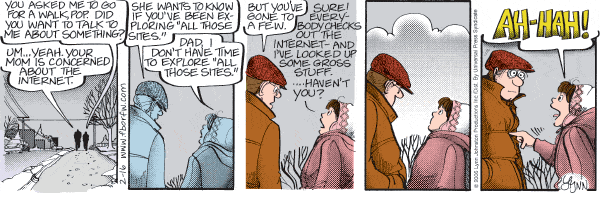
    And what about the people who are honestly worried about their children viewing pornography and other explicit sites? Well, you protect your children from this for a long time. But the key word is protection- and there comes a time for trust. I've been following the For Better or For Worse' comics lately, and they've really demonstrated the ideas that I believe in.


    This is the first really important thing to note. Children are curious. Teenagers are curious. So yes, it's probable that if you have the Internet in your house, at some point in time your child is going to see a picture of a naked woman. It may not even be intentional- there are a lot of cleverly disguised web addresses that lead to pornographic material. At some point in time, your child is going to learn about drugs, and alcohol, and all kinds of negative influences. Does that mean that your child is going to do drugs, or become addicted to pornography? No.


    You taught your children to be careful. You raised them carefully, intentionally deciding when to protect them and when to trust them. And do you see what she says? You taught me to make good choices. That's the end-all and be-all, the key phrase, the one idea that makes the difference between a Protector and a Shelterer.

    My parents are Protectors. They protected me from negative influences when I was young. Just because we own a TV doesn't meant that I was wined and dined on Primetime. As I already mentioned, I do watch TV shows, but I watch them now- now when I can separate people's actions from my own, when I understand that just because someone acts or speaks a certain way doesn't mean that that is the way that I have to act or speak. And as I formerly mentioned, the TV I watch, the books I read, the movies I go to- these all enhance my Judaism rather than undermining it.

    How can that be? Last time I gave you an example from Gone With the Wind. Here are some more examples.


    The Leonardo DiCaprio version of The Man in the Iron Mask is a brilliantly designed movie that deviates from the book by Alexandre Dumas. What is extremely interesting about it, however, is how it deviates. With a plot detail that occurs nowhere in the book by Dumas, we see the influence of the Tanakh, once again. Which story is displayed? Why the story of Bathsheba, David and Uriah.

    From the IMDB writeup:

    "One day on a royal party, the young and unliked king gets a crush on Christine. This young lady is the fiancé of soldier Raoul, the son of Athos. Without further ado, the king has Raoul recruited and sent to war, so that he himself can take care of her. Soon Raoul dies in combat and the king has him out of the way. "

    Take a look at Samuel II, Chapter 11 and then watch this movie. You'll be astonished by the similarities, down to the very fact that the King (DiCaprio) writes a letter stating that Raoul should be sent to the forefront. Later on Christine (who has become his mistress) confronts a very confused lookalike (the Man in the Iron Mask) about his cruelty.

    Another example can be seen when you consider King Ahab and King Jehosaphat's conversation (about prophets). Ahab says something very interesting in Kings I 22:

      8 And the king of Israel said unto Jehoshaphat: 'There is yet one man by whom we may inquire of the LORD, Micaiah the son of Imlah; but I hate him; for he doth not prophesy good concerning me, but evil.' And Jehoshaphat said: 'Let not the king say so.'

    Guess where else I had seen that before? Where a king knew that the man spoke the truth, but resented his bad news/ incessant tidings of evil? That would be- the Lord of the Rings, specifically 'The Two Towers.'

      Slowly the old man rose to his feet, leaning heavily upon a short black staff with a handle of white bone; and now the strangers saw that, bent though he was, he was still tall and must in youth have been high and proud indeed.

      'I greet you,' he said, and maybe you look for welcome. But truth to tell your welcome is doubtful here, Master Gandalf. You have ever been a herald of woe. Troubles follow you like crows, and ever the oftener the worse. I will not deceive you: when I heard that Shadowfax had come back riderless, I rejoiced at the return of the horse, but still more at the lack of the rider; and when Eomer brought the tidings that you had gone at last to your long home, I did not mourn. But news from afar is seldom sooth. Here you come again! And with you come evils worse than before, as might be expected. Why should I welcome you, Gandalf Stormcrow? Tell me that.' Slowly he sat down again in his chair.

      [Wormtongue speaks here] ...Why, indeed should we welcome you, Master Stormcrow? Laithspell I name you, Illnews; and ill news is an ill guest they say.' He laughed grimly, as he lifted his heavy lids for a moment and gazed on the strangers with dark eyes.'

      JRR Tolkien, The Two Towers, Page 138-139

    This entire incident is explained still more clearly if you read Oedipus Rex by Sophocles.

    King Ahab makes a statement after Michaiahu tells him the statement that he really wants to hear- that he should go up:

      16 And the king said unto him: 'How many times shall I adjure thee that thou speak unto me nothing but the truth in the name of the LORD?'

    But when Michaiahu does tell the truth, the king is extremely angry with him and throws him in jail on a bread-and-water diet until he (the king) returns from battle.

    That's very similar to what happens with Oedipus.

    Oedipus is speaking to the seer Teresias and says:

      OEDIPUS
      Oh speak, Withhold not, I adjure thee, if thou know'st, Thy knowledge. We are all thy suppliants.

    but he is enraged by what Teresias tells him, and states:

      OEDIPUS
      Must I endure this fellow's insolence? A murrain on thee! Get thee hence! Begone Avaunt! and never cross my threshold more.

    And a full reading of the play just brings more similarities to the forefront.

    And now we come to a work written by an avowed Anti-Semite, Tolstoy. You can learn Torah from an Anti-Semite? Well, you would be surprised.

    Take a good look at Leviticus 26:8 and Leviticus 26:36

    Leviticus 26:8 here:


      ח וְרָדְפוּ מִכֶּם חֲמִשָּׁה מֵאָה, וּמֵאָה מִכֶּם רְבָבָה יִרְדֹּפוּ; וְנָפְלוּ אֹיְבֵיכֶם לִפְנֵיכֶם, לֶחָרֶב.
      8 And five of you shall chase a hundred, and a hundred of you shall chase ten thousand; and your enemies shall fall before you by the sword.

    and 26:36 here:


      לו וְהַנִּשְׁאָרִים בָּכֶם--וְהֵבֵאתִי מֹרֶךְ בִּלְבָבָם, בְּאַרְצֹת אֹיְבֵיהֶם; וְרָדַף אֹתָם, קוֹל עָלֶה נִדָּף, וְנָסוּ מְנֻסַת-חֶרֶב וְנָפְלוּ, וְאֵין רֹדֵף.
      36 And as for them that are left of you, I will send a faintness into their heart in the lands of their enemies; and the sound of a driven leaf shall chase them; and they shall flee, as one fleeth from the sword; and they shall fall when none pursueth.

    Now for Tolstoy, specifically his masterpiece War and Peace:

      ...no one can gauge the force of a detachment. Sometimes- when there is not a coward in front to cry: "We are cut off!" and start running, but a brave, spirited man who shouts: "Hurrah!"- a detachment of five thousand is worth thirty thousand, as at Schongraben, while at other times fifty thousand will flee from eight thousand, as at Austerlitz."

      Page 775

    And then there are the famous lines from Deuteronomy 8:17 (kochi b'etzem yadi) that Tolstoy utterly and brilliantly refutes:

      During this entire period Napoleon, who is represented to us as the leader of all that movement (just as the figurehead on the prow of a ship may seem to a savage to be the power guiding the vessel), acted like a child who, holding onto the straps inside a carriage, imagines that he is driving the vehicle.

    So- to those of you who fear the influence of the secular world, to the Shelterers, to those who cannot have a stove or oven for fear that the child will burn himself- I say, you set yourselves up for disaster. By removing and refusing access to ideas you stop your children from thinking, by sheltering rather than protecting you do not allow your children the most basic coping skills, and moreover, you prevent them from seeing the beauty of their religion reflected by the secular- which is something that is vey prevalent in our world. The secular strengthens us; it does not destroy us- but so long as you shut it out and pretend it does not exist, you teach your children that it is destructive and antithetical to the Torah. You let them believe there is something that the Torah does not understand or include, something outside of God's jurisdiction. You teach them to fear, to believe they have no self-control. You teach them that all that is secular is evil.

    You prevent the publication of books like Making of a Godol because it states that men you view as great and holy read books, secular books and classics- and did not ban them. That- could it be possible- they drew strength from them.

    You ruin yourselves through this persistent sheltering...because you deny yourselves the beauty of our world, and the beauty of God and our religion reflected within it.

    But you don't see it this way. And there is no one who can persuade you of this.

    You have closed your ears. Stopped them up with wax, like Odysseus/ Ulysses did.

    But wait. You don't know who Odysseus/ Ulysses is. Because he's in a book with pagan gods, and of course you would instantaneously ban that. In fact, you've even tried to ban history. I remember some of you calling the principal when I was in sixth grade, complaining that the teacher was teaching us about polytheistic religions. So the teacher had to skip that unit in history.

    When is this going to end? When are you going to see that blocking everything out, pretending that works of literature, that movies, that the Internet does not exist or is an unholy seductive demon- is incorrect? When are you going to see?

    I don't know.

    Because you are all very good at engaging in smear campaigns against anyone who is more open-minded. As in people who don't rewrite history. Or read classic books. Or even watch movies.

    And who draw strength from this. And find God in this.

    No. You don't understand it. You don't even give it a chance.

    And you never will...

    Tuesday, February 14, 2006

    Speakers of the Truth

    I never realized before.

    I have just returned from my Tuesday night 'Jewish Business Ethics' class at TI.

    And I am crying.

    Tonight we saw a movie about whistleblowing. Whistleblowing is usually looked on as a negative trait, an informer, a traitor to his company or his kind. But under certain conditions, when whistleblowing arises out of a desire for truth rather than spite and hatred, it is not only something good but it is heroic, something dazzling and wonderful, something that can only be reached by those who are truly motivated for the good.

    We watched a movie entitled 'The Perils of Whistleblowing.' I didn't know the title at the time, but came home and looked it up. It was made by Mark Wallace, in accord with the History Channel. It is shocking.

    It is more than shocking. It is one of the most powerful movies I have ever seen.

    What is it about?

    From here, so that you may see:

      The Perils of Whistleblowing(1996) A Mike Wallace 20th century CBS program focuses on some high-profile whistleblowing incidents, including the Challenger O-ring disaster, the Brown & Williamson insider expose, GM’s surreptitious investigation of Ralph Nader, unsafe nuclear reactor situations, Silkwood, and defense analyst Fitzgeralds’ efforts to highlight fraudulent waste and overruns in the Air Force. The whistleblowers all seem credible in their charges. Virtually all of them were subjected to attempts to discredit and destroy them. Often careers were shattered. Despite a subsequent congressional whistleblowing law, the message is clear: become a whistleblower and face probable destruction of the messenger.


    I never realized before.

    I never realized there was a system, an actual, physical system, a way in which to unleash a smear campaign, to pour venom and hatred upon people. That people planned this. That people could lie so blatantly. That they could expend so much effort and energy in discrediting people who had been trying to tell the truth.

    I have difficulty believing that there are truly evil people in the world. I want to believe- I want so much to believe- that my teachers at Templars were uninformed of all the harm they did. That it was all unintentional. That they never intended to cause me so much pain. That they truly did not and do not understand.

    I want to believe in human goodness.

    And to an extent, I can. To an extent, I do believe that humans have the capacity for goodness. I believe that people desire to be good.

    But watching the video, seeing the enginners who knew there was a problem with the Challenger and hearing them speak...seeing that one of them had an actual memo in writing that said that if the problems were left unfixed something "catastrophic" would happen, and would result in the "loss of human life," seeing these men who have tears in their eyes as they describe how happy they felt when they saw they were wrong, that the Challenger was fine- and then seeing them describe what they felt when they saw the accident, how one of them returned to his office, closed the door, and just cried...seeing this, I feel such anger towards the needless waste of human life.

    And I feel so much sadness for this man whose life was summarily ruined, for his company shunned him, his managers had nothing to do with him, he was slandered and known as the man who caused the death of the seven people on the Challenger, his children grew up hearing him persecuted and hated, he had to sell his house in Utah and leave...seeing this, I wonder at the strength of these people, and bow my head before them.

    I look at the man who resigned from his job as head of a department with regard to nucler regulations, stating that at the moment Indian Point Three (the nuclear power plant) was not acting up to regulations, that he was very concerned about its performance and he felt that ultimately it would lead to disaster...seeing him, and then seeing the head of the entire company speak about the fact that this "young man should have expressed his concerns to his supervisors before making his pledge (i.e. resigning)"...and then seeing the response as the man states that he tried, he tried in every way he could, he attempted to talk to his supervisors and boss but was told to keep everything "low-key" and not to inform the public...

    Or the man working at a tobacco company who unmasked the fact that they knew very well nicotine was addictive and that cigarettes caused cancer, that the company deliberately was chemically producing an effect on the cigarettes so that the nicotine would act faster and people would rely more and more on their "fix"...This man was fired, and the head of the company blatantly lied to Congress, stating that he did "not believe nicotine was addictive..." What ensued was a slander campaign, a 500 page book talking about the fact that this whistleblower was a wife beater, an abusive husband, and a shoplifter, allegations which the Wall Street Journal later said was based on "scanty and contradictory evidence." This man was hunted, his children were targeted, his name was blackened, and why? Because he had tried to tell the truth....

    I had never before realized people could be so evil, so malicious, so cruel...to deliberately pretend they knew nothing, to state that their former employee was a liar and an abusive man, to drag his private life into a public case...When asked whether he (the whistleblower) would do it again, he hesitated. Sometimes he thinks he would not, because the cost was so high, but there are other times when he feels that he was compelled and would again have been compelled to tell the truth.

    There is a system, an actual system at work to discredit people, to make them into liars and fools, into criminals and people looking for revenge...there is a system to abolish truth in favor of falsehood.

    When I saw this movie, I was so emotionally impacted by it that I could not speak when it was time to leave. I was amazed by the seemingly careless responses of my classmates, people who did not intend to be crass or rude but who stated that the movie "was interesting" or said that "it was so sad" but then promptly forgot about it and began speaking about more interesting things, such as gossip, fashion and homework assignments.

    Sad? Sad does not describe it. These people, all people who stood up for the truth, were destroyed because of what they dared to say. Painted as heroes by the media, did we defend them? Did we protect them? Or did we forget them, and hence condemn them to the miserable, haunted lives that so many of them have led?

    It is difficutl to stand up for the truth, to stand alone, a figure who will not be believed, a figure who will be persecuted and hated.

    And so I bow to them.

    Because I realize- on a much smaller scale- how difficult this is. And because I hope that during my life I have the courage and strength to be as truthful, as strong, and as unrepentant as they are. Because I hope never to give in, never to succumb, never to be pressured into a situation where I give up my ideals, my values, and my concept of myself...because of fear.

    The only one I truly fear is God. There is no man who can hurt me- unless it is me, unless I betray myself.

    My father comforted me. For these men- these men who were persecuted and hated- are the men who can sleep at night. The men who know they did the right thing. These others, these vile creatures who preach falsehood and destruction, cannot rest easy with themselves. For they know- in their heart of hearts, they know. And it cannot be a pleasant knowledge.

    There are so many of us who have suffered at the hands of the Orthodox Jewish educational system. And while this is small in comparison to the types of scandals and truths that the men on this video revealed, we too must do our part. We know what has happened, what has been permitted to happen. And we must, must speak. Without fear of man and his ability to take revenge. Without fear of anyone but God.

    God is my judge, and He knows what I speak is true.

    We must accuse. And we must tell the truth, piece by piece, slowly and carefully. Each person must speak, for one individual may take a stand, but ultimately he will fall- fall prey to the campaign against him, the "dirt" that others have dug up on him. What you have seen and what you know.

    Because if we speak- if I speak- then those who are to come will not suffer the way I did, the way you did. We will have prevented a great and terrible tragedy- a tragedy that grows ever closer.

    It is difficult to be a whistleblower. It is difficult to tell the truth.

    I hope that I may be as worthy as these men and women were. I hope that I withstand temptation so that I too may speak. I hope that I will not fall prey to cowardice.

    I bow to them. Because it is in these people- in those that speak truth, and have been ruined because of it- that we see God.

    Friday, February 10, 2006

    Judaism, the Bible and our World: Part I


    I have often heard it said that the reason we cannot read secular books, watch secular movies, or have close friends who are gentiles is because we will be corrupted, our Judaism will fail, we will suddenly see the lure of forbidden fruit, and lusting for it, we will no longer be believers or adherents to our religion. Can this be proven? Possibly. But why does it happen? That is what I will attempt to answer.

    I would warrant that one of the main reasons this happens is because through sheltering your children, you raise them to be completely inept and incompetent when it comes to society and the "outside world." They cannot work in offices unless they are run by Orthodox Jews. They cannot survive college because there are members of the opposite sex there, and many times campuses run high with anti-Zionistic fervor. They can only speak in a dialectic that is curiously strewn with Yiddish and Hebrew phrases; these people who are born in this country cannot even articulate their thoughts in English. They do not know how to defend or discuss their own religion, and they are raised with certain prejudices that they have never concerned. In short, by refusing to allow children access to the world, you limit them immensely. But it is more than limitation. Sometimes, you utterly destroy them.

    As an adult, you are given a task- to raise your children in the way you think best, and that conforms to state laws. My parents spent a lot of time simply learning how to raise children: what impacts a child, a child's emotional feelings, a child's self-expression, and a child's method of learning. They read stacks of books, took certain families as their role models, observed different people's parenting styles, and truly thought through their actions. I am amazed by the responsibility they felt, and the fact that they invested so much effort in figuring out what approach to take with each of us, which way to treat us, how to punish and reward us, and how to explain different ideas to us. Each of the four children in my family is different, and we all value different things and different concepts. I am more introverted, enjoy reading and writing over social activities. But I can also be spontaneous, happy and free, running through the snow and looking up at the twinkling lights. My everyday conversation focuses more on books I've read that have made an impression on me, or on ideas I've thought of, or opinions that I have than on what happened at school that day. I'm more analytical and creative than I am mathematical and scientific. I don't like to deconstruct everything, but I am detail-oriented. Hence, I am a mixture~ I like details but find it important to regard ideas in a holistic fashion, I adore fairytales and fantasies, fiction being my favorite genre, and dislike being limited by my surroundings or personal failings (whether these be classmates who do not understand me or my inability to understand math.)

    My sister is different from me. Younger than I am, she is intelligent, clever and happy. She would prefer to spend the day with her friends (of whom she has many; she is constantly on the phone) at the mall, while I am perfectly happy sitting at Barnes and Noble reading an interesting book. Extremely extroverted, she is also more of a "doer" than I am, taking charge of different situations, organizing get-togethers and sleepovers, one of the popular children within her own set of friends. She likes animals (especially horses) and although she likes books, she is not as interested in classics or philosophy, opting to read a fun book over a difficult one. Her personality is grounded more in emotions than in ideas, unlike mine, and her fiery spirit contrasts with the water or earth that would describe me. She's also more skilled in actual upkeep and housekeeping abilities- she cooks dinner sometimes, she washes the dishes frequently, cleans the whole house, does the whole laundry, and instills the fear of God into anyone who has not done their part. She is more tempestous and headstrong than I am, her wavy auburn hair accentuates her personality. I am her opposite, but in my own way I am just as, if not more stubborn.

    My parents raised us to be curious, to desire to learn about the world around us. One of the reasons I refer to myself as 'The Curious Jew,' is because I, the oldest child, was raised in exactly that fashion. My father decided not to teach me the alphabet or how to read; he didn't value accomplishments like that so much as a child's natural intelligence, curiousity and wonder. What most characterized my chidhood was my imagination. I was extremely imaginative; I made stories for myself and told them to both my parents, acted out plays in which I was a character picking blueberries in the woods, danced and sang frequently, would repeat over the Rabbi's derasha after pounding the lid of my garbage can (which was sloped like a shtender), and could not spell or write my own name. When I first went to kindergarten my teachers were horrified by this fact, thinking that I was "behind" when in truth I had just been raised in a creative fashion. I think that the fact that I was raised this way has really helped me, and is reflected by my talent for English, Chumash and literature, all of which involve both analytical and imaginative thinking.

    I was never limited. My parents read me fairytales, especially Russian ones. I was raised on Baba Yaga, and my love for clever villains was instilled by her and her flying mortar and pestle. My favorite story was that of Vassilisa the Beautiful, specifically because of the brilliant dark images. I had my share of happy, colorful children's books, but I always the Russian illustrations, specifically this drawing:


    Image hosting by TinyPic

    Because I was raised with so much variety in my life, and because my education took the form of everything from The Little Midrash Says to Baba Yaga to Corduroy Bear, because I was raised to be imaginative, I think that I am able to say that I am the one person (or one of the very few) at Templars who could have made the switch I did.

    I don't say that to boast, but simply to state the obvious. How many other girls from Templars could have switched to a non-Jewish school and not gone dizzy because of the freedom that afforded them? Or have survived religiously? Or have continued to dress as they had always dressed, with the same standard of modesty? How many Jewish teenagers know who they truly are, and once being self-aware, know what they stand for? How many of them are curious, as opposed to being zombies, robots, programmed by their parents and schools to believe in certain things without ever hearing of the alternatives?

    My parents raised me in a very open house (although there were some limitations, and in some ways they were very strict) but the synthesis allowed me a knowledge and freedom that allowed me to discover myself as I am as opposed to who I was forced to be.

    Therefore, I want to make the following statement.

    If your Judaism is strong enough and you live in America (or any country that permits freedom of religion) there is no way your Judaism can be destroyed by "exposure" to outside influences unless you yourself choose to destroy it. You are in charge. The influences cannot rule you, but you can rule them. And many times, they are not even evil- rather, they are good, and helpful, and what is more, they demonstrate Judaism.

    This is actually one of the most fascinating things about our world- as far as I'm concerned. When I read, I cannot help but see God and Judaism in the subject matter. It isn't a conscious thought, it's not that I'm reading and thinking, "How can I make this Jewish?" but rather it's simply there. You can never be alone in the outside world, alienated and different...because the outside world oftentimes is not outside, but is simply an extension of the Bible that we learn.

    Here we go!

    From Gone with the Wind by Margaret Mitchell:

      "We need more gold and I am asking you for it," the doctor continued. "I am asking a sacrifice but a sacrifice so small compared with the sacrifices our gallant men in gray are making that it will seem laughably small. Ladies, I want your jewelry. I want your jewelry? No, the Confederacy wants your jewelry, the Confederacy calls for it and I know no one will hold back. How fair a gem gleams on a lovely wrist! How beautifully gold brooches glitter on the bosoms of our patriotic women! But how much more beautiful is sacrifice than all the gold and gems of the Ind. The gold will be melted and the stones sold and the money used to buy drugs and other medical supplies. Ladies, there will pass among you two of our gallant wounded, with baskets and-" But the rest of his speech was lost in the storm and tumult of clapping hands and cheering voices.

      Scarlett's first thought was one of deep thankfulness that mourning forbade her wearing her precious earbobs and the heavy gold chain that had been Grandma Robilard's and the gold and black enameled bracelets and the garnet brooch. She saw the little Zouave, a split-oak basket over his unwounded arm, making the rounds of the crowd on her side of the hall and saw women, old and young, laughing, eager, tugging at bracelets, squealing in pretended pain as earrings came from pierced flesh, helping each other undo stiff necklace clasps, unpinning brooches from bosoms. There was a steady little clink-clink of metal on metal and cries of "Wait-wait! I've got it unfastened now. There!" Maybelle Merriwether was pulling off her lovely twin bracelets from above and below her elbows. Fanny Elsing, crying, "Mamma, may I?" was tearing from her curls the seed-pearl ornmanet set in heavy gold which had been in the family for generations. As each offering went into the basket, there was applause and cheering..."

      Page 185

    Does this remind you of anything? I was in the middle of the book, and as soon as I came upon this passage, I was struck by its resemblance to:

    Exodus 32

    Judges 8:24

    Secular books and the outside world are not always bad. And this is certainly a quasi-classic secular book, at that. It is one's outlook that influences the way you see something rather than the work itself. You could think of Gone With the Wind and worry about immoral love stories. Or you could think of Gone with the Wind, appreciate the romance...and also learn something that is found in the Torah and Bible.

    One's outlook, and being raised with options. Not behind a veil, but free and dancing, coveting knowledge in all its various forms.

    Wednesday, February 08, 2006

    Mohammed, Cartoon Controversies, and Unreserved Violence


    Enmity sells. Hatred sells.

    At the moment, this takes the form of the uproar and brouhaha over the Mohammed/ Muhammed cartoons.

    Here is a link to the cartoons.

    And here is perhaps the most offensive one:

    Image hosting by TinyPic

    So, my view on the cartoons.

    This is wrong. This is vile, wrong and disgusting. There is no purpose in depicting the Muslims/Moslems' holiest prophet as a terrorist and bomber. If this is meant as social commentary, it is done in the poorest taste.

    We wouldn't want anti-semitic pictures about Jews circulating. We would not want to be defined by one radical, extremist faction. So in my opinion, the cartoons are wrong. And although they may be protected by free speech when it comes to the letter of the law, I think that when it comes to the spirit of the law, such cartoons can only provoke enmity rather than any kind of realization that certain tactics are wrong.

    Personally, therefore, I don't agree with Israpundit, who states that the Danish Newspaper is "courageous."

    However, the reaction of Moslems around the world is unfathomable by the logical mind. It is pure insanity.

    Take a look at Jameel's post about Insane Islamic Hatred, and you might wonder what the world is coming to. Or, as I discovered at S (On the Main Line), look at the fact that Iran has stated that it will engage in a Holocaust cartoon contest. Ezzie has a post about it as well, in which he includes a comic that I will show here.


    Image hosting by TinyPic

    That truly demonstrates how ridiculously out-0f-hand this situation has gotten.

    If anything, you would think tit-for-tat; you published a cartoon of Mohammed with a bomb in his turban; we'll publish a cartoon of Moses with a bomb on his head. But instead we head over for the Holocaust- an emotionally-packed issue- in order to get more responses and upset more people. That's a damnable kind of logic.

    Dry Bones isn't surprised by the extent of this hatred.

    DovBear writes about extremist supporters in the Gaza Strip who don't have anything that matters, but are busy burning Danish flags.

    More importantly, this anger over cartoons has run so far that extremists have burned the Norweigan and Denmark embassies. Police don't appear to have done anything about it...

    Because when someone accuses you of acting in a terroristic fashion...the best way to disprove them is to *eureka!* act in a violent and terroristic fashion.

    The idiots at the Danish Newspaper don't mind running the Holocaust cartoons.

    This is disturbing, upsetting and so on and so forth. In the end, I am left with two impressions.

    1. I am distinctly glad that I am Jewish, and that Jews (to my knowledge) have never engaged in aimless rioting, destruction and violence in order to protest cartoons/ comic strips, even though many of them have offered quite a lot of provocation.

    2. That, as my Art teacher said, this is extremely "disturbing and distressing" and doesn't bode well for the future of our society/ civilization. Or, as my fellow classmate said, "it's not that the world's gone suddenly insane- it's only that people are realizing it now."

    In the end, Calvin is right. Enmity sells. Enmity against Moslems, deciding to depict their holiest prophet in unsavory ways. Enmity against Denmark, and a boycott of all Danish goods. Enmity, no matter who it's against. Just enmity.