Munich
is the most deeply powerful, deeply affecting movie I have ever seen.
I am astounded that Crash received the award for Best Picture.
It makes the Academy Awards into a joke.
Spielberg is absolutely brilliant. The colors in which the movie is shot, the contrasts between the rich colors of the kitchen-store and gourmet meals as opposed to tense situations, the soundtrack, and the acting...astonishing.
Eric Bana...is astounding in this performance.
Avner is one of the most human characters ever relayed to the silver screen. His thoughts, his emotions, his reactions, and the subtlety of his characterization is remarkable. The scenes themselves are so subtle. This is not an over-the-top action movie; it is not high-minded and condescending or patronizing either. This movie asks questions.
I don't see how anyone could be upset that Spielberg compared the Palestinian terrorists to the Israelis. His comparison did not assign blame, unless it was assigned to everyone. It simply raised questions, difficult, disturbing questions. Everyone was human, no one was made into a caricature, an exaggeration, some black-and-white person. Everyone was three-dimensional. This movie is dark in tone, but it is definitely not anti-Israel, anti-Zionism, or pro-Intifada.
The scene that I found most chilling and most compelling was when Avner feels he's being hunted. He checks every room, looks under the bed for a bomb, disassembles his telephone, gouges open his television set, and slits his mattress. Then, still exhausted and soul-weary, he sleeps in the closet. There is a close-up of his face, and his expression is terrifying because he is so weary, his eyes red-rimmed and saddened, pain reflecting from his expression. When will this end?
I don't have the words to explain how much this movie moved me.
Thursday, May 25, 2006


Sunday, May 21, 2006
I'm done
When this blog starts doing more harm than good, then I'm done.
When this blog starts upsetting people for no good cause, then it's not fulfilling its purpose.
I've left up the posts that people may find important/ the ones people most commonly search for. I thank you for your kindness and your patience as readers.
I'm not sure what I'll do next. I might read but not comment. I might create a different blog. Who knows? One thing's for sure- this one is done.
When this blog starts upsetting people for no good cause, then it's not fulfilling its purpose.
I've left up the posts that people may find important/ the ones people most commonly search for. I thank you for your kindness and your patience as readers.
I'm not sure what I'll do next. I might read but not comment. I might create a different blog. Who knows? One thing's for sure- this one is done.
Tuesday, May 09, 2006
Oprah, Rwanda and Clemantine
If you watch Oprah, you may be interested in watching the show on May 24 or 25th.
That's when Oprah will speak to various essay winners.
Including Clemantine Wamariya, who goes to New Trier now but formerly attended my school.
Recently, I mentioned her story in a comment on DovBear's blog.
My transcript of her story (which may contain some inaccuracies) based on a speech she gave to my school last year, is available here. I don't know what she will be speaking about on Oprah's show, but no matter what it may be (I don't know how much time will be devoted to her), I believe it will be worthwhile. Her speech to me- to my school- was extremely powerful.
Below is her story (a reposting from my other blog.)
This is about the Rwanda genocide.
This is about the girl who goes to my school who survived.
---
Her name was Clementine. She was six years old at the time, and lived in Rwanda, where everything was beautiful, was wonderful. She was happy and her family was happy. There was no difference between the Tutsis and the Hutus, or at least, none that she could see. She went to kindergarten with all the other children, and together they played. Her mother always invited these children over to their house; it turned into a day-care center, really, after school. Her mother was the soul of kindness, always desiring to help other people- oh, they don't have salt, go give them salt, etc. Give them this and give them that.
Clementine describes her parents as being beautiful, wonderful parents. This is not a description teenagers often tender about those who care for them. She describes her mother, extremely spiritual, very Christian, a great believer in God.
And then, suddenly, overnight, everything changed.
This didn't happen long ago. This happened in 1994, when we were all alive.
Her mother came to her room, panicking, weeping. She clutched Clementine's hand, and her sister's hand, and said that they had to pray. "But why, mother, why?" Clementine kept on asking. What was going on? Her mother told her the president was being shot and tomorrow they were all going to die. But why?
Simply because they were Tutsis. They lived the Tutsi life, for though her father was of mixed blood, he was a rich man, and since he was rich, he was a Tutsi. Her mother was a Tutsi. And therefore they were Tutsis. They prayed, and that night everything changed. The three housekeepers, people she had trusted, left them that night. Left them because otherwise they would die.
Her father owned a taxicab company, and was very wealthy and well-known. Her mother was the soul of kindness. But everyone turned against them.
They hid for one, no, two, weeks. Hid in the house, eating off the food they had, starving. Then a friend of her father's came over and said he could only take the girls, it would be bad if he took the boys, because then they would kill him, but he could take the girls. Clementine's brother told her to think that everything was a movie; they were in a movie.
Clementine and her sister were sneaked into a car, hiding under piles of luggage. They drove swiftly, and all along was the stench and smell of the dead, even in the car, even though the windows were up, there was the smell of the corpses rotting away in the street. They were going to their grandparents, because they assumed that they wouldn't kill them. How could they kill them? They were too old. They got there, and found the rest of their aunts, uncles, cousins with them. They stayed there for a while.
They played different games, the children, to take their minds off what was happening.
Then one night her grandmother woke Clementine and her sister up. She screamed, "Get out, get out!" They jumped out the window, Clementine still remembers the little pants and sandals she was wearing. They ran, ran to the forest in the dark, and hiding in the dark forest they remained. Her grandparents and everyone else in that house- her aunts, her uncles- were all killed. Then she saw the house burning, and smelled the scorching bodies. She and her sister sat in the forest and watched them burn.
They walked. They walked for two days, these two children, one six and the other perhaps sixteen, at the oldest? There was no food, and no water, they were exhausted and hunted. They had to be quiet lest they attract attention. They finally came to a church and decided they would stop to rest in the church for a little while, because surely nobody would dare defile the church.
They opened the door and there were bodies; it was all piled high with bodies, and the confused six-year-old girl simply looked at the bodies. It was supposed to be a movie, her brother had said, but there were no cameras she could see; it was unreal, why was it happening. She wanted to die, she didn't want to live, she wanted to go back and burn with her grandparents in the house...
They hid in a corner of the church because they heard something; they heard footsteps. A man came into the church and asked whether everyone was dead, whether there was anyone left to finish off. He walked through the church; he looked straight at them. An overwhelming feeling came over Clementine, and she wanted to scream, I don't want to die, I don't want to die. Her sister told her to be quiet, otherwise he would see them. So she prayed...Did he seem them? Did he not? They do not know. He walked away, he walked out of the church, he did not kill them.
They stayed there maybe 20 minutes, how was it he did not kill them? They had to move, they had to leave before they were found, and so they left, and then her sister, after they crawled- walked some more, saw a sign, signifying the river that was the border between Rwanda and another place, where they could be safe. But the river was rushing, and fast, and there was no way they could swim it. Some men were in a boat, and they asked who these kids were, and the older sister had warned Clementine to be quiet and pretend she was deaf, so she answered they were walking to their aunt's house. The men allowed them to get in the boat.
Then...then...when they were in the middle of the river, one of the men lifted Clementine and pushed her into the lake. Pushed her in, a six-year-old, so that she would drown in the lake. She doesn't remember what happened; she only remembers awakening with her sister holding her hand, in the middle of the lake. Somehow, somehow, they were so cold, so cold, but they got to the other side, and walked some more, until they saw mango trees and they began to eat...starving, they fell upon them and tried to gorge themselves on mangoes.
They heard someone coming, and her brother had taught Clementine to climb, so she climbed the mango tree, and so did her sister. They remained there and looked down, where a family was walking. They didn't notice them, but then a little boy saw them and started screaming that there were people in the tree. They came down out of the tree and explained they were refugees to the family, who were living in the middle of nowhere in a little mud-grass-hut. They stayed with those people for a long time, there was no technology, they learned to care for themselves...Clementine remembers cooking over open fires, etc.
They then went to refugee camp, which was the worst experience in her life...being there with Hutus who had killed the Tutsis, being there amidst the death from all different causes, the death from disease or lack of shelter or hunger. Pure death. She shut her mouth and would not talk at all in the refugee camp, for two years she did not talk except to her sister, and then only with anger.
They went to many countries, to the Congo and many other places, and finally there was a kind of sponsorship through an immigration program that allowed her to get to the USA- a church or family needed to sponsor her here, and a church sponsored her, she lives with a member of the church. For a long time she believed she was all alone, had grown up alone, everything, everything had been taken from her.
But then, in the USA, one day they met a woman who knew her aunt, and had her aunt's phonenumber, and they found out her aunt was still alive. And a miracle- her parents, too, were alive, different, torn, having lost everything, leading a very different life, but alive. They had more children, too....they are still in Rwanda. Clementine has not returned to Rwanda, as of yet, she cannot in some ways.
But it was what she said later, when people asked her questions, that made the biggest impression on me. People asked her what made her survive, when she so wanted to die, when she truly hated her life. And she said, and this is her story and her life, not what you ought to do, but simply what she said- it was God. Her mother had taught her prayer and spirituality and God, and she believed in Him. She believes that He has a plan for her, the good and the bad, a master plan that is there for her. And someone asked her how she could believe in God after all she had been through, and she said that it had been very hard, and sometimes she asked herself how it was possible, but that she answered herself by showing her all the miracles- how was it she was alive? How was it the man in the church didn't see her? How did she survive the raging river, the currents that could have killed her in the lake? How did her parents survive? God is with her, He will always be with her...
And then she said that sometimes she hears us Americans says, " I have so much homework, I hate my life." And she said that although she understands what we mean, she wants us to remember that there are some who DO hate their lives, who suffer and feel pain and want to die. There is now a genocide going on in Sudan, and she feels that pain. And she wants, more than anything, simply to obliviate the difference betwen the Hutus and Tutsis and whoever else, because they are all people, and they all suffer, and nothing like this should ever happen...
And then...and then she stated something unbelievable. Not in a tone of confidence or pride, but someone asked her whether she had forgiven. She said it was a hard thing to forgive, you do not see someone kill your grandparents and forgive them. You do not remember corpses and forgive. But she said that she had forgiven, had fought so that she might forgive, and with that forgiveness had freed herself. Before she could not talk about it, but now she can. She can tell us of the spirituality of the good people who helped her, the Churches and her mother and prayer and God. She can tell us of the horror. She can tell us everything.
This is not my story to tell, but since I believe Clementine truly desires to end hatred, I think I can only help by typing this and allowing you, too, to see what she sees, and know what she knows. To see the strength that she had so that she might survive, that she might retain belief in God.
Today I saw a holy person. Perhaps I saw the holiest person I know.
And she is not a Jew.
And that is okay. Because she doesn't need to be a Jew to tell a story of such terrible grace and beauty, such magnified power, as to make me shudder, make me tremble.
Today I saw a holy person.
I pray that you might see her, too.
Sunday, May 07, 2006
The Next World

Not too long ago, DPChallenge hosted a challenge for digital photographers- the subject being the Afterlife. It was very interesting to see the different takes and views people had, and how they were able to express these beliefs through the medium of photograpy. The picture above won the blue ribbon for the challenge; it was the one that comforted or interested the most people. In some measure, this may just have been because of the technical skill or innovative setup, however, I think that the idea expressed- the reunion of the family unit- is what mainly drew viewers toward the picture.
I started thinking about the afterlife/ Olam HaBa/ the next world after this challenge. What is the Jewish view on the world to come? Do we even really know?
From here, it seems we do not:
- R. Hiyya b. Abba said in R. Johanan's name: All the prophets prophesied [all the good things] only in respect of the Messianic era; but as for the world to come 'the eye hath not seen, O Lord, beside thee, what he hath prepared for him that waiteth for him.'18
On the other hand, there are certain themes, motifs and ideas that are repeated and represented in terms of the world to come. I don't profess to understand them, but I thought I would represent them here.
1. Judgement-
- There will be three groups on the Day of Judgment: one of thoroughly righteous people, one of thoroughly wicked people and one of people in between. The first group will be immediately inscribed for everlasting life; the second group will be doomed in Gehinnom [Hell], as it says, "And many of them that sleep in the dust of the earth shall awake, some to everlasting life and some to reproaches and everlasting abhorrence" [Daniel 12:2], the third will go down to Gehinnom and squeal and rise again, as it says, "And I will bring the third part through the fire, and will refine them as silver is refined, and will try them as gold is tried. They shall call on My name and I will answer them" [Zechariah 13:9]... [Babylonian Talmud, tractate Rosh Hashanah 16b-17a]
- The school of Hillel suggested a more merciful view, in which the middle group are sent directly to Gan Eden (Heaven) instead of Gehinnom after death. Rabbi Hanina added that all who go down to Gehinnom will go up again, except adulterers, those who put their fellows to shame in public, and those who call their fellows by an obnoxious name [Babylonian Talmud, tractate Baba Metzia 58b]. Source here
Also,
- All the good deeds which Israel does in this world will bear testimony unto them in the world to come, as it is said, Let them bring their witnesses that they may be justified; let them hear and say it is truth. Let them bring their witnesses that they may be justified — that is Israel; let them hear and say it is truth — these are the idolaters.
And,
- R. Samuel b. Nahmani in the name of R. Jonathan also said: Every good deed that one does in this world precedes him and walks in front of him in the world to come, as it is said: And thy righteousness shall go before thee; the glory of the Lord shall be thy rearward.5 Likewise, every transgression that one commits clasps him and leads him on the day of judgment, as it is said, They clasp him in the course of their way.6 R. Eleazar said: It is tied on to him like a dog, as it is said, He hearkened not unto her, to lie by her, to be with her;7 [it is to say that] to lie by her in this world, [would mean for him] to be with her in the world to come.
2. Rewards-
A. The Shining Face
- (and I'm certain that the Little Midrash Says brings up an idea, somewhere, stating that one's face shines in accordance to one's learning- the brightest have radiant faces like the sun, the next like the moon, then there are those who glow like the light of the menorah...and hence one can tell one's level of learning from one's face.) I'm not sure if this is the source for that, but...
R. Judah, son of R. Simeon, expounded: He who emaciates25 his face for the sake of the study of the Torah in this world,26 the Holy One, blessed be He, will make his lustre shine in the next, as it is written, His countenance shall be as the Lebanon, excellent as the cedars.27
B. The Leviathan
- Likewise, Leviathan the slant serpent and Leviathan the tortuous serpent he created male and female; and had they mated with one another they would have destroyed the whole world.19 What [then] did the Holy One, blessed be He, do? He castrated the male and killed the female preserving it in salt for the righteous in the world to come; for it is written: And he will slay the dragon that is in the sea.20
and also stated here,
- Rabbah said in the name of R. Johanan: The Holy One, blessed be He, will in time to come make a banquet for the righteous from the flesh of Leviathan; for it is said: Companions will make a banquet of it.11 Kerah12 must mean a banquet; for it is said: And he prepared for them a great banquet13 and they ate and drank.14 Companions must mean scholars,15 for it is said: Thou that dwellest in the gardens, the companions hearken for thy voice; cause me to hear it.16 The rest [of Leviathan] will be distributed and sold out in the markets of Jerusalem...
C. The Crowns
- A favourite saying of Rab was: [The future world is not like this world.]19 In the future world there is no eating nor drinking nor propagation nor business nor jealousy nor hatred nor competition, but the righteous sit with their crowns on their heads feasting on the brightness of the divine presence, as it says, And they beheld God, and did eat and drink.20
D. Golden Three-Legged Tables
- Rabbi Chanina ben Dosa's wife said to him, "For how much longer are we to continue to suffer so much?" When he asked her what they should do, (she replied), "Pray to God for mercy that He provide us with something."
Rabbi Chanina ben Dosa davened for mercy and something like the palm of a hand miraculously appeared, and he was given one golden leg of a table. He (others have the version she) saw in a dream that in the future world, the righteous people are eating at golden tables that have three legs, whereas Rabbi Chanina ben Dosa was eating at a table with only two legs. He said, "Are you content that everyone else is eating at a complete (three-legged) table, while we eat at a defective (missing a leg) table?"
She said to him, "What shall we do?"
"Let us pray for mercy that they should take it back."
He prayed for mercy, and they took it back...
Ta'anit 25a
E. Justice
- R. Abbahu also said: Solomon was asked: Who has a place in the future world? He answered: He to whom are applied the words, and before his elders shall be glory.7 A similar remark was made by Joseph the son of R. Joshua. He had been ill and fell in a trance. [After he recovered], his father said to him: 'What vision did you have?' He replied, 'I saw a world upside down, the upper below and the lower above.'8 He said to him: 'You saw a well regulated world.' [He asked further]: 'In what condition did you see us [students]?' He replied: 'As our esteem is here, so it is there. I also [he continued] heard them saying, Happy he who comes here in full possession of his learning. I also heard them saying, No creature can attain to the place [in heaven] assigned to the martyrs of the [Roman] Government.' Who are these? Shall I say R. Akiba and his comrades?9 Had they no other merit but this? Obviously even without this [they would have attained this rank]. What is meant therefore must be the martyrs of Lud.10
3. Punishments (while there's an entire discussion simply about Gehinnom and its purpose, and about those who have no portion in the world to come, here are some explicit punishments)
A. Titus
- What I decreed for myself. Every day my ashes are collected and sentence is passed on me and I am burnt and my ashes are scattered over the seven seas.
B. Bilam
- He replied: With boiling hot semen.2
C. Sinners of Israel
- What is your punishment? They replied: With boiling hot excrement, since a Master has said: Whoever mocks at the words of the Sages is punished with boiling hot excrement.
All of these are from Gittin 57 (which has the very fascinating story of Onkeles communing with the dead)
4. The Dead and Our World
Are the dead cognizant of humans? There is a an extensive debate about this in Berakoth, beginning in Chapter 3, 18a. It starts with:
- R. Hiyya and R. Jonathan were once walking about in a cemetery, and the blue fringe of R. Jonathan was trailing on the ground. Said R. Hiyya to him: Lift it up, so that they [the dead] should not say: Tomorrow they are coming to join us and now they are insulting us! He said to him: Do they know so much? Is it not written, But the dead know not anything?19
They continue through various dreams (money hidden in forgotten places, children 'forgetting their learning' and wondering how their parents would respond, the story of the two girls, one buried in a shroud of matted reeds, whose discussions help out a pious man until they learn their words are being 'heard" in the world below...) and each "proof" brought is subject to argument, so it cannot conclusively be said the dead are cognizant of the living.
Relating back to the topic that brought on my curiousity about this subject- namely, the DPChallenge pictures- there was another evocative photograph that I personally connected to Ecclesiastes/ Koheles, even though the quote was taken from the New Testament.

"For what is your life? It is even a vapour," by mpeters
The above picture and this picture were my favorites.
What about you? What do you think of the afterlife/ the next world? Which picture do you find compelling?
Sunday, April 30, 2006
The Da Vinci Code aka What in Tarnation...?
As you may know, The Da Vinci Code, the controversial intellectual thriller by Dan Brown, has been made into a mass motion picture and will be coming to theaters on May 19th. I very much enjoyed the book and am looking forward to the movie.
I have a question, however.
Dan Brown begins his work by stating unequivocally: All descriptions of artwork, architechture, documents and secret rituals in this novel are accurate.
Now, since I assume Dan Brown doesn't really want to be sued by various religious groups, his scholarship can't be too shoddy. That's why I'm especially confused by this:
What?!
This defies words.
We had priestesses in the Temple? Not to my knowledge; I thought we had male priests who were levi'im. And the Shekinah as an equal God? Sorry, that's way off. Women made love in the Temple? First, that seems completely impossible, but more importantly, then wouldn't the whole Temple be considered tamay, impure?
Does anyone know what the source is for this belief/ supposedly secret ritual? Is it somehow accurate? If not, how is it that Mr. Brown has escaped complaint or suits from the Jewish community on account of misrepresentation (not that I necessarily wish that upon him?) I wish he had documented his sources, and I'd appreciate anyone who could explain this to me.
Update: The first results of this google search all describe the abovementioned statement/ quotation as an appalling error that is completely inaccurate. If so, I really don't understand Mr. Brown's seemingly over-confident statement that "all secret rituals described...are accurate."
I have a question, however.
Dan Brown begins his work by stating unequivocally: All descriptions of artwork, architechture, documents and secret rituals in this novel are accurate.
Now, since I assume Dan Brown doesn't really want to be sued by various religious groups, his scholarship can't be too shoddy. That's why I'm especially confused by this:
- "He gave her a moment. Admittedly, the concept of sex as a pathway to God was mind-boggling at first. Langdon's Jewish students always looked flabbergasted when he first told them that the early Jewish tradition involved ritualistic sex. In the Temple, no less. Early Jews believed that the Holy of Holies in Solomon's Temple housed not only God but also His powerful female equal, Shekinah. Men seeking spiritual wholeness came to the Temple to visit priestesses- or hierodules- with whom they made love and experienced the divine through physical union. The Jewish tetragrammaton YHWH- the sacred name of God- in fact derived from Jehovah, an adrogynous phyiscal union between the masculine Jah and the pre-Hebraic name for Eve, Havah."
In my version (the European paperback, purchased in Israel) this is on page 411
What?!
This defies words.
We had priestesses in the Temple? Not to my knowledge; I thought we had male priests who were levi'im. And the Shekinah as an equal God? Sorry, that's way off. Women made love in the Temple? First, that seems completely impossible, but more importantly, then wouldn't the whole Temple be considered tamay, impure?
Does anyone know what the source is for this belief/ supposedly secret ritual? Is it somehow accurate? If not, how is it that Mr. Brown has escaped complaint or suits from the Jewish community on account of misrepresentation (not that I necessarily wish that upon him?) I wish he had documented his sources, and I'd appreciate anyone who could explain this to me.
Update: The first results of this google search all describe the abovementioned statement/ quotation as an appalling error that is completely inaccurate. If so, I really don't understand Mr. Brown's seemingly over-confident statement that "all secret rituals described...are accurate."
Tuesday, April 25, 2006
Yom HaShoa: The Day of Remembrance
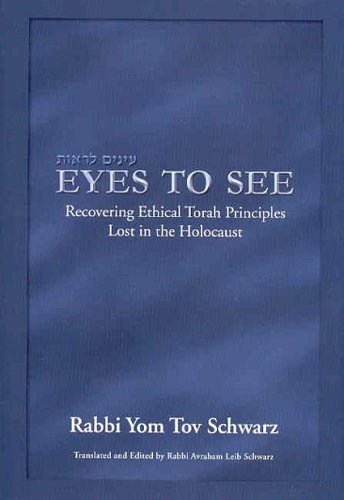
There are some who refuse to remember on Yom HaShoa.
The reason they give for refusing to remember is because they are busy quibbling about the date. "It should be on Tisha B'av!" they cry. "We cannot add a new holiday!"
This is one of the reasons Rabbi Yom Tov Schwarz's work, Eyes to See, is so desperately needed.
My father purchased this book for me. I found it to be purposeful- a book that is well-written, logical, obviously well-researched, told from the viewpoint of a man who is, above all things, compassionate.
It is his compassion that moves him to write, to cry out, to deplore the nonsense that so many grasp, to speak of meaning and halakha simultaneously.
Rabbi Yom Tov Schwarz does not merely think we ought to celebrate Yom HaShoa as a day of rememberance...he believes it ought to be a fast day.
He brings proofs for his opinion, cites historical examples, and documents his ideas clearly and effectively in a chapter titled 'The Failure to Establish an Annual Day of Mourning, Fasting and Repentance for the Holocaust is a Grievous Sin.'
He proffers proofs of all kinds- logical, historical and rational...but I wish to quote his emotional proof. I do not want to misrepresent him, and again state that if you are a rationalist, you will be more interested in his other ideas and proofs. I am more interested in this idea, however:
- To put this in perspective, let us examine the following response from the Responsa of the Radbaz (vol 3, no. 585), where he writes as follows:
- Question: One of the leading Torah authorities of the generation suffered the death of his son, and did not shed even a single tear over him. Is this a positive attribute, or not?
- Answer: This is indeed a negative attribute. It is indicative of hard-heartedness, and an evil quality of the soul. It is a trait of cruelty...Crying, mourning, and shedding tears for the passing of relatives- let alone for the passing of a righteous individual- is characteristic of the prophets, the saintly and the pious. Such behavior is indicative of the purity of one's soul, and of his humility before the Creator. He will then grieve over his sins, and mourn for his transgressions, which were a cause for this tragedy. It was not without reason that our Sages taught (Mo'ed Katan 27b): "Three days [following a death] are for weeping; seven (Shiva) for mourning; thirty (Sheloshim) for [the prohibition of] ironing and haircuts." Had weeping been considered unseemly, the rabbis would certainly not have instituted three days for this purpose. So too, with regard to Avraham Avinu a"h, the Torah states (Gen 23:2) that he came "to eulogize Sarah, and to weep for her." We find similar examples with regard to Yaakov, King David, and countless others.
I'm paraphrasing the next paragraph-Rabbi Schwarz infers that by the very nature of the question we can see that "the questioners were motivated by astonishment, for this behavior was strange, and unlike anything they had ever seen before." He describes that some might have thought the desire not to cry was to fulfill a very high spiritual level- similar to Aharon's silence upon the death of his two sons-but then continues to show the Radbaz believed that "reacting to the death of a family member in this manner is improper for a Jew, and indicative of a cruel nature."
Now, continuing:
- Now, if our master, the Radbaz, viewed one's failure to shed tears over the passing of his son as an indication of his cruelty, how much cruelty does one reveal when nearly one's entire family- brothers and sisters and, in some cases, even spouses and children, or parents and uncles and aunts- were gruesomely murdered with disgrace and degredation, their bodies burned together with the bodies of thousands of other holy ones, and their ashes scattered over the face of the earth. Yet a mere generation later, when marrying their son or daughte,r this post-Holocaust family spares no effort in making it the very biggest wedding, so that they will receive more glory and honor than other people, and squanders vast sums of money in order to emulate princes and counts, without even the slightest indication or reminder that in our own lifetime, this family and the entire Jewish nation suffered a great catastrophe. How can such pleasure, honor and glory be pleasant to him when he visualizes a single image from amongst the hundreds and thousands of horrible images during the days of the Holocaust?
Did not the prophet Jeremiah cry out (Jer. 8:23), "If only my head were water, and my eyes a fountain of tears, so that I could weep day and night for the slain of the daughter of my people!" Similarly, we find many instances in Megilas Eichah (Lamentations), in which Jeremiah weeps not only for the destruction of the Holy Temple, but also for the multitudes who were slain at the time of the destruction and the many horrible deaths that they suffered, as well as for the terrible travail that our forefathers endured, and the ensuing chilul Hashem (desecration of G-d's Name). More than 1,800 years later, our fathers had still not ceased to recite these lamentations each year on the bitter day of Tishah B'Av, as well as on each night, during Tikkun Chatzos, crying profusely all the while these prayers were recited.
Rabbi Schwarz explains why he believes a day to commemorate the Holocaust must and should be seperate from Tisha B'Av. But I think perhaps the more important thing for all to concentrate on is simply the fact that we ought to mourn.
There may be those who find the practice unecessary- who may dislike the idea of a separate day to remember the destruction and the strength we experienced through the Holocaust.
I think, however, that such people do themselves and their students a disservice by stressing the fact that "no, we cannot mourn on this day, we have to mourn on a different day." Does it matter? Does it truly matter? The fact remains the same- the Holocaust is when generations perished, where Jews, gypsies, political prisoners, homosexuals, cripples...all perished. This fact astounds us, confuses us; we are not sure how to understand it. But it must be through compassion- through suffering-through trying to comprehend the incomprehensible.
We are told we must relive the Exodus. We must remember ourselves as slaves, descendants of idol-worshippers, and then we must relive the glorious redemption as we underwent a transformative and long process- changing from the slave to the king.
Before we were kings, we were slaves. We cannot understand the Exodus unless we understand suffering.
And how much more so by the Holocaust.
At times we are repulsed, even disgusted by the pictures we see of emaciated men, standing by the concentration camps. Sometimes, in the back of our minds, we might think about these men, going quietly like 'lambs to the slaughter." We think that we wouldn't change, we wouldn't transform, surely we would have been among the heroes, the martyrs, the men who remained clean and decent and upstanding human beings.
And maybe we would have been. Maybe you and I could have retained our humanity. Maybe we are the ones.
And maybe not.
The most disturbing scene, for me, from Elie Wiesel's Night, has not been that of the fire and smoke, or even that of the corpses, but this one (page 95):
- Some years later, I watched the same kind of scene at Aden. The passengers on our boat were amusing themselves by throwing coins to the "natives," who were diving in to get them. An attractive, aristocratic Parisienne was deriving special pleasure from the game. I suddenly noticed that two children were engaged in a death struggle, trying to strangle each other. I turned to the lady.
"Please," I begged, "don't throw any more money in!"
"Why not?" she said. "I like to give charity..."
In the wagon where the bread had fallen, a real battle had broken out. Men threw themselves on top of each other, stamping each other, tearing at each other, biting each other. Wild beasts of prey, with animal hatred in their eyes; an extroardinary vitality had seized them, sharpening their teeth and nails.
A crowd of workmen and curious spectators had collected along the train. They had probably never seen a train with such cargo. Soon, nearly everywhere, pieces of bread were being dropped into the wagons. The audience stared at these skeletons of men, fighting one another to the death for a mouthful.
A piece fell into our wagon. I decided that I would not move. Anyway, I knew that I would never have the strength to fight with a dozen savage men! Not far away I noticed an old man dragging himself on all fours. He was trying to disengage himself from the struggle. He held one hand to his heart. I thought at first he had received a blow in the chest. Then I understood; he had a bit of bread under his shirt. With remarkable speed he drew it out and put it to his mouth. His eyes gleamed; a smile, like a grimace, lit up his dead face. And was immediately extinguished. A shadow had just loomed up near him. The shadow threw itself upon him. Felled to the ground, stunned with blows, the old man cried:
"Meir. Meir, my boy! Don't you recognize me? I'm your father...you're hurting me...you're killing your father! I've got some bread...for you too...for you too..."
He collapsed. His fist was still clenched around a small piece. He tried to carry it to his mouth. But the other one threw himself upon him and snatched it. The old man again whispered something, let out a rattle, and died amid the general indifference. His son searched him, took the bread, and began to devour it. He was not able to get very far. Two men had seen and hurled themselves upon him. Others joined in. When they withdrew, next to me were two corpses, side by side, the father and the son.
I was fifteen years old.
There are many who try to recreate the people from the Holocaust. They call them heroes. Martyrs. The sacred ones.
This is not who these men were.
They were frightened. Some were brutal, bestial, doing what they had to in order to survive. Others acted in a superhuman fashion and restrained themselves. They were all of them, all of them, victims.
They were scared, frightened, running from their children, trying to outrn their fathers. Family ties could not mean anything. Some were acting on instinct, struggling to survive in any way they can or could.
We are not their judges. None of us can judge them. There were many who refrained from this behavior; there ar emany who withstood. But there are others who became beasts.
And I think that perhaps this is the true sadness and reason to grieve for the Holocaust. We can tell ourselves fairytales and claim that everyone who died was pure and good and innocent. We can say that these people were all heroes by virtue of being persecuted. That isn't true. They were victims, and some of them discovered facets of themselves that were ugly and awful. When we cry about the Holocaust, we mourn the dead...and we also mourn these people. We mourn for the people who were transformed, through hunger, through beatings, epithets and propoganda...into animals. We could be them. Who knows what lurks within me? What I could and could not withstand?
The Holocaust is a subject that forces our tears, our questions, our anger with God. How could He allow this? What kind of God could this be? We have no easy answers; we have only our questions.
The Holocaust is also something that brings us together. Every Jew- no matter whether he is Atheist, Reform, Reconstructionist, Orthodox, Conservative, Humanistic or of any other affiliation- is united through our sense of tragedy.
As Rabbi Soloveitchik stated (source here):
- When representatives of Jews and Jewish interests kelapei hutz are involved, all groups and movements must be united. There can be no divisiveness in this area, for any division of the Jewish camp can endanger its entirety...In the crematoria, the ashes of the pious and those filled with praiseworthy deeds mingled with the ashes of radicals and freethinkers. We must jointly fight against the enemy who does not recognize the difference between one who worships and one who does not.
Today is a day of sadness. Mourning and remembrance for our brethren. Our grandparents. Our relatives. A day of reflection, of questions, of thoughts. A day to realize that we are united by our past. And a day to consider ourselves...as though we had been there.
Sunday, April 23, 2006
Reflections and Dreams

I've made up my mind as to where I'll be going to school.
So let's just say: See you in New York next year!
This past week, I spent a Shabbos at the University of Chicago. It was a beautiful Shabbos, and there were and are many ways in which I would grow as a Jew if I had decided to attend that school. The question is not whether I would stay religious if I went there- that is essentially a given.
The question became- or perhaps it always was- who is Chana? And what is important to her?
And I realized that challenging and honing one part of my mind would not be enough for me. I am a whole person, and as a whole person I need my Judaics. Rather, I need to be challenged Judaically. I can supplement my English studies; I cannot supplement my Judaica.
Which was hard. Because it meant letting go of a dream.
It meant looking at this dream-Chana, the dream-Chana who has the ability to dazzle the world, attend a famous and prestigious grad school, hobnob with intellectuals and future Nobel Laureates, looking at her and saying- No.
Not, "No, I will never do this." Not, "No, my life is ruined, I will never fulfill my dreams." Not even, "No, I cannot be as great as I wished to be."
Because I believe I can still fulfill this dream if I choose to do so. I can be the exception. I shall not be the typical or stereotypical "Stern girl." I will simply fulfill my dream differently.
It meant saying no to one dream, and replacing it with a different one.
Do I want the University of Chicago? Yes, I do. I love their academics, I love their people, I love their facilities, their amenities, their libraries. I want everything there. I want my dream-Chana. But the only way I could go there is if I weren't Chana.
The truth is- if I weren't Jewish I would go there in a heartbeat. Easiest decision ever made.
But what I realized is that not only am I Jewish, but I have the ability to give over Judaism. I felt like there was so much I could contribute to the Hillel there, if I chose to attend, and there was also a lot I would gain simply from being a part of that environment; eating Shabbos dinner with people of all different affiliations. But as I was thinking this, I couldn't help but realize, My God, if I can give this now, what could I give if I knew more? If I can be the teacher-the enthusiast- the individualist- now, then who could I be?
I felt it would be a crime to sacrifice that part of myself- the part that has the aptitude for Chumash and Tanakh. It would be...a waste. And it would leave me only half-fulfilled.
Because I could be...oh, I can be!...brilliant, when it comes to English. My education at U of C would have been brilliant. I would have been tested, challenged, prodded, forced to reevaluate my ideas and opinions- I would have been amidst my peers and equals, and I would have thrived.
But at what expense?
Last night was painful. I was mourning my dream. I let it drift away from me, flying up towards the sky, perhaps to stand before God. I saw myself as I could be...and I realized it could not be.
Perhaps the worst part is that I have made this decision myself. My parents had nothing to do with it. They said nothing. It was and is completely up to me. They were both completely shocked; they had assumed I would go to U of C. Everything I had stated pointed toward that conclusion.
We shall see. I'm going to Stern. I'm going to develop both parts of my mind. And I'm going to do my damndest to be brilliant, but it shall come about in a different way.
כב וְרָאִיתִי, כִּי אֵין טוֹב מֵאֲשֶׁר יִשְׂמַח הָאָדָם בְּמַעֲשָׂיו--כִּי-הוּא, חֶלְקוֹ: כִּי מִי יְבִיאֶנּוּ לִרְאוֹת, בְּמֶה שֶׁיִּהְיֶה אַחֲרָיו.
22 Wherefore I perceived that there is nothing better, than that a man should rejoice in his works; for that is his portion; for who shall bring him to see what shall be after him?
Ecclesiastes 3:22
Sunday, April 16, 2006
Colleges: Your Input Appreciated
I'd like your help.
I'd like you to tell me about your personal experiences at YU or Stern, what you know of the University of Chicago, what your criteria for college is (was), which other colleges you were considering (if you went to either YU or Stern) and your major.
If you'd like, feel free to remain anonymous so I don't associate you with the college you're telling me about. In addition, I'll keep in mind that some of the material may be dated/ things may be different, due to the fact that many of you are adults.
Please place the following in order from 1-10. (1 being the most important, 10 the least) How do you rank (in terms of making your or a college decision) the following?
__ Economic/ Monetary concerns
__ Convenience
__ Location
__ Diversity
__ Judaism (Jewish studies, population)
__ Social Life
__ Academics
__ Campus
__ Campus Facilities (dorms, beds, library)
Here is a list that I have compiled (you may not want to read this right off, because it might interfere with whatever it is you wanted to tell me):
I'd like you to tell me about your personal experiences at YU or Stern, what you know of the University of Chicago, what your criteria for college is (was), which other colleges you were considering (if you went to either YU or Stern) and your major.
If you'd like, feel free to remain anonymous so I don't associate you with the college you're telling me about. In addition, I'll keep in mind that some of the material may be dated/ things may be different, due to the fact that many of you are adults.
Please place the following in order from 1-10. (1 being the most important, 10 the least) How do you rank (in terms of making your or a college decision) the following?
__ Economic/ Monetary concerns
__ Convenience
__ Location
__ Diversity
__ Judaism (Jewish studies, population)
__ Social Life
__ Academics
__ Campus
__ Campus Facilities (dorms, beds, library)
Here is a list that I have compiled (you may not want to read this right off, because it might interfere with whatever it is you wanted to tell me):
| University of Chicago | Yeshiva University/ Stern Honors Program |
Judaic studies- none that would serve me, due to the fact that I myself am an advanced student comparatively | Many Bible, Tanakh, Talmud classes |
| English program is superior | English program is good, but not as excellent as that of U of C |
| Dorm facilities are beautiful- I can have a single if I’d like; a double at most | Four people in a room simply to start out with, and although I know one person I’d room with, I’m really more of a solitary creature |
| I can study in my own room, type, use my laptop, go to bed whenever I like | I must be considerate of other people. Also, the noise level is bound to be high, so I’ve heard from reliable sources that “staking out a classroom” is a better way to get homework done. |
| Location is Chicago, and not the best neighborhood at that | Location is New York, home of the big and the brave |
| The students are very intellectual, motivated, passionate about their learning, exciting and easy to speak with. | You can find your band of students, but on the whole the student body is united through religion rather than a shared desire to learn/ passion for learning. |
| The social scene (in the sense of the Jewish community) is very small, but workable. | The social scene is large and invigorating- there’s a good chance I’d like meeting new people with different types of Judaic thought. |
There is a kosher deli and supposedly they are building a kosher kitchen (for what would be my Junior year) but other than that and the Hillel, I’m on my own. | There are kosher cafeterias, restaurants; I don’t have to cook. |
I have to arrange taking tests due to my religious requirements (holiday restrictions) | Holidays are given off, no tests |
Saturday, April 08, 2006
The White Rose: Eating Disorders in (Orthodox) Judaism
I am very disturbed by recent articles that have been published under the titles, 'Thin is not a Mitzvah for Religious Girls' and Religious Girls More Comfortable with their Bodies. While factually it is possible (although I question that) that there may be a correlation, I think that articles like these do not serve our community well. After reading such an article, one may come away with the impression that one's child is "protected" or in some way immune to negative comments, peer pressure, body image, or feeling negatively about their weight, and this could not be farther from the truth.
Anorexia and bulimia are eating disorders that affect everyone, regardless of faith, race or gender, and therefore a study involving "320 religiously observant Jewish girls" is nothing to write home about. Using this study to talk about the many ways in which Orthodox Judaism has done away with glamorized versions of thin girls is completely ridiculous. It's not time for anyone to pat themselves on the back. Our community needs to be more open when it comes to eating disorders, for such topics are very much taboo in the religious world- people do not want to hear that their children suffer from these kind of disorders, they do not even want to believe that they are real. In the very heavily marriage-conscious Orthodox world, anorexia and bulimia are considered secrets, deep, dark skeletons in one's closet that cannot be addressed publically. This is a terrible thing.
Would you believe me if I told you that these concerns were never touched on, never discussed and never talked about while I was at Templars? Somehow our compulsive tzniut observance rated higher on the list of speech topics than our personal health. The only reason I am familiar with the concepts of anorexia, bulimia and the like is because my mother is a nurse and she purchased many reading materials about such topics for me. Denying that such a problem exists in the Orthodox community, or believing articles that claim such a problem has somehow bypassed our community due to our religious observance is unsafe and very damaging to a child who does suffer from either of these eating disorders.
I am so disturbed by the fact that people are treating these articles and studies as the undeniable truth that I am compelled to repost something I previously wrote, The White Rose.
The White Rose
This is for an Anonymous person- someone I know, and didn't know before. And someone who has made me a better person simply because I have now known her.
This is for someone I know who has suffered, in the past, from an eating disorder- anorexia that developed into bulimia. She is better now; she is well. She is doing beautifully, keeping busy and happy and possibly even stressed. But this is what happened in her past, a topic that is not often discussed within the parameters of the Jewish community, and certainly never discussed at that point in time.
___
She was the youngest of three daughters. The first daughter was the good child, a perfect one who could do no wrong. Ever since the time she had been a baby, she had never caused her parents a moment's worry. She did not walk until the age of two, and therefore never was under everyone's feet. She barely cried. She followed all the rules her parents laid down, went to school and was happy there, then went on to seminary. She was also, however, overweight.
The second daughter was the rebellious one, the one who broke every rule her parents laid down, who caused the most worry and trouble, who lashed out at school and was a daredevil. She was the one who got attention, who was noticed. She, too, attended a certain high school.
The third daughter- Anonymous- was lost in their shadow. She had gone to a very closely-knit elementary school, one where she had known everyone in her class very well, and more so, her parents had known everyone else's parents. There were only eleven children in her grade. From this elementary school, however, she was thrust into the chambers of torture- a high school that would have a grade of eighty students, twenty of whom would be in her class. She was going to attend that high school simply because both of her sisters had gone there before her- she had no choice in the matter. She wore hand-me-downs from her sisters- again, she had no choice in the matter. She never really seemed depressed or unhappy around the house, because she was the performer, the one who smiled and amused others. But in truth, she lacked coping skills- and she was thrust into the ultimate training ground- high school.
There she realized that her elementary school education had not been that good, and she was failing classes miserably. But not only was she failing her classes, she was suffering from tremendous culture shock. From a close-knit community of eleven to a grade of eighty, she again felt lost, invisible, forgotten- a loner who lacked the ability or capacity to make friends. There was no way for her to interact with the other girls in her grade- she did not know what to say, how to act, what to offer them. Luckily, her second-oldest sister was in high school with her as well, so for a time Anonymous hung around with her sister's group of friends. But then the inevitable happened- her sister graduated, and went on to attend a seminary in Israel. Anonymous was shattered. Now she was truly alone- one sister in Israel, the other one attending college. She, the third, the only one remaining in an unfriendly and hostile environment.
She knew a boy. There was a certain boy who she was very much attracted to, had been attracted to since elementary school, even. He was extremely popular, had many friends, and was very attractive. He hung out with her group of friends (from elementary school) but visited her every single Shabbos (Sabbath) during the break between the afternoon and evening prayers. She felt singled out in some ways for his attention, because he would never visit anyone else during that time, even though they lived much closer to him- only her. However, at the same time, he had become cruel and angry because his father and his stepmother had given birth to their first child. He lashed out at Anonymous. He continuously mocked her, teased her, told her she was completely ugly and that he would never even consider going out with her. However, she was very attracted to him and wanted the attention he lavished upon her, even if it were negative. She liked him very much- even loved him- and accepted his cruelty. Not only was he verbally abusive, but he was even physically abusive. He hit her in the middle of the street once- and a neighbor saw. Her parents forbade her to have anything to do with that boy ever again.
During the stress of her high school years, Anonymous had lost a few pounds. And she liked it. She felt ugly and unlovable, and the boy she liked had only enforced that impression of herself. She really wanted to be pretty. So she decided to adopt a diet- a diet she had created for herself, a diet that would cause her to lose weight so that she would become pretty- not beautiful, not gorgeous, only pretty. She would skip breakfast in the mornings, then eat two Snyder pretzels along with either a Coke or a Snapple for lunch, and eat a very small dinner. Her parents didn’t notice what she was eating/ throwing out because they were never home for dinner. Her younger brother came home at 4:30, and he ate dinner then. Her older siblings were away. She came home at 6:30, would take what she wanted for dinner, “nuke it in the microwave,” then eat it. Nobody noticed because they didn’t eat dinner as a family. And her diet was truly working- nobody would have noticed it at all for a long time.
There was one other experience she had with this boy she really liked. One Shabbos he came over to her house and they were in the kitchen together. The boy acted really nicely to her and was very sweet. Then he took a fancy white paper napkin and formed a rose out of it. He offered this rose to her, then said, very sincerely, then he thought she was right, and that they should go out. She began to cry, almost sobbing with joy. That was when he threw himself down on the floor with laughter, told her how ugly she was, and said it would be really funny if they ever went out. His offering the white rose to her was all part of a cruel and malicious joke. But even then, she went with him the next day as they walked and he pushed his sister in her baby carriage, and she went with him when they went shopping. She was being treated abusively but at least she had some contact with the boy she liked so much…she didn’t realize that he was treating her badly, because she thought herself completely lovely and unlovable- and he was very fond of telling her that.
Then, one day, she fainted at school. They took her to a doctor, and the doctor noticed that she looked ill- her color was off, her blood was lacking certain nutrients (what can you expect from a Coke and Snyder pretzels every day?) and that there were problems. These were the first signs of the anorexia she was going through. Every single day she was weighing herself on the scale, looking to see whether she had lost weight. However, nothing was really enforced at that time.
This then led to Pesach (Passover) vacation. Her mother had noticed that her daughter was too thin and unhealthy, and had whispered about her to the other mothers at the Passover table. They all watched her, and Anonymous felt obliged to eat. But once she began to eat, she ate and ate, continuing to gulp down food. Her mother was obviously delighted. But when Anonymous went upstairs, she watched her older overweight sister undressing, and she began to imagine the food she had just eaten sticking to her body in all the places that her sister was overweight. She felt disgusted with herself and really sick. So she went to the bathroom and made herself throw up. The first time was very difficult and very traumatizing, but it got easier. She began to eat very well in front of her family, and then would throw up her food later. This gave her control. She felt as though this was one thing that she could control- she couldn’t control her clothing, or her school, or her lack of friends, but this was hers to do with what she willed.
But afterwards she went to her nutritionist/ therapist (her father had grasped there was a problem, enough to make her go see them) who instantly recognized she had bulimia. The reason why was because there were certain swellings around her jaw/ mouth, telltale redness and tenderness that showed him what she was doing. He told her that she couldn’t keep on abusing her body, and she resolved to stop throwing up for a while. She was able to stop herself for two entire days. But then she gained back four pounds very quickly- because she had lost weight very quickly and her metabolism had slowed down. When she began to eat again, the “false weight” she had lost returned. This made her extremely scared, so she resorted to making herself vomit again. She wasn’t one of the people who binged and purged, though, because she was worried she wouldn’t be able to make herself throw up everything.
One night she had a terrible fight with a member of her family. Afterwards she rushed upstairs to the second-floor bathroom, while the members of her family watched TV, and violently forced herself to vomit. She did it violently, angrily, to the extent that after she had vomited she began to cough up blood. Her revenge was taking its toll on her body. Her days of vomiting- to the point of retching, or simply vomiting up nothing, only air- were hurting her badly abused body. She was scared, but not scared enough to tell anyone. The next day, she developed pustules/ burst blood vessels all under her eyes. She put on a hooded sweatshirt and dashed out of the house, catching her bus to school without letting her family members look at her. Even then, she felt that in the end she would be pretty.
She sat on the back of the school bus, but her friend sat next to her. Her friend noticed how ill Anonymous was looking, and told her so. Anonymous shrugged it off and simply said she was tired. The friend followed Anonymous around school all day, and watched when Anonymous coughed into a tissue, and the telltale stain of red blood spread across it. Then the friend dragged Anonymous to the payphone (these were the days before cellphones) and tried to call her therapist. Anonymous, however, would not give her friend the number; instead she sat and sobbed, weeping and screaming about how she hated her friend so much, hated her for this betrayal. The school administration had the phone-number, and gave it to the friend. Anonymous had been suffering horrible cramps and pains in her stomach all day. Anonymous’s sister came to pick her up and took her to the hospital, where it was determined that Anonymous would be an outpatient rather than an inpatient. But she had said something as she sat weeping in school- she had asked, “How did this happen? How did everything spiral out of control?” That was the first time she had admitted she was not in control of the situation.
Anonymous was slowly treated, because the eating disorders were really the scar over the greater pain and hurt- the fact that she was ugly, unloved, had a very low self-esteem and simply hated herself. She went through emotional therapy and learned to understand nutrition and her diet. She learned slowly that the people who had told on her were really her true friends. She was always weighed backwards so she wouldn’t know how much her weight was at, but at one of her lowest times, she weighed in at under 90 pounds…and she is 5”5. After a long period of time, she learned to cope, to begin again.
But she had ruined her body. Her esophagus was red and swollen and had abrasions or pustules all over it. She developed acid reflux. Her intestines at one point in time were strangling one another. Her body was raw, attacking itself, killing itself from the inside. Her therapist had told her that if she continued to abuse her body, it would hurt her back. And that’s what it was doing.
Even after Anonymous returned to normal and overcame her eating disorder, she still went through a very difficult time, a time of depression and hatred and anger, a time where she had to fight with God. Then, after intervention and miracles, she began to crave stability and to recreate her life- to learn to live for herself, to love herself, to find the good things in herself as well. A time to learn to understand the goodness of her friends- friends who knew everything about her and had stood by her anyway, had helped her. A friend who had overheard her vomiting in the school bathroom, and who had told on her.
Even now, Anonymous is not normal. For a time she had lost her period- thank God, she regained it. Every morning she must take four or five pills simply so that she can eat her food and keep it down, and sometimes when she is stressed, she cannot keep her food down even if she tries. She had to have emergency surgery several times. She cannot simply wake up and eat in the morning- she must live with her body, the body that is hers and will not change.
Anonymous knows intimately what it means to have an eating disorder. She knows the signs, the obsessive discussion about food, binging and purging, over-exercising to the point that one is trying to outrun something, to run from their demons, to exercise and imagine food floating off of her. She knows the distinctive odor that suggests someone is bulimic. She knows personal stories, people who rally to her as a symbol of strength. She does this- she talks to us, to teenagers- so that we may learn to understand, and to feel for her and the others who have been in these situations- to feel for those beautiful people who only wanted to be pretty, who wanted to do away with their ugliness.
Anonymous is very brave to speak about this. She was advised not to, because people were worried she would never marry because of this. But she decided she could do more good than harm, that she could help others, that many could learn from her and her words. She felt she could be the one who could understand. She put others before herself- and she knows that her husband, whoever she marries, will need to understand that this is and was a part of her life, and is integral to what she is today, and what she finds important- what she believes in.
As I heard Anonymous’ story, I was very deeply affected. I have always been an Empath, taking other people’s pain for my own. And though this happened ten years ago, and Anonymous is better now, I feel the pain of the girl who wanted friends, the girl who only wanted to be pretty, the girl who was given a white rose only to have it rudely snatched from her and ripped to pieces. The girl who was treated as though she were worthless. I felt as though it had happened to me, as though I had been there with Anonymous, as though I had watched her. I cried, when I returned to my room, cried in my room as I was racked by feelings and emotions- feeling the pain Anonymous had gone through. It was more than understanding, more than a speech, more than a lesson. It was a person’s life- a life, a human life that had been hurt, a beautiful woman who had been victimized. It hurt me because I was her, in that moment. I felt as though we were one.
We all asked Anonymous questions afterwards. There were three answers she gave that I felt very deeply. One: she would never allow her daughters to play with Barbie dolls. This is because Barbie dolls are unnatural. If a Barbie doll were to be proportional to a real human being, that human being would be crawling on the floor- because the limbs, as they would be made, could not support her. Two: Her youngest daughter would always choose her own clothes, never have to have hand-me-downs. Three: She would always eat dinner as a family. Not just to check up on what her children were eating, but to bond- to make sure that nobody ever felt unloved.
As I heard this I struggled not to weep- I did not want to make her sad. I cried in my room, because this is what my mother had done for me. My mother forbade me to play with Barbie dolls- I disliked her for it. We always eat dinner as a family, and my younger sister always gets clothes that are not just mine- she feels special, and different. I never understood how lucky I am until I heard Anonymous describe her life and what had happened- the very opposite of the beauty that fills my life.
And yet I tell you, Anonymous- you have touched me very deeply. I cried for you, upstairs, cried for you and the pain you went through, cried for the little girl you were, cried for your soul and spirit and the way you felt. Cried because of the white rose. I cried because you were and are so real in this moment- because I feel you inside me, I feel as though I have seen you and known you, as though you are somehow mine and belong to me. I feel as though I had been with you- had seen everything that had ever hurt you. And I draw your pain away from you, and cry for you, because I have seen it- I have lived it- I have lived your pain in your story, I saw the fingers snatching away the love, stealing the white rose and making a mockery of it.
And I swear, just as your sister swore that when she makes a million dollars she will buy you an entire wardrobe of clothing so that you will never need to be an imitation of her again, I swear to you, Anonymous, that you will have your white rose. One day you will be given your white rose, Anonymous, because you are too beautiful and wonderful a person and you have suffered too much to be without it.
You say you have met people who are prejudiced against you because you had an eating disorder. And I say shame, shame to those people who do not feel for you and cannot see the little girl only wanting friends, only wanting to be pretty. Shame on them for the way in which they behave.
You’ve touched my heart, Anonymous, and you will touch many other people’s when you write your book- the book in which you will write about your story, and the stories of others. Your actions have changed me, and they will change others. I lived with you, as I spoke, I saw you and felt you. I love you, and I wish you all the good that I may bestow upon you. I want only happiness for you. I want you to have the richest life possible.
I want to give you your white rose.
You will have it, Anonymous. One day, I swear you will.
Anorexia and bulimia are eating disorders that affect everyone, regardless of faith, race or gender, and therefore a study involving "320 religiously observant Jewish girls" is nothing to write home about. Using this study to talk about the many ways in which Orthodox Judaism has done away with glamorized versions of thin girls is completely ridiculous. It's not time for anyone to pat themselves on the back. Our community needs to be more open when it comes to eating disorders, for such topics are very much taboo in the religious world- people do not want to hear that their children suffer from these kind of disorders, they do not even want to believe that they are real. In the very heavily marriage-conscious Orthodox world, anorexia and bulimia are considered secrets, deep, dark skeletons in one's closet that cannot be addressed publically. This is a terrible thing.
Would you believe me if I told you that these concerns were never touched on, never discussed and never talked about while I was at Templars? Somehow our compulsive tzniut observance rated higher on the list of speech topics than our personal health. The only reason I am familiar with the concepts of anorexia, bulimia and the like is because my mother is a nurse and she purchased many reading materials about such topics for me. Denying that such a problem exists in the Orthodox community, or believing articles that claim such a problem has somehow bypassed our community due to our religious observance is unsafe and very damaging to a child who does suffer from either of these eating disorders.
I am so disturbed by the fact that people are treating these articles and studies as the undeniable truth that I am compelled to repost something I previously wrote, The White Rose.
~
The White Rose
This is for an Anonymous person- someone I know, and didn't know before. And someone who has made me a better person simply because I have now known her.
This is for someone I know who has suffered, in the past, from an eating disorder- anorexia that developed into bulimia. She is better now; she is well. She is doing beautifully, keeping busy and happy and possibly even stressed. But this is what happened in her past, a topic that is not often discussed within the parameters of the Jewish community, and certainly never discussed at that point in time.
___
She was the youngest of three daughters. The first daughter was the good child, a perfect one who could do no wrong. Ever since the time she had been a baby, she had never caused her parents a moment's worry. She did not walk until the age of two, and therefore never was under everyone's feet. She barely cried. She followed all the rules her parents laid down, went to school and was happy there, then went on to seminary. She was also, however, overweight.
The second daughter was the rebellious one, the one who broke every rule her parents laid down, who caused the most worry and trouble, who lashed out at school and was a daredevil. She was the one who got attention, who was noticed. She, too, attended a certain high school.
The third daughter- Anonymous- was lost in their shadow. She had gone to a very closely-knit elementary school, one where she had known everyone in her class very well, and more so, her parents had known everyone else's parents. There were only eleven children in her grade. From this elementary school, however, she was thrust into the chambers of torture- a high school that would have a grade of eighty students, twenty of whom would be in her class. She was going to attend that high school simply because both of her sisters had gone there before her- she had no choice in the matter. She wore hand-me-downs from her sisters- again, she had no choice in the matter. She never really seemed depressed or unhappy around the house, because she was the performer, the one who smiled and amused others. But in truth, she lacked coping skills- and she was thrust into the ultimate training ground- high school.
There she realized that her elementary school education had not been that good, and she was failing classes miserably. But not only was she failing her classes, she was suffering from tremendous culture shock. From a close-knit community of eleven to a grade of eighty, she again felt lost, invisible, forgotten- a loner who lacked the ability or capacity to make friends. There was no way for her to interact with the other girls in her grade- she did not know what to say, how to act, what to offer them. Luckily, her second-oldest sister was in high school with her as well, so for a time Anonymous hung around with her sister's group of friends. But then the inevitable happened- her sister graduated, and went on to attend a seminary in Israel. Anonymous was shattered. Now she was truly alone- one sister in Israel, the other one attending college. She, the third, the only one remaining in an unfriendly and hostile environment.
She knew a boy. There was a certain boy who she was very much attracted to, had been attracted to since elementary school, even. He was extremely popular, had many friends, and was very attractive. He hung out with her group of friends (from elementary school) but visited her every single Shabbos (Sabbath) during the break between the afternoon and evening prayers. She felt singled out in some ways for his attention, because he would never visit anyone else during that time, even though they lived much closer to him- only her. However, at the same time, he had become cruel and angry because his father and his stepmother had given birth to their first child. He lashed out at Anonymous. He continuously mocked her, teased her, told her she was completely ugly and that he would never even consider going out with her. However, she was very attracted to him and wanted the attention he lavished upon her, even if it were negative. She liked him very much- even loved him- and accepted his cruelty. Not only was he verbally abusive, but he was even physically abusive. He hit her in the middle of the street once- and a neighbor saw. Her parents forbade her to have anything to do with that boy ever again.
During the stress of her high school years, Anonymous had lost a few pounds. And she liked it. She felt ugly and unlovable, and the boy she liked had only enforced that impression of herself. She really wanted to be pretty. So she decided to adopt a diet- a diet she had created for herself, a diet that would cause her to lose weight so that she would become pretty- not beautiful, not gorgeous, only pretty. She would skip breakfast in the mornings, then eat two Snyder pretzels along with either a Coke or a Snapple for lunch, and eat a very small dinner. Her parents didn’t notice what she was eating/ throwing out because they were never home for dinner. Her younger brother came home at 4:30, and he ate dinner then. Her older siblings were away. She came home at 6:30, would take what she wanted for dinner, “nuke it in the microwave,” then eat it. Nobody noticed because they didn’t eat dinner as a family. And her diet was truly working- nobody would have noticed it at all for a long time.
There was one other experience she had with this boy she really liked. One Shabbos he came over to her house and they were in the kitchen together. The boy acted really nicely to her and was very sweet. Then he took a fancy white paper napkin and formed a rose out of it. He offered this rose to her, then said, very sincerely, then he thought she was right, and that they should go out. She began to cry, almost sobbing with joy. That was when he threw himself down on the floor with laughter, told her how ugly she was, and said it would be really funny if they ever went out. His offering the white rose to her was all part of a cruel and malicious joke. But even then, she went with him the next day as they walked and he pushed his sister in her baby carriage, and she went with him when they went shopping. She was being treated abusively but at least she had some contact with the boy she liked so much…she didn’t realize that he was treating her badly, because she thought herself completely lovely and unlovable- and he was very fond of telling her that.
Then, one day, she fainted at school. They took her to a doctor, and the doctor noticed that she looked ill- her color was off, her blood was lacking certain nutrients (what can you expect from a Coke and Snyder pretzels every day?) and that there were problems. These were the first signs of the anorexia she was going through. Every single day she was weighing herself on the scale, looking to see whether she had lost weight. However, nothing was really enforced at that time.
This then led to Pesach (Passover) vacation. Her mother had noticed that her daughter was too thin and unhealthy, and had whispered about her to the other mothers at the Passover table. They all watched her, and Anonymous felt obliged to eat. But once she began to eat, she ate and ate, continuing to gulp down food. Her mother was obviously delighted. But when Anonymous went upstairs, she watched her older overweight sister undressing, and she began to imagine the food she had just eaten sticking to her body in all the places that her sister was overweight. She felt disgusted with herself and really sick. So she went to the bathroom and made herself throw up. The first time was very difficult and very traumatizing, but it got easier. She began to eat very well in front of her family, and then would throw up her food later. This gave her control. She felt as though this was one thing that she could control- she couldn’t control her clothing, or her school, or her lack of friends, but this was hers to do with what she willed.
But afterwards she went to her nutritionist/ therapist (her father had grasped there was a problem, enough to make her go see them) who instantly recognized she had bulimia. The reason why was because there were certain swellings around her jaw/ mouth, telltale redness and tenderness that showed him what she was doing. He told her that she couldn’t keep on abusing her body, and she resolved to stop throwing up for a while. She was able to stop herself for two entire days. But then she gained back four pounds very quickly- because she had lost weight very quickly and her metabolism had slowed down. When she began to eat again, the “false weight” she had lost returned. This made her extremely scared, so she resorted to making herself vomit again. She wasn’t one of the people who binged and purged, though, because she was worried she wouldn’t be able to make herself throw up everything.
One night she had a terrible fight with a member of her family. Afterwards she rushed upstairs to the second-floor bathroom, while the members of her family watched TV, and violently forced herself to vomit. She did it violently, angrily, to the extent that after she had vomited she began to cough up blood. Her revenge was taking its toll on her body. Her days of vomiting- to the point of retching, or simply vomiting up nothing, only air- were hurting her badly abused body. She was scared, but not scared enough to tell anyone. The next day, she developed pustules/ burst blood vessels all under her eyes. She put on a hooded sweatshirt and dashed out of the house, catching her bus to school without letting her family members look at her. Even then, she felt that in the end she would be pretty.
She sat on the back of the school bus, but her friend sat next to her. Her friend noticed how ill Anonymous was looking, and told her so. Anonymous shrugged it off and simply said she was tired. The friend followed Anonymous around school all day, and watched when Anonymous coughed into a tissue, and the telltale stain of red blood spread across it. Then the friend dragged Anonymous to the payphone (these were the days before cellphones) and tried to call her therapist. Anonymous, however, would not give her friend the number; instead she sat and sobbed, weeping and screaming about how she hated her friend so much, hated her for this betrayal. The school administration had the phone-number, and gave it to the friend. Anonymous had been suffering horrible cramps and pains in her stomach all day. Anonymous’s sister came to pick her up and took her to the hospital, where it was determined that Anonymous would be an outpatient rather than an inpatient. But she had said something as she sat weeping in school- she had asked, “How did this happen? How did everything spiral out of control?” That was the first time she had admitted she was not in control of the situation.
Anonymous was slowly treated, because the eating disorders were really the scar over the greater pain and hurt- the fact that she was ugly, unloved, had a very low self-esteem and simply hated herself. She went through emotional therapy and learned to understand nutrition and her diet. She learned slowly that the people who had told on her were really her true friends. She was always weighed backwards so she wouldn’t know how much her weight was at, but at one of her lowest times, she weighed in at under 90 pounds…and she is 5”5. After a long period of time, she learned to cope, to begin again.
But she had ruined her body. Her esophagus was red and swollen and had abrasions or pustules all over it. She developed acid reflux. Her intestines at one point in time were strangling one another. Her body was raw, attacking itself, killing itself from the inside. Her therapist had told her that if she continued to abuse her body, it would hurt her back. And that’s what it was doing.
Even after Anonymous returned to normal and overcame her eating disorder, she still went through a very difficult time, a time of depression and hatred and anger, a time where she had to fight with God. Then, after intervention and miracles, she began to crave stability and to recreate her life- to learn to live for herself, to love herself, to find the good things in herself as well. A time to learn to understand the goodness of her friends- friends who knew everything about her and had stood by her anyway, had helped her. A friend who had overheard her vomiting in the school bathroom, and who had told on her.
Even now, Anonymous is not normal. For a time she had lost her period- thank God, she regained it. Every morning she must take four or five pills simply so that she can eat her food and keep it down, and sometimes when she is stressed, she cannot keep her food down even if she tries. She had to have emergency surgery several times. She cannot simply wake up and eat in the morning- she must live with her body, the body that is hers and will not change.
Anonymous knows intimately what it means to have an eating disorder. She knows the signs, the obsessive discussion about food, binging and purging, over-exercising to the point that one is trying to outrun something, to run from their demons, to exercise and imagine food floating off of her. She knows the distinctive odor that suggests someone is bulimic. She knows personal stories, people who rally to her as a symbol of strength. She does this- she talks to us, to teenagers- so that we may learn to understand, and to feel for her and the others who have been in these situations- to feel for those beautiful people who only wanted to be pretty, who wanted to do away with their ugliness.
Anonymous is very brave to speak about this. She was advised not to, because people were worried she would never marry because of this. But she decided she could do more good than harm, that she could help others, that many could learn from her and her words. She felt she could be the one who could understand. She put others before herself- and she knows that her husband, whoever she marries, will need to understand that this is and was a part of her life, and is integral to what she is today, and what she finds important- what she believes in.
As I heard Anonymous’ story, I was very deeply affected. I have always been an Empath, taking other people’s pain for my own. And though this happened ten years ago, and Anonymous is better now, I feel the pain of the girl who wanted friends, the girl who only wanted to be pretty, the girl who was given a white rose only to have it rudely snatched from her and ripped to pieces. The girl who was treated as though she were worthless. I felt as though it had happened to me, as though I had been there with Anonymous, as though I had watched her. I cried, when I returned to my room, cried in my room as I was racked by feelings and emotions- feeling the pain Anonymous had gone through. It was more than understanding, more than a speech, more than a lesson. It was a person’s life- a life, a human life that had been hurt, a beautiful woman who had been victimized. It hurt me because I was her, in that moment. I felt as though we were one.
We all asked Anonymous questions afterwards. There were three answers she gave that I felt very deeply. One: she would never allow her daughters to play with Barbie dolls. This is because Barbie dolls are unnatural. If a Barbie doll were to be proportional to a real human being, that human being would be crawling on the floor- because the limbs, as they would be made, could not support her. Two: Her youngest daughter would always choose her own clothes, never have to have hand-me-downs. Three: She would always eat dinner as a family. Not just to check up on what her children were eating, but to bond- to make sure that nobody ever felt unloved.
As I heard this I struggled not to weep- I did not want to make her sad. I cried in my room, because this is what my mother had done for me. My mother forbade me to play with Barbie dolls- I disliked her for it. We always eat dinner as a family, and my younger sister always gets clothes that are not just mine- she feels special, and different. I never understood how lucky I am until I heard Anonymous describe her life and what had happened- the very opposite of the beauty that fills my life.
And yet I tell you, Anonymous- you have touched me very deeply. I cried for you, upstairs, cried for you and the pain you went through, cried for the little girl you were, cried for your soul and spirit and the way you felt. Cried because of the white rose. I cried because you were and are so real in this moment- because I feel you inside me, I feel as though I have seen you and known you, as though you are somehow mine and belong to me. I feel as though I had been with you- had seen everything that had ever hurt you. And I draw your pain away from you, and cry for you, because I have seen it- I have lived it- I have lived your pain in your story, I saw the fingers snatching away the love, stealing the white rose and making a mockery of it.
And I swear, just as your sister swore that when she makes a million dollars she will buy you an entire wardrobe of clothing so that you will never need to be an imitation of her again, I swear to you, Anonymous, that you will have your white rose. One day you will be given your white rose, Anonymous, because you are too beautiful and wonderful a person and you have suffered too much to be without it.
You say you have met people who are prejudiced against you because you had an eating disorder. And I say shame, shame to those people who do not feel for you and cannot see the little girl only wanting friends, only wanting to be pretty. Shame on them for the way in which they behave.
You’ve touched my heart, Anonymous, and you will touch many other people’s when you write your book- the book in which you will write about your story, and the stories of others. Your actions have changed me, and they will change others. I lived with you, as I spoke, I saw you and felt you. I love you, and I wish you all the good that I may bestow upon you. I want only happiness for you. I want you to have the richest life possible.
I want to give you your white rose.
You will have it, Anonymous. One day, I swear you will.
Monday, April 03, 2006
The Outcast
- I have a liking for pioneers, for experimenters, for people who do not follow the crowd. I always admired the first ones, the early ones, the beginners, the originators. Even in my derashot, I prefer to speak about Abraham, Joseph, or Moses. They were the early ones, the biblical figures who defied public opinion. They disregarded mockery and ridicule, and blazed new trails in the historical jungle of pagan antiquity.
~Rabbi Joseph B. Soloveitchik, The Rav: The World of Rabbi Joseph B. Soloveitchik, Volume 2, Page 65
The role of the outcast (which is often synonymous with the role of the leader or creator) is a difficult one to describe, but a common one throughout literature and the Bible. I think one of the reasons I love literature so much is because of my ability to relate my entire life to it, to find characters I identify with, and to realize that in some ways I am not alone.
I've been an outcast for most of my life. At first this was a terrible thing that haunted me and made me unhappy- elementary school can be very hard for someone without friends. I was always irritated by the teachers' assumption that we could "take a friend" and go someplace. I will admit that I was somewhat of an intellectual snob during my elementary years, but I was a well-meaning and cheerful one. The problem was, people didn't see me the same way I saw myself.
As I grew older I became more upset about my status. People were not cruel to me, exactly; it was just that we did not share common interests. There was one point in time where I was part of the Popular group because of my ability to tell stories. However, when I saw the girl in the vanguard brandishing a large stick and warding off all those who tried to join us when we went in to daven mincha, I was disgusted and refused my status as a member of the elite, going back to my fellow outcasts, both of whom had been much perturbed by my sudden switchover.
I remember saving swings for my good friend in Kindergarten, and making up stories/ acting out stories through grades three or four with three other girls. However, when we were separated (the classes were divided) we drifted apart, and I was left drifting on my own unhappily. This was made worse by the fact that there was one girl in the class who really had it in for me. She bullied me, picked on me, her tongue acerbic and acidic, a mercenary for hire when it came to upsetting Chana. She made jokes about me and she frightened me. She was the bane of my existence.
She was also shorter, slighter and less physically adept than I was.
So how could she scare me so much? How could this girl have me in tears day in and day out?
It was her words, her remarks, that cut me. Mean, cruel remarks that I could not stop. I told my parents, and they tried talking to her parents and the principal. Of course neither of those attempts worked. When we were called to the principal, he just told us to try to get along. And I wasn't going to be the one to tattle-tale on her; I was far too scared of her to do so.
A brilliant book that I found in the library one day and that helped me very much is called Sticks and Stones: When Words are Used as Weapons. I highly recommend it to anyone who is ever bullied, put down, or hurt by other peoples' comments.
How did I deal with my status as outcast? In elementary school, it was through my favorite movie, Beauty and the Beast. From a very young age I used to dance and sing, and I would always sing Belle's song, which you can view and see here: (Obviously, this is licensed to Disney and I do not claim it in any way, shape or form)
The clip is here (it won't load when I embed it on the page) so please go watch it.
My favorite words from this song and from the reprise were, "I want much more than this provincial life."
This was always my feeling. I identified with Belle; she and I were alike in every way. We liked books and stories, we were somehow "different from the rest" in ways that others thought strange, we didn't seem to fit within our immediate communities, and we both wanted so much more than we were given.
What I found special about Belle was her ability to see the beauty in everyone, even in a Beast. This led me to my fascination with Beauty and the Beast type stories, such as The Phantom of the Opera (the book, the movie and the musical, although I prefer the book) and The Hunchback of Notre Dame.
My second-favorite Disney movie is The Hunchback of Notre Dame. I don't know how many of you pay attention to the themes and lyrics of the songs in Disney movies, but I have always found the opening to the Disney Hunchback movie to be brilliant. The question, "Who is the monster and who is the man?" is one that has intrigued me throughout my life. I also felt (and still feel) vindicated by the fact that it is a supposedly holy and religious man, Judge Claude Frollo, who is the true monster. After my experience at Templars the words of the opening song struck me even more. Here is the piece I am referring to- please pay close attention to the words and imagery:
Clopin:
Judge Claude Frollo longed
To purge the world
Of vice and sin
Chorus:
Kyrie Eleison (Lord have mercy)
Clopin:
And he saw corruption
Ev'rywhere
Except within
Isn't this what happened to me? I am thinking of this in light of my Templars experience, but this song is written for so many people. This was exactly the problem with my teachers- they "longed to purge the world of vice and sin" but did not see the innate corruption and or hypocrisy in their approach. Notice that later on Frollo feels a "twinge of fear for his immortal soul" but even then he cannot release the power and control he has seized. The irony in Frollo bringing prisoners to the "Palace of Justice" is also wonderful.
Hunchback as a Disney movie focuses very much upon outcasts (obviously, it veers greatly from the sexual relationships and the recluse that are the firm focuspoint of Victor Hugo's masterpiece). Quasimodo is an outcast because of his ugliness. Esmeralda is an outcast because she is a gypsy. She even sings a song, "God Help the Outcasts."
The third most powerful influence on my life as an outsider is the famed musical Wicked. This time, it is Elphaba, a woman, who has the "Beast" status, not the male figures of the Phantom, the Hunchback or the Beast. Elphaba is a rebel who practices that which is good and true but who faces a false and slanderous campaign by higher authority figures in order to malign and blacken her name. Elphaba in the musical (and not Elphaba of the book, who is an entirely different character) is brilliant.
The following is the very famous sequence, Defying Gravity. Everything about this song appeals to me (though it is my second-favorite, with No Good Deed being my first). The fact that Elphaba hears herself being slandered and falsely accused, her expression when she states, "The Wizard should be afraid of me," her statement that she is through "playing by someone else's rules" and her desperate avowal that Galinda "had nothing to do with it" allow us to see her as someone whose strength matches her idealism ("but until I try, I'll never know.") Here it is:
In truth there is no need for me to discuss what happened at Templars- everything is modeled in media that we see; the story is an old one that is constantly and sadly renewed. Belle, the bookish girl who finds herself in a world where Judge Claude Frollo reigns triumphant, and finally decides that she must react to the false accusations made about her, the fact that she has been termed a "Wicked Witch" when in truth she is the only one doing what is good and correct, flees in an attempt to fulfill her idealistic goals. Of course, the details make the difference in my case, but the story is the same...I am Belle, I am Elphaba, and I am living in the world of Judge Claude Frollo and Madame Morrible.
At first I was assigned the label "outcast," now it is more of my choice. It is not necessarily a desirable role but I have accustomed myself to it. I am confident that one day I shall meet more people whom I can easily interact with. Perhaps this will be soon! Even if not, I am very blessed to know the people who are my friends today. In many ways, they are all the friends I will ever need.
Thursday, March 30, 2006
TextWord, Abridgements and False Advertising

What do you, dear readers, know of the company called TextWord?
It is a company that claims to "cleanse" literature, allowing us all to remain pure and clutch at our "traditional values." In 'The TextWord Story' they explain, "TextWord Press emerged in response to a critical need expressed by private and parochial high school principals across America. "Give us an academically superior high school literature series that is free of material that conflicts with our values," they urged. [emph. mine] The result is our Implications of Literature series, a breakthrough in literature/language arts integration. The series features content chosen for time-tested literary quality, providing a classic and traditional values-oriented curriculum."
I had the unfortunate experience of being made to read the TextWord edition of Julius Caesar while at Templars. To their credit, Templars has resumed using Folger Classics, after that one regrettable lapse. However, their reason for switching back to Folgers is not the correct one- they're doing it because the TextWord edition made it "too easy" for the students; I would do it because you're simply not reading Shakespeare otherwise.
The method of editing these people employ is completely ridiculous. Every time the words "ye gods" or "thy gods" appear, they are suddenly taken out. What is this? Are you holier than the Torah? If the Torah discusses idols, idolworshippers, and other gods, why do you suddenly decide this conflicts with Jewish teenagers' "traditional values"? All mention of sex and sexuality is also excised. Most importantly, there can be no violence depicted. {Clarification: No self-mutilation, like Portia's wound, but apparently suicides and Brutus'/Julius' violent deaths are okay. The logic in this? I don't know.} This makes for an interesting reading of the play.
The following is an example of the idiotic re-bawdlerization (but worse!) or rather, Jewification of Shakespeare.
The words in print are those that are in the work itself, while the words in bold are those that disappeared, were replaced by ellipses, and simply vanished from Shakespeare.
Here's a "gods" example from Act 1, Scene 3.
- CASCA
Are not you moved, when all the sway of earth
Shakes like a thing unfirm? O Cicero,
I have seen tempests, when the scolding winds
Have rived the knotty oaks, and I have seen
The ambitious ocean swell and rage and foam,
To be exalted with the threatening clouds:
But never till to-night, never till now,
Did I go through a tempest dropping fire.
Either there is a civil strife in heaven,
Or else the world, too saucy with the gods,
Incenses them to send destruction.
Now a violence example:
- BRUTUS
Kneel not, gentle Portia.
PORTIA
I should not need, if you were gentle Brutus.
Within the bond of marriage, tell me, Brutus,
Is it excepted I should know no secrets
That appertain to you? Am I yourself
But, as it were, in sort or limitation,
To keep with you at meals, comfort your bed,
And talk to you sometimes? Dwell I but in the suburbs
Of your good pleasure? If it be no more,
Portia is Brutus' harlot, not his wife.
BRUTUS
You are my true and honourable wife,
As dear to me as are the ruddy drops
That visit my sad heart
PORTIA
If this were true, then should I know this secret.
I grant I am a woman; but withal
A woman that Lord Brutus took to wife:
I grant I am a woman; but withal
A woman well-reputed, Cato's daughter.
Think you I am no stronger than my sex,
Being so father'd and so husbanded?
Tell me your counsels, I will not disclose 'em:
I have made strong proof of my constancy,
Giving myself a voluntary wound
Here, in the thigh: can I bear that with patience.
And not my husband's secrets?
BRUTUS
O ye gods,
Render me worthy of this noble wife!
Knocking within
Hark, hark! one knocks: Portia, go in awhile;
And by and by thy bosom shall partake
The secrets of my heart.
All my engagements I will construe to thee,
I can understand (although I don't agree) with someone's decision to remove the insinuations of sex and relationships between a husband and wife. But why in the world would you remove the lines, "Think you I am no stronger than my sex, Being so father'd and so husbanded?" from the text? Obviously, sex is referring to gender in this passage. What is wrong with Portia asking Brutus whether he believes she is no stronger than her gender? The only reason I can come up with is that the editor indiscriminately removed all references to sex, which I find truly laughable.
Here's the real kicker to the whole situation, however- unless you know the company and have seen their website, you won't know the version you are buying is adapted/ abbreviated/ lacks certain passages. Nowhere on the back book jacket or online (unless it's the actual site itself) does it explain this.
The front cover doesn't say "Abbreviated/ Abridged" but simply "The TextWord Edition."
Even in TextWord's description of their own product, they do not mention this, but simply state the many pluses and advantages to having it.
The Amazon link doesn't say anything about this fact, and the woman who wrote the second review only discusses the special features- leaving out the fact that certain passages have vanished completely.
Barnes and Noble has the same description for the TextWord version as it does for every other Julius Caesar version.
So tell me, isn't this false advertising? If the book is available from major retailers such as Barnes & Noble and Amazon, is unmarked (nowhere does it say Edited/ Bawdlerized/ Jewified/ Abridged) on it, then how can it be sold? Why is this less of an infringement on "traditional values" than the actual words of the text are? Isn't this misleading and wrong?
Now, it is possible that this is not done deliberately- that TextWord believes the changes are so insignificant to the book that this really is the same Julius Caesar. The thing is, if they state so clearly on their website that what they are doing is being done in order to mantain "traditional values" doesn't that mean they are fully aware that for some people, they have made major changes? And if so, why isn't that written anywhere? The words 'TextWord edition' on a book is not going to convey this meaning to unsuspecting customers looking for a helpful edition on Amazon. They'll just think it's the same thing as 'Puffin Classics' or 'Penguin Classics' or something- it would not occur to them that by the very fact that it's made by TextWord, this means it's been edited.
If something very significant like this, however, is not mentioned anywhere on or in the book...isn't that false advertising? And isn't this all rather ironic, considering the goal in mind?
I found a nice website apparently based in Jerusalem- something called the Schechter Institute (and no, I have no idea how religious this place is or isn't) and saw this interesting article about Jewish Business Ethics. It discusses the origins of false advertising. All his examples, however, focus on someone DOING something to mislead another person. In the case that I describe, where passivity is the problem (i.e. nowhere does it say the book has been modified in any way) is that still called false advertising? And if not, what's the correct term?
Anyway, here's an interesting Gemara from the aformentioned website.
- Our Sages have taught: one should not sell a sandal made from the leather of an animal that died of disease as if it was made from the leather of an animal that was slaughtered, because he is misleading the customer" (Hullin 94a).
I like that. I like that a lot.
Anyhow, what are your thoughts on TextWord? I suppose that in the end, if this is the only way certain students are ever going to read Shakespeare, then I approve (because at least they're reading) but I disagree with the ideas behind it/ prompting it. I also find the attempt to rewrite history ridiculous. Moreover, according to these people's specifications, no Jew could ever read Madame Bovary, Anna Karenina, The Awakening or Tess of the D'Urbevilles (not that I mind that one) even if the books are aimed against the flagrant flaunting of sexuality as Gustave Flaubert's book was:
from the Trial of Madame Bovary:
- You are not the kind of men who condemn books on a few lines; you are the kind who judge the intention and the execution above all, and you will ask yourselves the question with which I opened my defense and with which I now close: Does the reading of such a book give a love of vice or does it inspire a horror of vice? Is not so terrible an expiation an inducement and an incitement to virtue?
So, thoughts?
Monday, March 27, 2006
Keren HaYeled: Project Lake Michigan
It has come to my attention that Keren HaYeled, apparently one of the of the oldest and largest orphanages in Israel, will be launching a U.S.-wide fundraising campaign by publicizing a record-breaking stunt two young men are attempting- kayaking across Lake Michigan, 100 miles in 16 hours.Whether or not they succeed, I think you will find this website interesting and informative.
I particularly like the idea that they are open to every Jewish child.
The site and mission statement is up and available at Project Lake Michigan.
I particularly like the idea that they are open to every Jewish child.
The site and mission statement is up and available at Project Lake Michigan.
Sunday, March 26, 2006
Pure
They Are All Gone Into the World of Light.
There is so much in this world that is beautiful, and persistent, that fights the darkness and struggles to live. There is so much to see and yet I have eyes for so little; I notice only the obstacles, the problems, those who try to thwart me and destroy me.
And then one day there is something that shocks and thrills me, or fills me with a deep, sudden sadness, something that cannot hold me by my rational mind but by my feelings, that keeps me spellbound and enchanted with all that is terrible and wonderful, and that fades away in the pure light of reason.
I am purified through this feeling; I am cleansed when I can understand another as deeply as I understand myself. It is books and movies that inspire such emotion within me, and that leave me feeling cleansed, so that I hug the book to myself and swear that I will never let it go.
But it is not the book I will not leave so much as myself, the part of myself that I have found in the reading of that book, the part of myself that I value most and which is the most secret. I am vulnerable in front of others, and I cannot expose myself to the gaze of people who would frighten and attack me. I exist within my own imagination, and it takes tremendous effort to express a true thought or feeling in front of others. We are always so, afraid of rejection or of misunderstanding, but most afraid that the part of ourselves which is the most precious should be laughed at and mocked, worse yet, dismissed.
I'm scared. We all are. Are we ever ourselves in the company of others? How much can we reveal? How much before the other person laughs, a cruel form of torture that we cannot take? How much before he grows acutely uncomfortable, and makes up excuses to avoid you? How much can you say, and why is it that we keep the purest part of ourselves hidden?
I think it is because, if we brought it into contact with the world, it would be broken.
Who would understand your tears if you cried for someone who didn't exist? Who would understand that you cried for all the people who did and were embodied by that one character? There is always one person, special, kindred to your heart and soul. This person understands you, but he may not like to understand you. There is no choice, however.
The most intimate relationship we can form is when we expose this vulnerable part of ourselves to another, remove all masks or pretences, forget to consider what the other will think but simply continue as you truly are. It is the most frightening thing we ever do. We allow another to see us, to observe our nakedness, not of physical bodies but of our minds, hearts, souls. We do not need to speak to make ourselves heard. It this action that is so eloquent, and it is because it is so rare that it is always suspect, for people will give themselves over to base, vulgar ideas to avoid understanding.
How many people have we met that know us in this true sense? We are lucky if there is even one. One to see us as both our better self and the worst demon, the human being in his entirety. One to view us without shame. And one to whom we can be revealed.
And beyond people, who is it but God?
What is God? Who is He? This is the question the youngest child asks, though it may not be formed on his lips. How do you explain? What do you teach? How to comprehend? As a child, God was my father. He watched me and cared for me and I thanked Him each night. He was the heavens in all their vastness, the stars that glimmered down at me. He sent me the snow that glittered at my feet, and looked down on me all the time. He was my guardian.
As I grew older, God became more than a father. He was a King, mighty in judgment, someone I feared and served. He was my liege-lord and I the commanded, the Gandalf to my Frodo, but more than that, somehow. God became nobility and glory and I His vassal, but there was no duty that made me feel more proud.
And then I became angry with God. Angry because people I knew died or passed away. Angry because of Templars and the teachers I saw there. Angry because I encountered superficiality and hypocrisy and stupidity, and He did nothing to stop it. And what did I do? I screamed. I shouted at God,for he was my God and I was his, so there were and could be no barriers between us. He knew my thoughts and my every emotion, and my screams were a prayer, a way of protesting and speaking. I am allowed to be angry with God, because anger is only a continuation and a part of love.
I was so angry when my Grandpa died. It was close to my birthday, and I was horrible to everyone that day. I was angry because he couldn't be there. But I felt I could express my anger- I didn't need to bottle it up or repress it, because I felt that God listened to me, and that he was sad for me. I felt a tear drop from his eye and roll before my feet. There was a strange and awful knowledge that God carried, and that burden was far greater for Him than ever it was for me. If my Grandpa could have been with me, God would have given him to me. But it was not the time for my Grandpa to be mine.
Everything- all my thoughts and words, my stories, my feelings, my anger and hatred, my love and my life- has been given to God, shouted at him, stormed from the tallest turrets. I have been defiant and defied God at times, I have railed against him, I have accused him, but I have also loved him. And it is because of that, because of my personal "romance with the Creator" as Rabbi Soloveitchik wrote, that I go on.
All my faults and all my strengths are revealed to God. He sees me as a person and as I could be, with my potential and ability shining through. He sees me as I am when I read books and feel a curious ache, a phantom pain that settles upon me, and when I shirk my responsibilities, am lazy or idle or cruel. He knows me intimately. I am his Creation.
If I see beauty in God, it is reflected in me, if I see the darkness within Him, then that is mine as well. For am I not the image of God? He stands mightier than I am, but he has many different personas- father, lover, creator, master, king- who could name them all? In my anger, he is my master, when I am loving, he is my father. But above all He is mine, intimately mine.
And so that is why I don't need the warnings and gates and chains to surround me. At least, I do not need them yet- I cannot be so cocky as to claim I will never need them. My parents raised me to know God, and to feel accepted by Him no matter how I am. I feel shame and guilt and responsibility for my actions, but God is a Judge, and it is not feelings that touch him. He cannot hate me for my actions, but he can judge me for them- and I know the verdict and sentence before they are ever pronounced.
I do not know how many of you will understand this. I do not know how many will think this nothing more than the pretty but naive wonderings of a little girl. In truth, it does not matter. There are moments where we are all transcendent- either through superb joy or pain. You have all experienced the wonder and awe that dawns on you then, the way you look at the world with new eyes, the unhappiness you feel on behalf of another. This is what I speak of.
I love McMurphy, and Alan, and Vicky Austin. I love my family and my Mermaid friend. And I love God.
Even when I don't understand the reason why. Because I don't feel helpless. I feel like I can talk to God, scream, shout, write or laugh. And that God watches me and sees what I do. That he cares about people, and about me. Perhaps this is a gift that has been given me. I know some who would consider it the height of selfishness. Either way, I am ecstatic, bathed in golden light, my hair shining in the sun.
I like the idea of a little girl walking along the seashore, the wind in her hair and her hand outstetched. She is walking with someone, someone very special who holds her hand. And as her beaming eyes look upward, she smiles- because she is walking with God.
And maybe that little girl will drown, or be hurt, or in some way be made to feel pain. And she will ask why, and she will wonder and stand confused and bewildered. And she will not have the answers. But she will have the ability to ask these questions- of God.
Someone once directed me to Rilke, specifically to Letters to a Young Poet. There is a quote there, a very beautiful and profound quote. This is the quote.
"Live the questions now. Perhaps then, someday far in the future, you will gradually, without even noticing it, live your way into the answer."
The person who told this to me no longer believed in a personal God. But I do. And I hope to live the questions, and through my life, to live the answer.
There is so much in this world that is beautiful, and persistent, that fights the darkness and struggles to live. There is so much to see and yet I have eyes for so little; I notice only the obstacles, the problems, those who try to thwart me and destroy me.
And then one day there is something that shocks and thrills me, or fills me with a deep, sudden sadness, something that cannot hold me by my rational mind but by my feelings, that keeps me spellbound and enchanted with all that is terrible and wonderful, and that fades away in the pure light of reason.
I am purified through this feeling; I am cleansed when I can understand another as deeply as I understand myself. It is books and movies that inspire such emotion within me, and that leave me feeling cleansed, so that I hug the book to myself and swear that I will never let it go.
But it is not the book I will not leave so much as myself, the part of myself that I have found in the reading of that book, the part of myself that I value most and which is the most secret. I am vulnerable in front of others, and I cannot expose myself to the gaze of people who would frighten and attack me. I exist within my own imagination, and it takes tremendous effort to express a true thought or feeling in front of others. We are always so, afraid of rejection or of misunderstanding, but most afraid that the part of ourselves which is the most precious should be laughed at and mocked, worse yet, dismissed.
I'm scared. We all are. Are we ever ourselves in the company of others? How much can we reveal? How much before the other person laughs, a cruel form of torture that we cannot take? How much before he grows acutely uncomfortable, and makes up excuses to avoid you? How much can you say, and why is it that we keep the purest part of ourselves hidden?
I think it is because, if we brought it into contact with the world, it would be broken.
Who would understand your tears if you cried for someone who didn't exist? Who would understand that you cried for all the people who did and were embodied by that one character? There is always one person, special, kindred to your heart and soul. This person understands you, but he may not like to understand you. There is no choice, however.
The most intimate relationship we can form is when we expose this vulnerable part of ourselves to another, remove all masks or pretences, forget to consider what the other will think but simply continue as you truly are. It is the most frightening thing we ever do. We allow another to see us, to observe our nakedness, not of physical bodies but of our minds, hearts, souls. We do not need to speak to make ourselves heard. It this action that is so eloquent, and it is because it is so rare that it is always suspect, for people will give themselves over to base, vulgar ideas to avoid understanding.
How many people have we met that know us in this true sense? We are lucky if there is even one. One to see us as both our better self and the worst demon, the human being in his entirety. One to view us without shame. And one to whom we can be revealed.
And beyond people, who is it but God?
What is God? Who is He? This is the question the youngest child asks, though it may not be formed on his lips. How do you explain? What do you teach? How to comprehend? As a child, God was my father. He watched me and cared for me and I thanked Him each night. He was the heavens in all their vastness, the stars that glimmered down at me. He sent me the snow that glittered at my feet, and looked down on me all the time. He was my guardian.
As I grew older, God became more than a father. He was a King, mighty in judgment, someone I feared and served. He was my liege-lord and I the commanded, the Gandalf to my Frodo, but more than that, somehow. God became nobility and glory and I His vassal, but there was no duty that made me feel more proud.
And then I became angry with God. Angry because people I knew died or passed away. Angry because of Templars and the teachers I saw there. Angry because I encountered superficiality and hypocrisy and stupidity, and He did nothing to stop it. And what did I do? I screamed. I shouted at God,for he was my God and I was his, so there were and could be no barriers between us. He knew my thoughts and my every emotion, and my screams were a prayer, a way of protesting and speaking. I am allowed to be angry with God, because anger is only a continuation and a part of love.
I was so angry when my Grandpa died. It was close to my birthday, and I was horrible to everyone that day. I was angry because he couldn't be there. But I felt I could express my anger- I didn't need to bottle it up or repress it, because I felt that God listened to me, and that he was sad for me. I felt a tear drop from his eye and roll before my feet. There was a strange and awful knowledge that God carried, and that burden was far greater for Him than ever it was for me. If my Grandpa could have been with me, God would have given him to me. But it was not the time for my Grandpa to be mine.
Everything- all my thoughts and words, my stories, my feelings, my anger and hatred, my love and my life- has been given to God, shouted at him, stormed from the tallest turrets. I have been defiant and defied God at times, I have railed against him, I have accused him, but I have also loved him. And it is because of that, because of my personal "romance with the Creator" as Rabbi Soloveitchik wrote, that I go on.
All my faults and all my strengths are revealed to God. He sees me as a person and as I could be, with my potential and ability shining through. He sees me as I am when I read books and feel a curious ache, a phantom pain that settles upon me, and when I shirk my responsibilities, am lazy or idle or cruel. He knows me intimately. I am his Creation.
If I see beauty in God, it is reflected in me, if I see the darkness within Him, then that is mine as well. For am I not the image of God? He stands mightier than I am, but he has many different personas- father, lover, creator, master, king- who could name them all? In my anger, he is my master, when I am loving, he is my father. But above all He is mine, intimately mine.
And so that is why I don't need the warnings and gates and chains to surround me. At least, I do not need them yet- I cannot be so cocky as to claim I will never need them. My parents raised me to know God, and to feel accepted by Him no matter how I am. I feel shame and guilt and responsibility for my actions, but God is a Judge, and it is not feelings that touch him. He cannot hate me for my actions, but he can judge me for them- and I know the verdict and sentence before they are ever pronounced.
I do not know how many of you will understand this. I do not know how many will think this nothing more than the pretty but naive wonderings of a little girl. In truth, it does not matter. There are moments where we are all transcendent- either through superb joy or pain. You have all experienced the wonder and awe that dawns on you then, the way you look at the world with new eyes, the unhappiness you feel on behalf of another. This is what I speak of.
I love McMurphy, and Alan, and Vicky Austin. I love my family and my Mermaid friend. And I love God.
Even when I don't understand the reason why. Because I don't feel helpless. I feel like I can talk to God, scream, shout, write or laugh. And that God watches me and sees what I do. That he cares about people, and about me. Perhaps this is a gift that has been given me. I know some who would consider it the height of selfishness. Either way, I am ecstatic, bathed in golden light, my hair shining in the sun.
I like the idea of a little girl walking along the seashore, the wind in her hair and her hand outstetched. She is walking with someone, someone very special who holds her hand. And as her beaming eyes look upward, she smiles- because she is walking with God.
And maybe that little girl will drown, or be hurt, or in some way be made to feel pain. And she will ask why, and she will wonder and stand confused and bewildered. And she will not have the answers. But she will have the ability to ask these questions- of God.
Someone once directed me to Rilke, specifically to Letters to a Young Poet. There is a quote there, a very beautiful and profound quote. This is the quote.
"Live the questions now. Perhaps then, someday far in the future, you will gradually, without even noticing it, live your way into the answer."
The person who told this to me no longer believed in a personal God. But I do. And I hope to live the questions, and through my life, to live the answer.
Subscribe to:
Posts (Atom)